








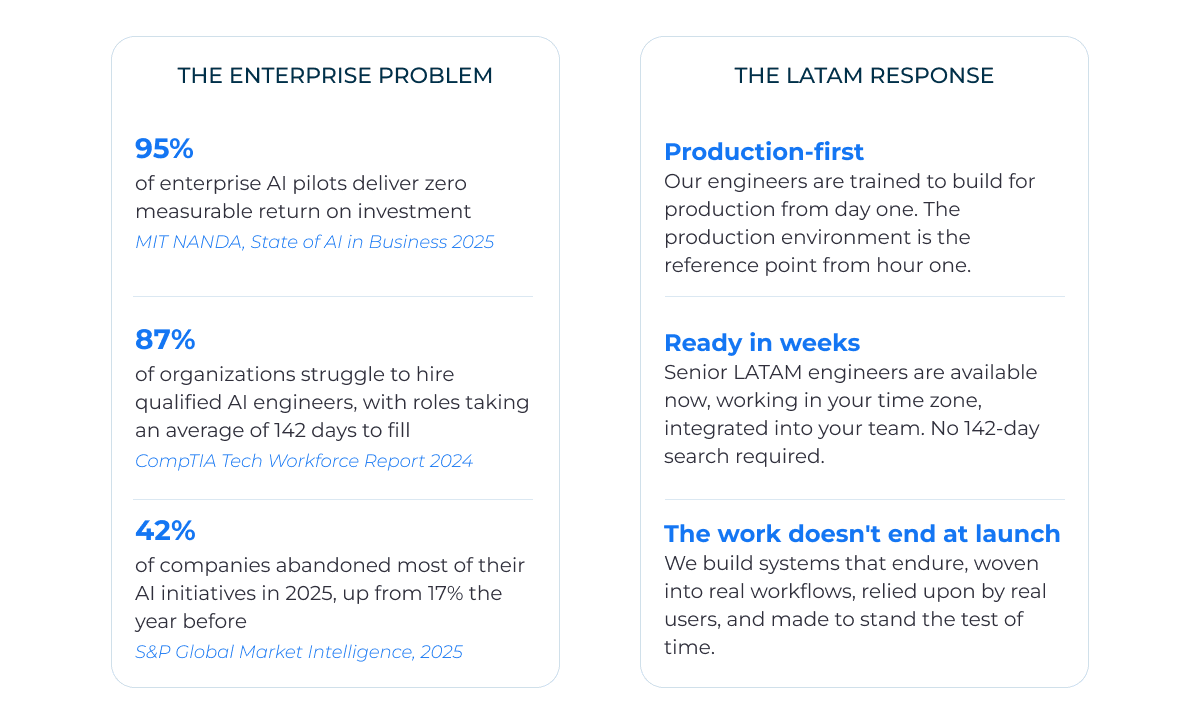
McKinsey found that only 16% of executives feel comfortable with the AI and technology talent they have available. The other 84% are still looking. Turns out, some of the best answers to that search aren’t in San Francisco.
The engineers worth their weight in gold have one thing in common. And those are not who look for the most elegant and beautifully-made answer; they look for the one that works best for each business. They anticipate failure and design for recovery. And when the system cracks at 3pm on a Tuesday, they already know which seam gave first.
That mindset is hard-won — working in highly regulated environments where mistakes have consequences for users, and budgets don’t allow for trial and error. It is exactly the kind of experience U.S. enterprise companies have been hunting for, often without much luck.
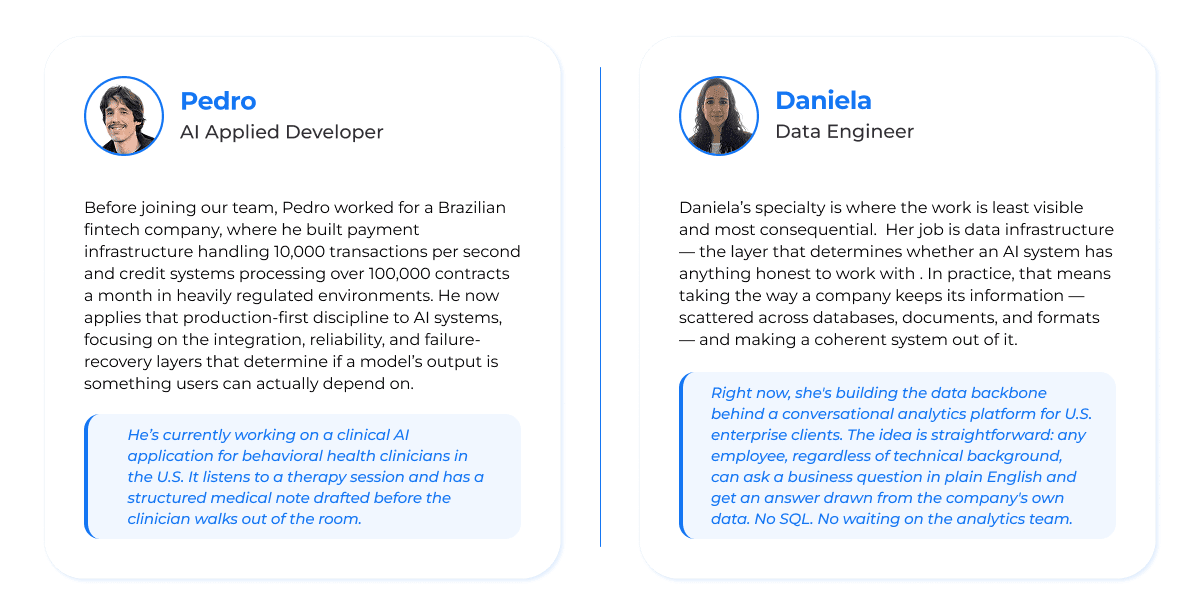
Meet two of them from our LATAM team. We spoke with Pedro and Daniela about the problems they solve, the systems they build, and what it means to deliver production-grade AI.
Building systems that don’t get a second chance
Pedro’s route to AI ran through Brazilian fintech, where the systems he built didn’t have the option of failing. Payment rails, credit infrastructure, code that processed hundreds of thousands of contracts a month under regulatory scrutiny. As he puts it: “When money is moving through your code, you learn what production reliability costs.” That’s the lens he brings to every project today.
While most of the industry obsesses over the model, Pedro’s attention goes to the layer underneath — the infrastructure that keeps outputs reliable, keeps systems recoverable, and keeps the whole mechanism running inside workflows that real people depend on without thinking twice.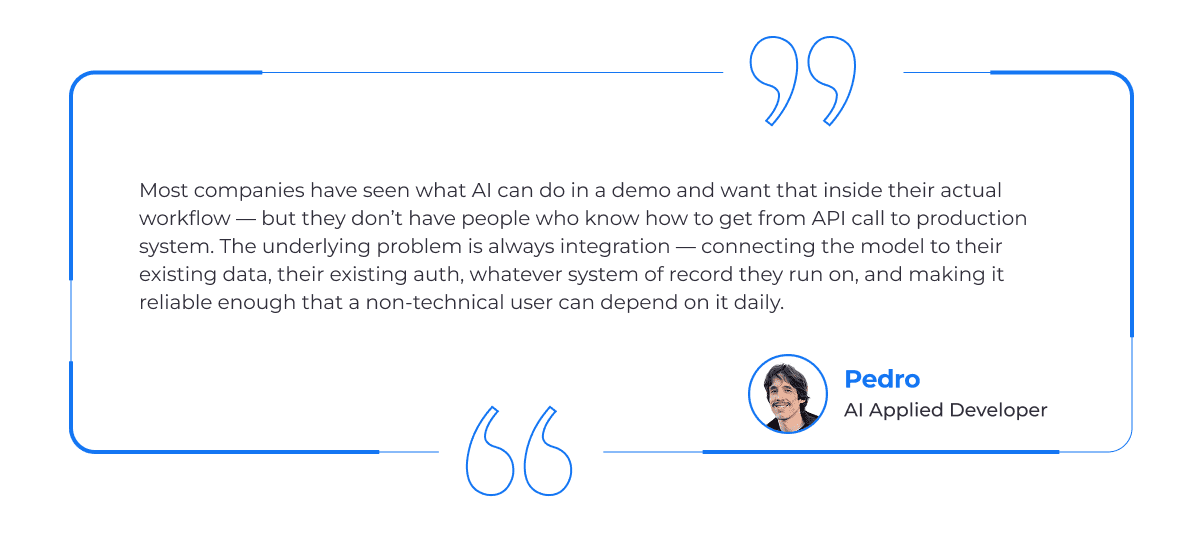
The hardest problems Pedro runs into have nothing to do with the model. They are the integration bugs that return a success code while delivering nothing. The outages that permanently disable reconnection logic without leaving a trace. The edge cases that appear only once real people are depending on the system. “Getting the AI to produce a good output was solved relatively quickly. Getting the system to handle a failure at 3pm on a Tuesday without silently dropping data — that took months. You can’t predict these things from test data. You find them when a real user calls to ask where their work went.”
You develop an eye for these things over time. From having built enough systems to know their hiding spots.
The data layer no one sees. The one everyone depends on
Pedro’s work is what you see. Daniela’s is why it works. She operates in the data infrastructure underneath — the layer most people never think about until something in it goes wrong.
In practice, her job is to take the way a company keeps its information — databases that don’t talk to each other, documents in three different formats, live feeds that move faster than anyone anticipated — and build something a model can reason across without losing its footing. “Building a system that can query a video transcript and a sales spreadsheet simultaneously without losing the relationship between them and without adding lots of latency is a massive architectural challenge.” The answer that comes out has to be fast enough to feel effortless and grounded enough to be believed.
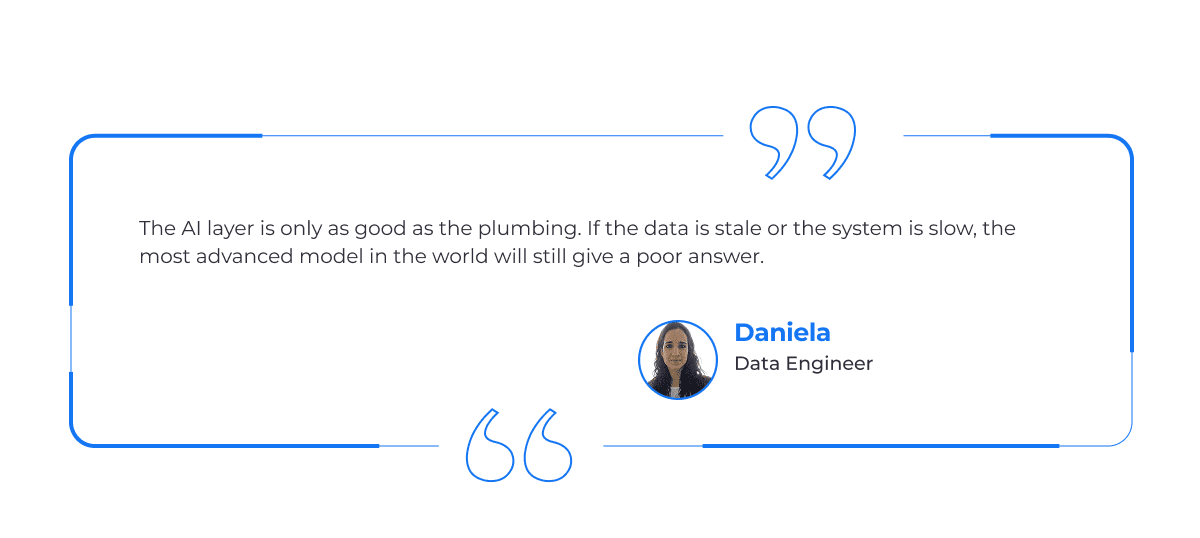
A slight inconsistency in how data is indexed and the model walks confidently in the wrong direction. “There were many times where a single word or phrase in a prompt caused the model to be redirected to an answer that wasn’t correct. If any one of those steps lags or pulls the wrong data, the answer falls apart.” Daniela builds her systems to catch these things before they become someone’s problem — logging every decision, handling ambiguity before it compounds, keeping the answer tethered to what the data says at every step. The goal is simple, even if the work isn’t: an answer the user can trace, check, and rely on.
The LATAM advantage – is a different way of building
Ask either of them what working from Latin America actually means in practice, and the answer is more grounded than you might expect.
Daniela describes it without much fanfare: “People here are experts at doing more with less and finding creative workarounds to technical debt or non-organized teams. We tend to prioritize functional results over over-engineered hype tools.”
They also work like part of the team. Same hours, same standups, same Slack windows. Pedro on why that matters more than people expect: “When you’re debugging a production issue together, that synchronicity matters. Cultural proximity is underrated — there’s less friction in how you scope work, how you raise blockers, how you push back on a bad requirement. Over months, that compounds.”
And the cost math is honest. As Daniela puts it: “You can often hire two senior LATAM engineers for the cost of one in the U.S., which instantly doubles capacity without sacrificing quality. But the real value is the fresh eye you’re bringing to the problem.”
Nobody pretends the savings don’t matter. But it’s rarely what clients lead with when they come back. What they mention is the systems — still running, thought through properly, handed off cleanly. The geography, as it turns out, is a bonus.
Most AI projects have a plumbing problemPedro has a name for the gap: “The underlying problem is always integration — connecting the model to existing systems and making it reliable enough that a non-technical user can depend on it daily.” Daniela sees it from the data side: “Before a model sees a byte of data, there is a massive amount of work spent on consistency, latency, and edge cases. If any one of those steps lags or pulls the wrong data, the answer falls apart.” So our engineers start there. What happens when the API fails? When the database goes down mid-session? When an edge case surfaces in production and no one finds out until a user calls to ask where their data went? These questions get answered before the work starts — not after an incident report. For them, this isn’t a methodology. It’s just how they think. |
We work best with companies who’ve already learned that a good demo and a working system are not the same thing. If that’s where you are, we’re worth a conversation.



Source link