








Updated: December 12, 2025
The digital transformation in banking addresses many of the issues financial institutions are currently facing. Not all, however, know how to implement new technologies. Some banks are making stepwise, gradual changes, others are pursuing targeted transformations in specific areas, and some are pursuing wholesale digital transformations. In this article, we will review several prime examples of upgrades from top market players.
Read on to learn about the key drivers, benefits, and impact of digital transformation in banking and why custom financial software development
What is Digital Transformation in Banking?
Digital transformation in banking industry is about adopting new strategies and modern digital technologies in every aspect of a financial institution’s operations and services. This changes how a bank operates, removes data silos, and alters how value is delivered to customers. More importantly, digital transformation is not confined to technological changes but also requires a cultural shift toward a more innovative and agile orientation. Some banks vigorously nurture an experiment-friendly and agile approach, even on a grand scale.
Basically, digital transformation in this sector embeds technology in every aspect of banking with the goal to:
- improve efficiency,
- enhance customer experience,
- and boost competitiveness in the technology-driven market.
Why Digital Transformation in Banking Matters
Digital transformation in banking sector is vital because it helps financial institutions enhance their infrastructure in a way that will allow for operational efficiency, resource optimization, and improved customer service. They can also achieve greater competitive gains through advanced, custom marketing tactics and by focusing on ever-increasing customer needs. Banks also stand to gain significantly through low operational expenses. These can be attained through clever marketing, custom-tailored to automated, machine-assisted, and scale-optimized bespoke risk management procedures, analytical offerings, and multi-channel frameworks.
We would like to note that hyper-personalization has always been critical to differentiation in the banking domain. Customers no longer accept peripheral, irrelevant financial services. Instead, they look for services that are contextually tailored to their financial needs and prove relevant, rather than outdated, generic ones.
Digital Transformation Examples in Banking
Currently, several major banks have successfully leveraged digital transformation services and solutions
JPMorgan Chase
JPMorgan Chase is often cited as a frontrunner in bank digitization, as evidenced by its massive resource commitment. In 2024, its tech investment budget reached $17 billion, the highest ever in the industry. Roughly half of this new innovation and modernization funding is dedicated to cloud migration, data platforms, and customer-facing digital products.
The bank generated over a billion dollars in revenue from AI and ML use cases, either through increased revenue or cost savings. Having an AI system to conduct Know Your Customer reviews is one example. It led to a 90% productivity improvement in the function. The rest of the staff manages the workload, and the function is performed by 20% fewer staff.
DBS Bank
DBS Bank is a pioneering bank in Singapore and is known to practice digital banking transformation. They cross-reference business objectives and customer experiences to the digital innovation primary focus. DBS reorganized its employees into data and agile teams, framework platforms, and innovation centers to be retrained. To expedite processes, the bank deployed AI platforms and analytics to streamline the engineering of new resources from 18 months to under 5 months, leveraging prior models.
HSBC
As one of the largest banks in the world, HSBC is well known for the innovations it drives in traditional banking, particularly in its retail operations. Like many banks in the UK, HSBC underwent a digital transformation in response to a shift in consumer behavior. Over a five-month period, HSBC observed a sharp decline in branch usage, while digital transactions soared.
HSBC data indicates that 97.5% of its customers’ transactions in the UK are made online. To enhance the user experience, HSBC allocated resources to improve its digital banking. An example is the mobile app that enables payment transactions, account management, and even investment portfolio building. HSBC has also expanded the use of chatbots and live chat for customer interactions.
Key Drivers and Enablers of Digital Transformation
Today’s banking sector has various crucial motivators and facilitators fostering the advancement of digital transformation for enterprises.
- Changing Customer Expectations. Customers today expect banking services to be convenient, personalized, and available 24/7, 365 days a year. Custom apps, instantaneous payments, and tailored services are the order of the day.
- Competitive Pressure from FinTechs and Big Tech. Digital-only banks, along with big technology companies, have built vast customer bases through innovative, easy-to-use services. Established banks can fight for their clients by providing better, faster services enabled by advanced technologies. That is why many of them resort to custom enterprise software development.
- Pandemic Acceleration. The COVID-19 pandemic has shown the world a new way of living. While the world was under lockdown, consumers transitioned from traditional banking to digital banking services. Banks began to understand that operational digital channels became a necessity for business continuity.
- Regulatory and Market Drivers. There has been a lot of focus on digital transformation trends in banking, such as Open Banking, which enables secure, easy data communication via APIs. Banks have been forced to innovate in digital and data technologies (e.g., use blockchain in banking) due to new regulations that mandate robust data systems.
- Technology Enablers. Emerging technologies and cost reductions are among the most important pain levers for progress. So the banks can still modernize some systems (e.g., get out from under mainframes) and scale services more flexibly — thanks to cloud computing. AI development of tools for analyzing data enables banks to extract meaningful insights from the largest data banks, for example, to enhance risk models, target marketing, and automate customer interactions (via chatbots and robo-advisors).
Benefits of Digital Transformation in Banking
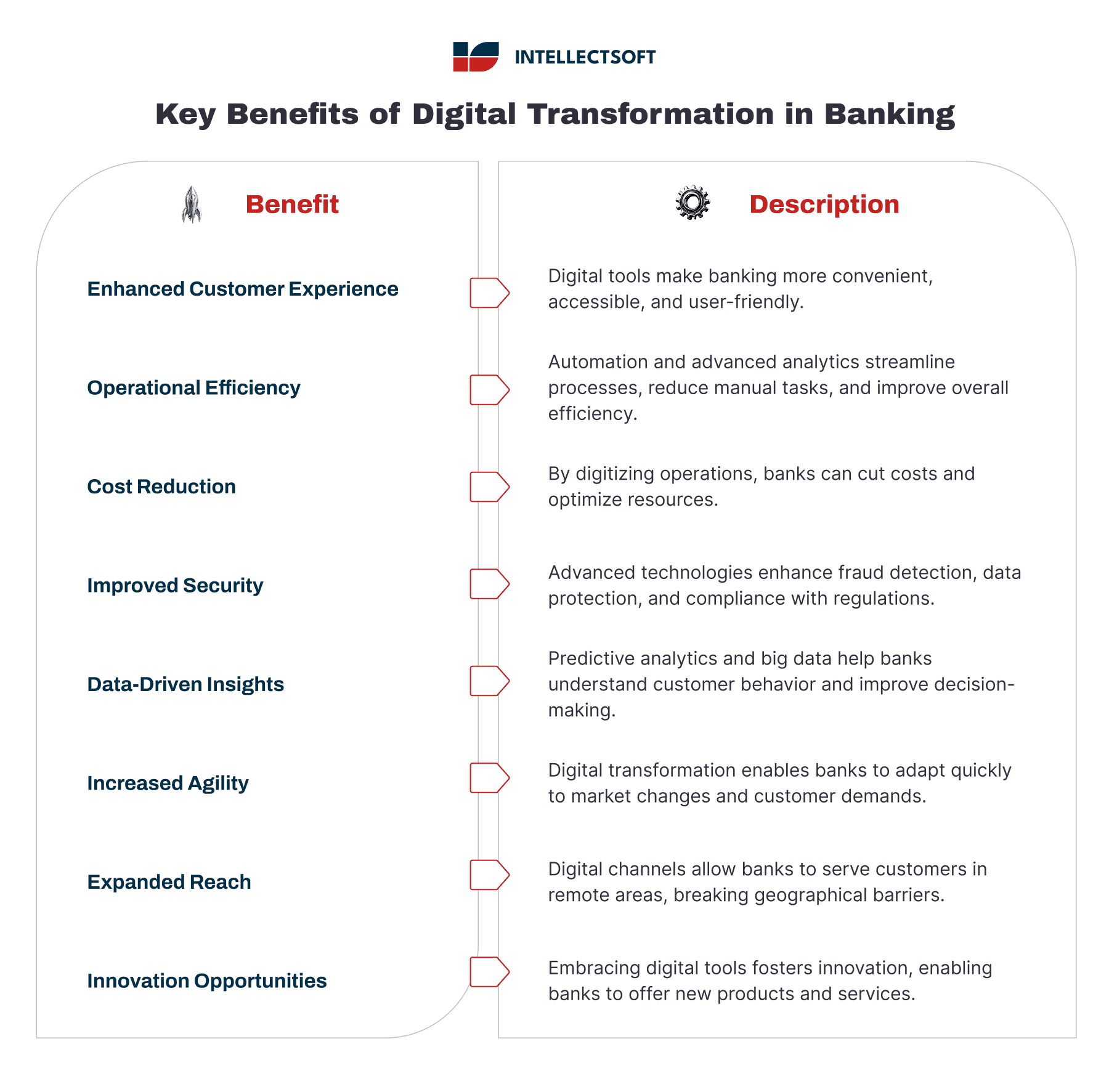
Advantages of digital transformation in the banking industry include a growing customer base and customer satisfaction, greater efficiency in work and resource use, innovation, and new income sources.
Implementing a Digital Transformation Strategy in Banking
Although digital transformation in banking and financial services is a distinct journey, some steps and principles are common across banks. These steps create a roadmap for a digital transformation strategy in banking.
1. Establish a Clear Vision and Objectives
Start with a digital plan that strategically integrates with the business plans. Software development services for startups and established firms require clearly specified objectives. These outcomes could include reducing online loan approval time from days to minutes or achieving an X% increase in active mobile users. To drive organizational focus, the vision needs to be top-down as it requires sponsorship from the highest levels of the organization, the CEO, and the board.
2. Assess Current State and Gaps
Conduct a gap analysis between current and projected digital capabilities. This should encompass technology (what systems are outdated, what systems require supersession and what systems require fusion), data (what data is available, what data is absent for the purpose of an analytics process), people (what gaps are there in the data science, and agile methods), and processes (what steps are manual that should be automated). Also, take into account the budgetary, regulatory, and analysis timeline constraints.
3. Align Around the Customer and Prioritize Use Cases
Determine and rank the importance of potential use cases or “journeys” to digitalize, considering both potential customer impact and value. For each, outline a goal. It may sound like “Empower small businesses to get a loan totally online in under 24 hours,” or “Provide a 360-degree customer view to relationship managers for better cross-selling.” Customer need focus is necessary for the transformation to deliver value. It is essential to aim for early wins: quickly delivered use cases that deliver value can help gain support and momentum.
4. Develop the Roadmap and Architecture
Splitting tasks across multiple teams, with each setting its own deliverables, will help meet the time frame. This stage normally requires picking an architectural strategy. Most banks prefer a modular, platform architecture in which core switch legacy systems are digitally augmented or gradually replaced. Such a strategy also raises the chances that modernization of core systems or migration to the cloud, together with the introduction of new technology platforms and process changes such as the adoption of DevOps or agile methodologies, will coincide. If you don’t know how to develop this type of roadmap, resort to software architecture consulting for help.
5. Secure Buy-In and Governance
To obtain the necessary funds and permits, present the case for the shift to every vital stakeholder: the board, all necessary executives, and even the regulators. Protect the organization’s market position. It’s crucial to identify people in the upper leadership structure who can track and report key points during the transformation and communicate them to those who are not as involved in the process. This step is quite tricky, so consider hiring an IT consulting company to help you obtain the necessary permits.
6. Implement in Agile, Iterative Fashion
Try to use agile practices to offer value in pieces. Banks like DBS phased their transformation in T-shaped sprints to build confidence and skills along the way and to advance focus on specific journeys. Educate your teams on agile methods if necessary. Prepare MVPs for innovative digital offerings and use their feedback for enhancements.
7. Focus on People and Change Management
To move forward, banks must change their thinking and posture at all levels of the organization to become more innovative and customer-focused. However, frontline employees are frequently skeptical of new systems, and mid-level managers worry about disruption. Therefore, change management, as one of the transformation’s objectives, needs to focus on behavior and goal alignment, new communication incentives, and change processes.
8. Monitor, Measure, and Adapt
Establish feedback mechanisms to monitor changes and progress, and measure their impact. For example, DBBank developed and collaboratively built a digital value capture framework that estimates the value created from digital customers and serves them having higher revenues, lower costs to serve, and higher return on equity. They then used those estimates to manage and score performance, generating value for the organization and its stakeholders.
Critical Obstacles to Digital Transformation in Banking
Each of the businesses is unique and comes with varying market barriers. These barriers, at times, make progress even more complex. Let’s dig into the most immediate challenges of digital transformation in banking.
Legacy Systems
Outdated and, in some cases, decades behind modern approaches and technology, legacy systems lack the flexibility needed to keep pace with banking industry technology trends and requirements. Not only do these systems increase operational costs, lead to inefficient operations, and lack appropriate scale and flexibility, but they also reduce overall efficiency. 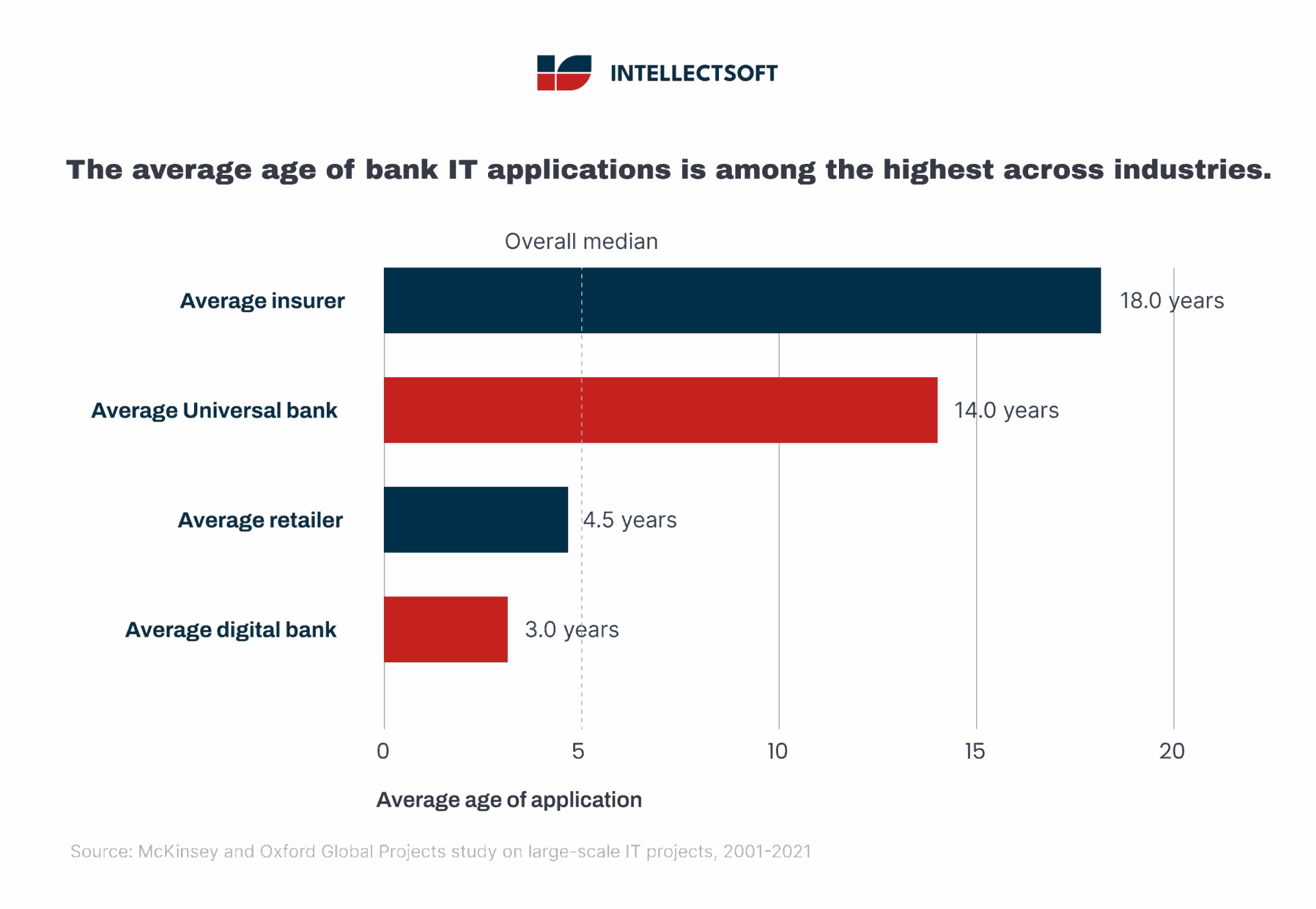
Solution: To overcome the hurdles posed by legacy systems, institutions may pursue components within each phase of the modernization approach. In fact, altering legacy software with new code is one of the top digital transformation trends for 2025. Transforming a system for an entire organization at once, however, is not realistic, so banks should initially focus the migration strategy on core banking systems and functions and gradually move toward system replacements. Scalable, cloud-native system architectures can support integration with legacy systems while providing a pathway to incorporate emerging technologies.
Data Security and Privacy
As a direct consequence of outdated banking systems, the attempts to compromise their security have become more complicated and frequent. So, the focus of any digital transformation agenda reset should be on protecting the bank’s customer data. In a bid to comply with requirements, banks build multi-layered security systems as they handle complex client finances.
Solution: The zero-trust security approach enables a bank to implement a robust multi-layer security system that authenticates every user and device seeking to connect to the system. This is achieved through pile systems and protocols such as multi-factor authentication, encryption, and system monitoring. Also, it is imperative to teach bank employees to spot phishing attacks and to educate them on the fundamentals of cybersecurity, given the social engineering attacks banks face.
Cultural Resistance to Change
Employees are often reluctant to use new software when the training is insufficient, they lack the necessary competencies, or the previous software is simply easier to use. Such mindsets can sabotage the transformation, even when using the industry’s best practices.
Solution: Cultural issues are best managed through communication, new training courses, and the creation of change programs that engage employees. Organizations are best served when their leaders are the anchor sponsors of the transformation and are willing to tell employees what is in it for them to embrace the change.
Meeting Digital-First Demands
Customers now expect mobile banking or other instant, personalized transactions and consider them basic requirements. Delivering on the anticipated value requires product strategy & solutions or a value offering.
Solution: Mapping out customer journeys is vital for accelerating digital transformation in banking. First, banks need to detect aspects of their business that underdeliver, then find ways to patch them.
Regulatory Compliance
The nature of financial institutions is that they operate in heavily regulated environments that must meet numerous intricate requirements. The pace of technological change is coupled with regulations such as PCI DSS, GDPR, and other provisions in the SME digital banking domain.
Solution: Regulatory Technology (RegTech) products reduce manual supervision and automate compliance. These regtechs monitor compliance, oversee real-time transactions, generate compliance reports, and alert institutions to potential breaches.
Harmonizing Innovation with Existing Systems
The use of new technologies such as AI and machine learning, blockchain development services, and Internet of Things devices introduces innovations that are mired with both technological and operational challenges.
Solution: Defining technology evaluation frameworks enables banks to make more informed and systematic decisions on emerging technologies. The frameworks should take into account the implementation costs, security, compliance with the legal and business environment, and alignment with strategy before use.
Talent Acquisition and Retention
Digital transformation requires leadership in areas that traditional banking institutions know little to nothing about. These areas include data analysis, cybersecurity, experience design, and other new technologies.
Solution: Educating and training bank staff is a must. Banks need their employees to understand and help potential clients use novel functions within their tools and apps. In addition, internal talent development has proven to be more cost-effective than hiring and onboarding new staff.
5 Digital Transformation Traps Banks Should Avoid
Identifying digital transformation risks in banking will allow banks to strategize more effectively and target more sustainable outcomes from their digital transformation.
Underestimating the Importance of Culture
Old banking culture tends to be conservative, emphasising centralised decision-making and adherence to set procedures. A culture of digital transformation calls for more flexibility, greater integration, and a drive for new ideas. Banks need change management programs that go beyond the identified technological upgrades.
The length of the pipeline for successful cultural change transformation rests on the continuous, cohesive development of messages along ideological lines from the organization’s apex over a period of 18 to 24 months.
Neglecting Customer-Centricity
The majority of banks still approach digital transformation from the “operational” angle rather than the “customer experience” perspective. This comes out when institutions computerize systems that do not serve clients effectively. Customer-centric digital transformation requires a complete rethink of service delivery, informed by the design and analysis of customer journeys and behaviors. This goes beyond digital contact shift to effortless, tailored, and relevant interactions at every step in the user journey.
Prior to adopting digital solutions, banks must conduct thorough customer analysis to ensure the implemented technologies address customer pain points rather than solely internal inefficiencies. Ongoing collection of customer feedback and continuous improvement of the transformation will ensure that customer centricity is retained throughout the transformation.
Failing to Reskill and Upskill Employees
Transformation in the digital space alters the fundamental methods of executing workflows. It, as such, requires a new set of skills. Banks that do not invest adequately in workforce development usually experience slippages in implementation timelines, user adoption issues, or sub-optimal utilization of the systems implemented.
So, how to build a good software development team? To do this, financial institutions need to engage in collaborative partnerships with schools, technology consulting for business, and training development specialists in order to formulate practical skills, reskilling, and upgrading strategies. Moreover, establishing internal mentorship and communities of practice tends to accelerate the organization’s knowledge base.
Focusing Too Much on Short-Term Gains
Banking institutions that prioritize instant results often make poor strategic technology decisions or implement unfinished strategies that fail to deliver meaningful value.
A lack of polishing can lead to systems that are broken down into new and old technology integrals that are not sustained, and to weak investments in primary capabilities such as data concentration systems and protective control layers. This practice creates an evolutive technical debt shortcut that can become costly to fix over time.
Ignoring Ecosystem Partnerships
Tier-one banks increasingly rely on ecosystem partnerships with fintechs, technology providers, and other service vendors. Banks that try to develop all digital capabilities internally almost always run into resource scarcity, extended timeframes, and subpar outcomes.
Final Word
The digital transformation in banking services is a global phenomenon that fundamentally alters the view of the future of business banking. Why is this transformation necessary? It allows banks to better serve their customers and address technological pressures. While retail banks lead with personalized omnichannels, corporate banks emphasize automating complex operations and improving client portals. Meanwhile, investment banks are studying how AI is used in fintech to improve decision-making. All of these, together, strive to serve their customers better and to be agile and efficient in the digital era.
While there are both advantages and disadvantages to digital transformation in banking, it seems an inevitable change that every bank will have to accept sooner or later.
What are the key aspects of digital banking transformation in banking sector?
The transformation of digital banking remains focused on altering customer experience, improving effectiveness through the modernization of infrastructure, and the adoption of cloud technologies. We, for instance, offer Azure consulting services for smooth cloud migration. The transformation also ehould comprise AI, and automation; personalizing data-use analytics for more precise services and wise choice making; employing geolocation and AI-assisted fraud prevention for reinforced security; and promoting the culture of working with fintechs for the limitless innovation of new digital products and services.
Why should a bank implement digital transformation?
Several critical milestones underpin the importance of digital transformation in banking:
– meet customer expectations;
– keep up with neobanks;
– improve the effectiveness of operations;
– optimize resource utilization;
– upgrade security and data protection measures;
– foster creativity in product and service offerings.
What technologies foster digital transformation in banking industry?
The evolution of technology is the driving force of digital transformation. The digital transformation toolkit for every bank, comprising cloud computing, AI, and other technologies, is more than sufficient for an affordable, economically sensible transformation. For example, adopting microservices and APIs enables faster innovation by integrating new features or fintech services into a bank’s ecosystem. Encryption, biometric systems, and AI-driven fraud detection are the next frontiers for advanced online banking security.
How long does it take for a bank to undergo a digital transformation?
The timeline depends on the bank’s size, objectives, and infrastructure. A customized transformation can take as little as a few months, while a fully scaled transformation can take more than several years.
What are the benefits of digital banking transformation for banks?
Some of the key advantages of digital transformation in banking are:
1. Elevated productivity across operations;
2. Enhanced customer trust and loyalty;
3. Optimized operational costs via automation;
4. Improved fraud detection;
5. New innovative services for additional revenue streams.




Source link