








Intro
CRM software for financial services industry integrates classic relationship management tools with a bespoke toolkit for finance sector demands. The result is a single, unified platform that evolved past traditional CRM (like contact tracking, activity logging, and pipeline management) by layering in risk profiling, suitability checks, portfolio tracking, and regulatory reporting.
Such systems account for core industry demands. From regulatory reporting to airtight document security and careful risk controls, service consistency, and the robust governance of complex compliance obligations.
Let us walk you through essential dimensions of CRM software for financial services, including core functionalities, deployment challenges, and strategic advantages.
Key Features of Financial Services CRM
Modern CRM software for financial services delivers features across seven key functional domains. Each is aimed at satisfying workflows and regulations that govern the sector.
Marketing & Lead Management
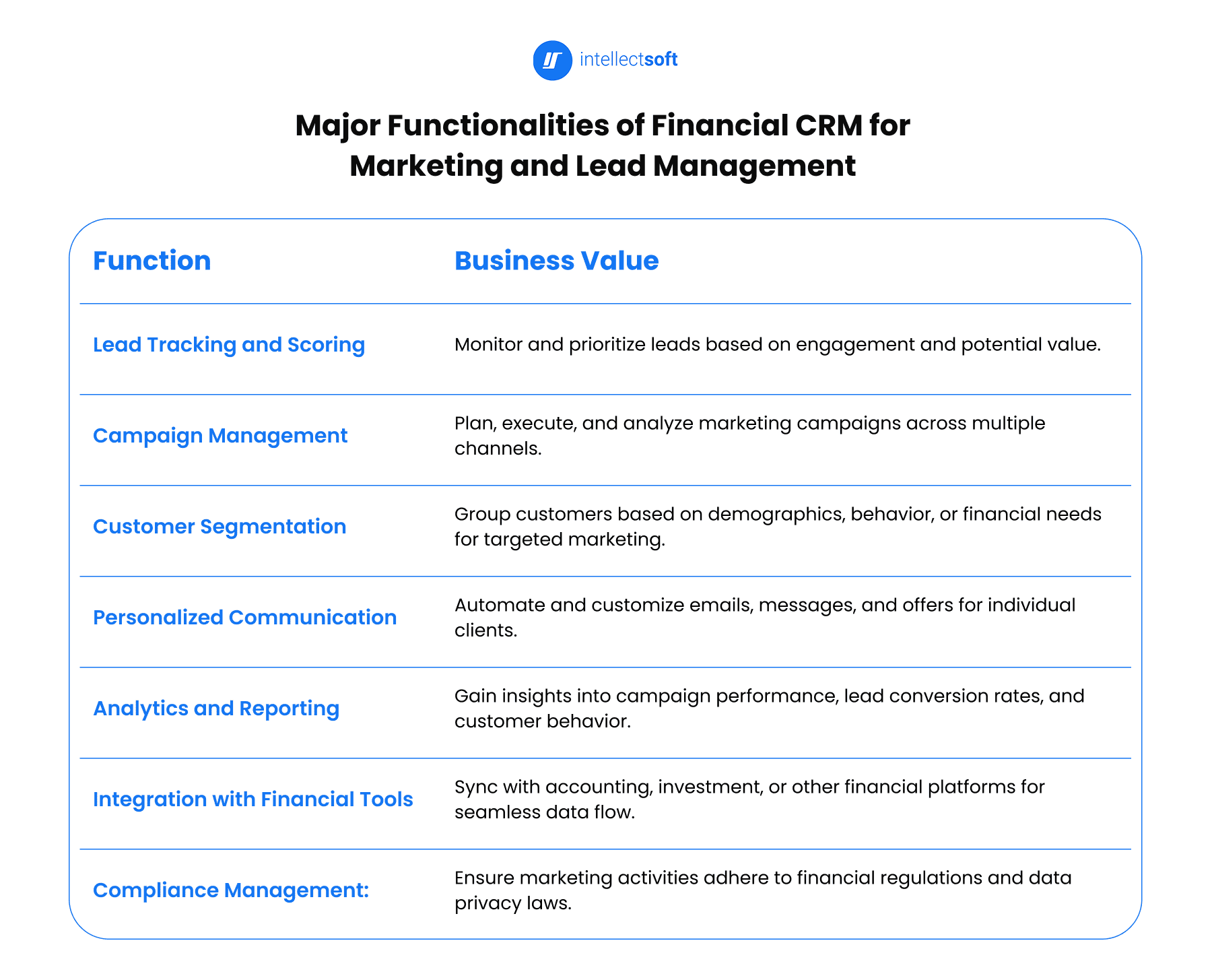
Strong lead management is the engine that drives enduring performance in financial services operations. CRM systems boost lead generation by gathering prospect information from every available digital footprint:
- corporate websites;
- social media platforms;
- outbound emails;
- formal referrals.
After this real-time data collection, built-in segmentation tools classify leads by demographics, wealth indicators, and prior engagement.
Sales Management
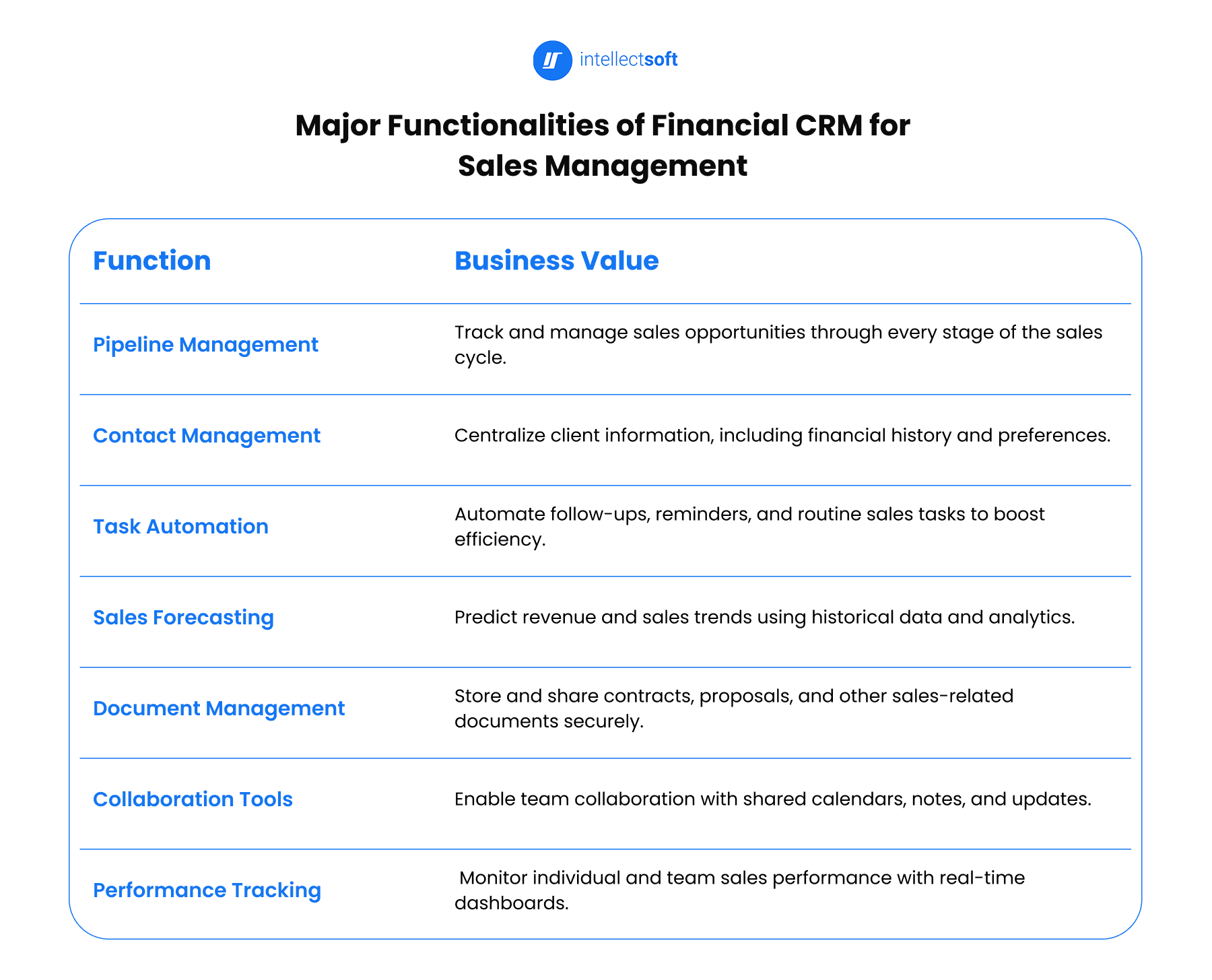
Comprehensive sales management capabilities unify the entire new-customer journey into one fluid workflow. Pipeline visualizations offer leaders immediate visibility of how prospects move from first outreach to closed deal, helping teams spot bottlenecks early. CRM system for financial services
Service Management
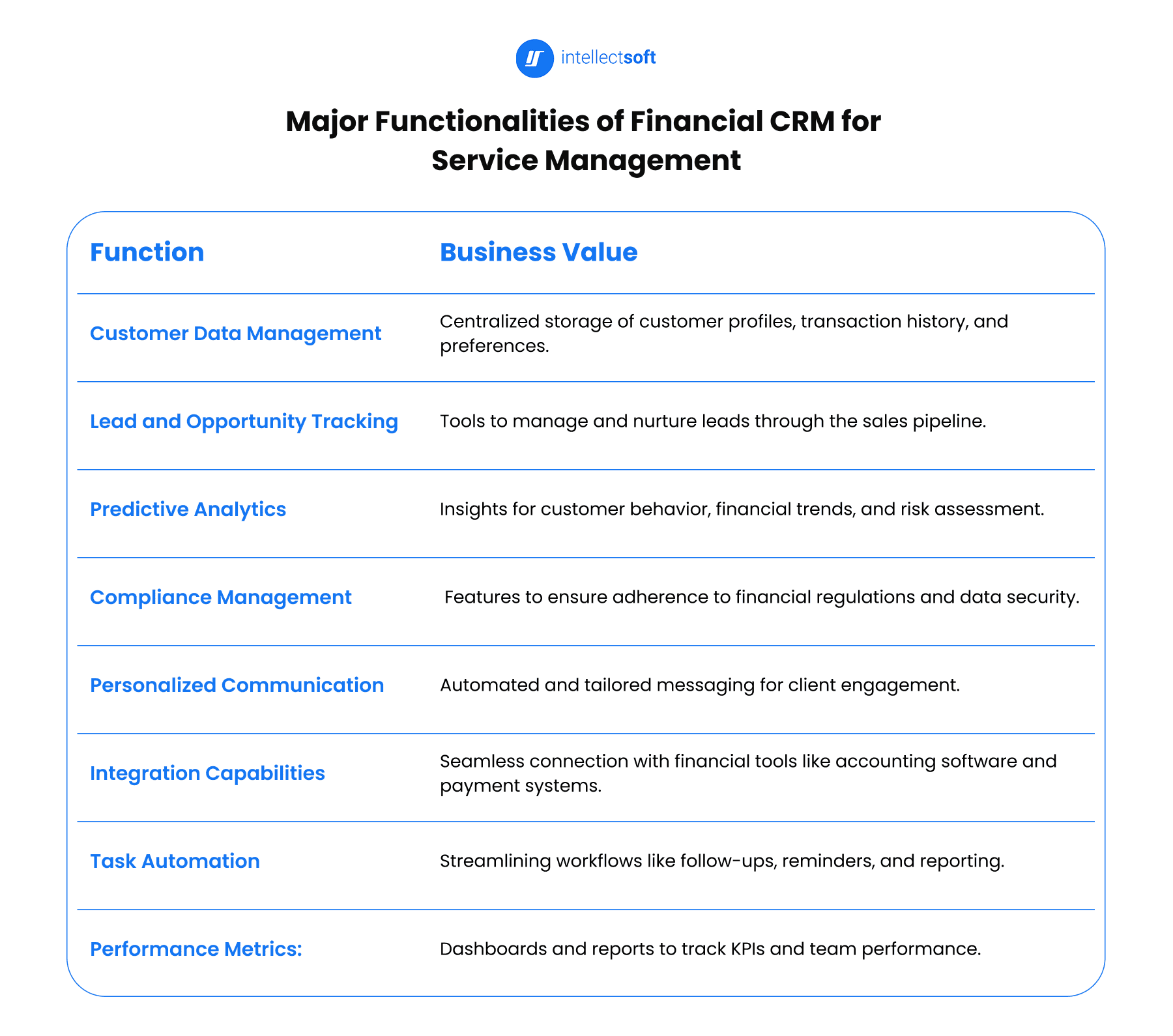
Exceptional customer support sets the industry’s best banks and investment platforms apart. Today’s CRM software for financial services industry embeds disciplined case-management workflows. They classify incoming requests by type, urgency, and client segment, guiding each inquiry to the most qualified team. Furthermore, enterprise knowledge repositories equip advisors with:
- on-demand access to policy documents;
- diagnostic playbooks;
- documented resolutions.
Access to this data speeds up issue closure while sustaining consistent standards.
Contact Management
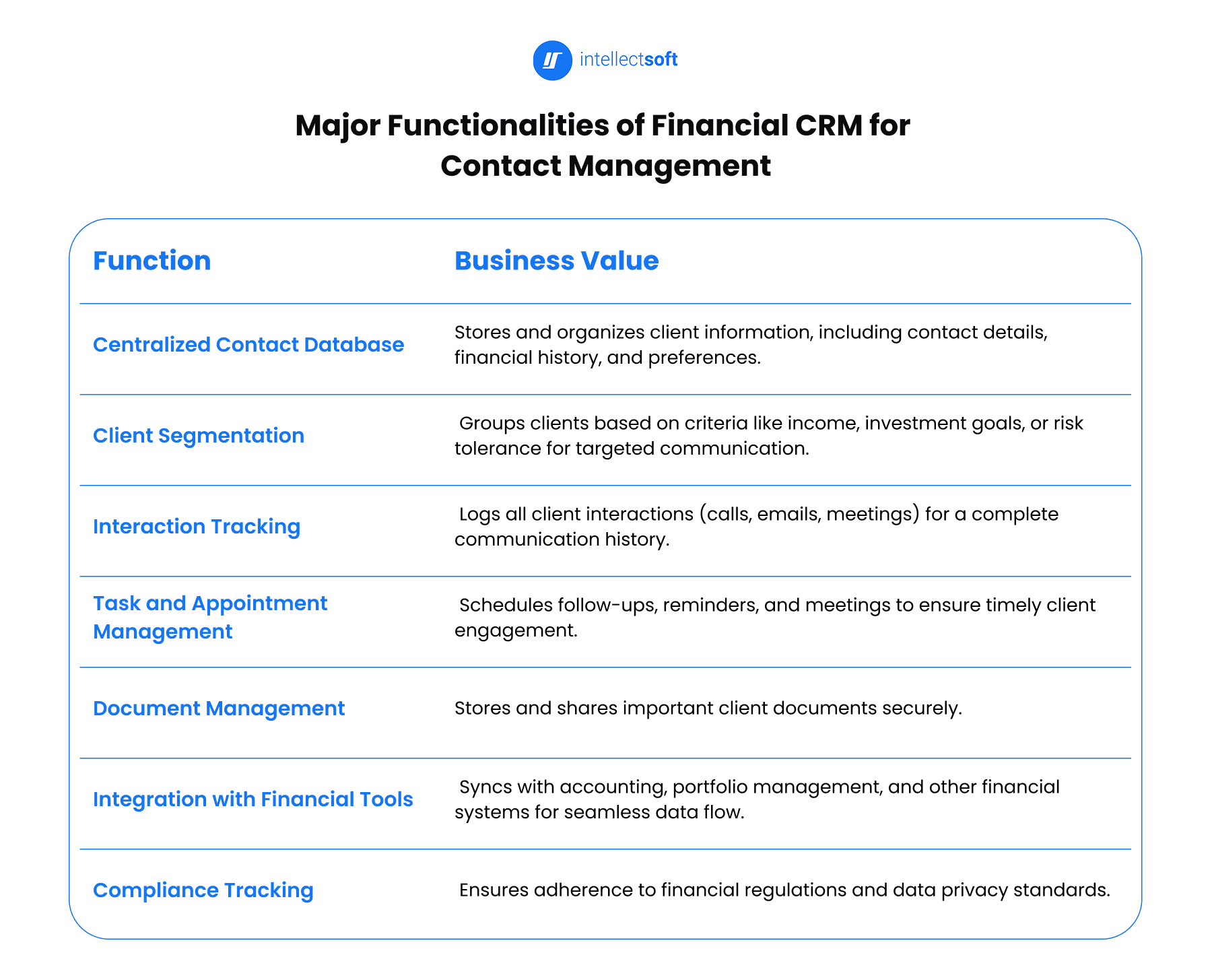
Centralization of contact management is, first of all, about convenience. Having a unified, clear picture of each client’s profile helps ensure no detail is overlooked. This is important, particularly when a loan is under consideration. Decision-making process in this case will rely, in part, on reviewing application data, such as
- credit history;
- demographic info;
- transaction history;
- tax returns.
With a CRM in place, all this information is just one click away.
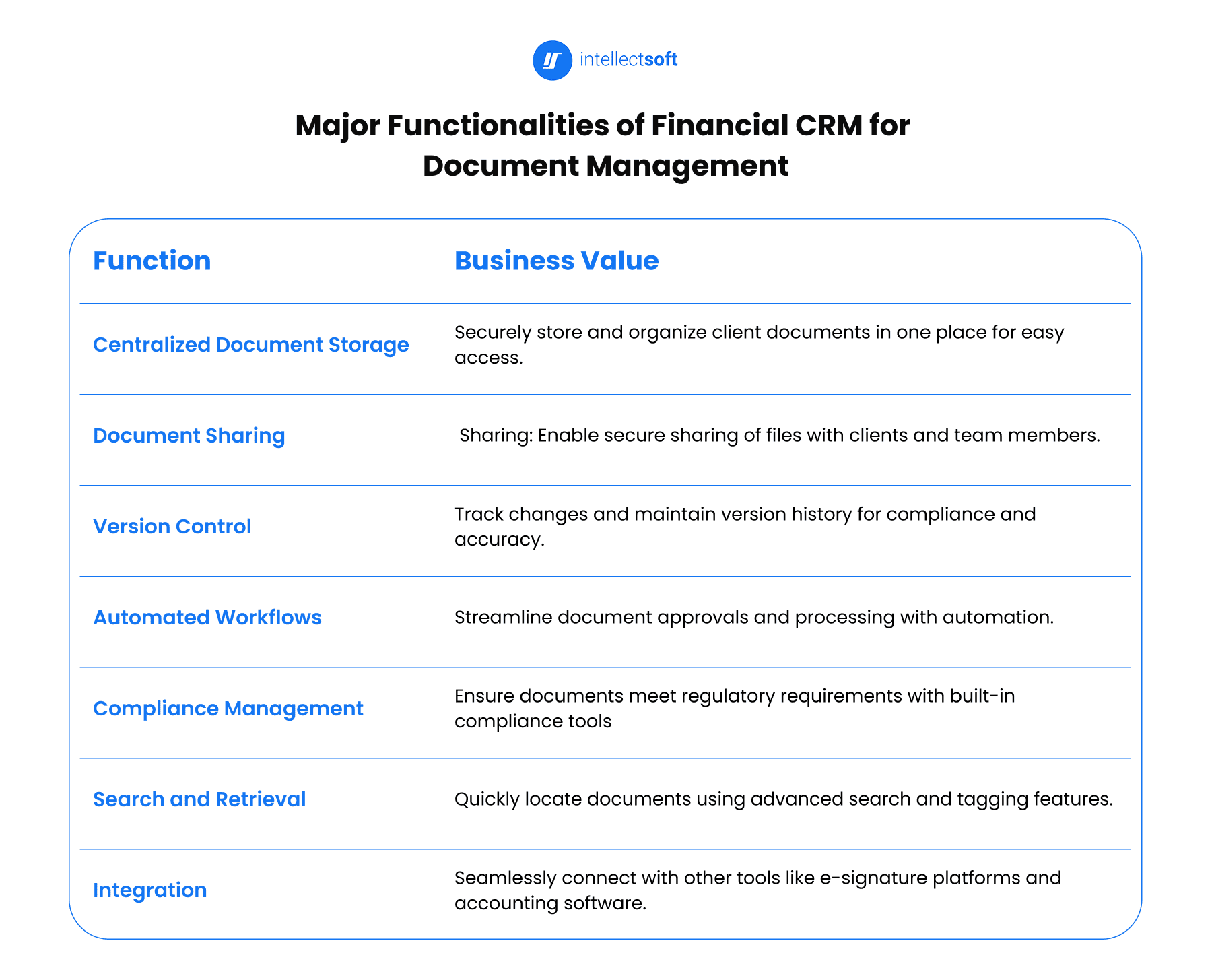
Document Management
In financial services, vast amounts of data drive the need for secure, easily searchable storage. So, the document flow should be easily manageable but also protected. That being said, only parties with granted access keys should view records. This also concerns extracting, signing, and editing contacts. Seamless teamwork and collaboration within shared files is also critical.
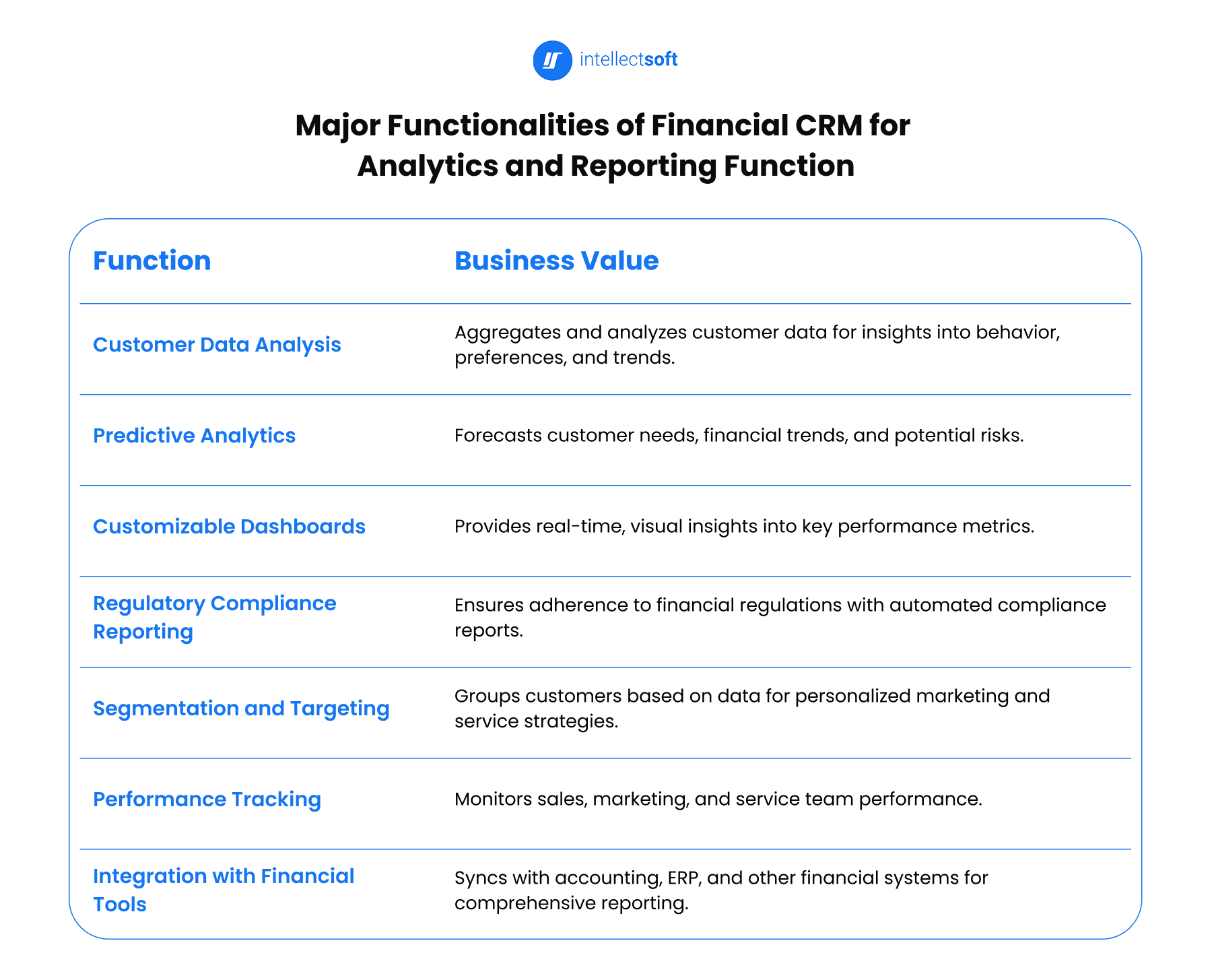
Analytics & Reporting
Sharp choices today come from tomorrow’s thorough analysis. CRM software for financial services industry modules project lifetime value, forecast churn risk, and surf hidden cross-sell cues—all from one unified behavioral stream. This way, campaign ROI lands on customizable performance dashboards, breaking down results by segment and channel to spotlight which marketing dollars truly pay off.
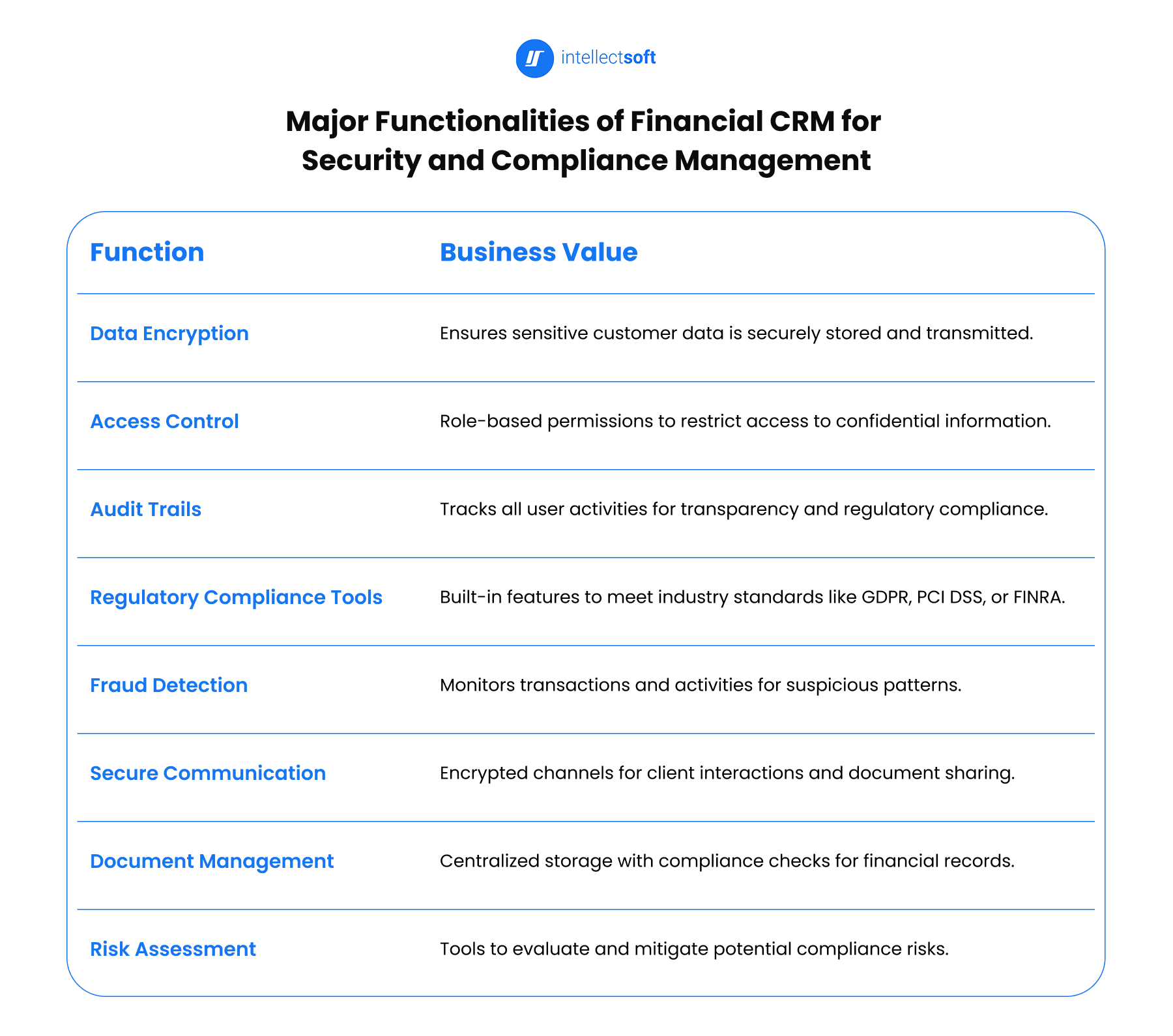
Security & Compliance Management
Banks and credit unions face intense oversight, so every customer relationship system should deliver rock-solid defense. CRM software for financial services combines layered security features:
- users authenticate through multiple steps;
- permissions are governed by fine-grained roles;
- every system event is stitched into a tamper-proof audit log;
- sensitive customer data is shielded by strong encryption at rest and across the wires.
Looking for a CRM implementation partner? Intellectsoft is at your service.
CRM Functionality for Financial Institutions
Different classes of financial institutions have distinct operational workflows and strict regulatory mandates, driving the need for tailored CRM capabilities. When the particulars of these environments are mapped accurately, an institution can confidently choose and configure the right technology platform.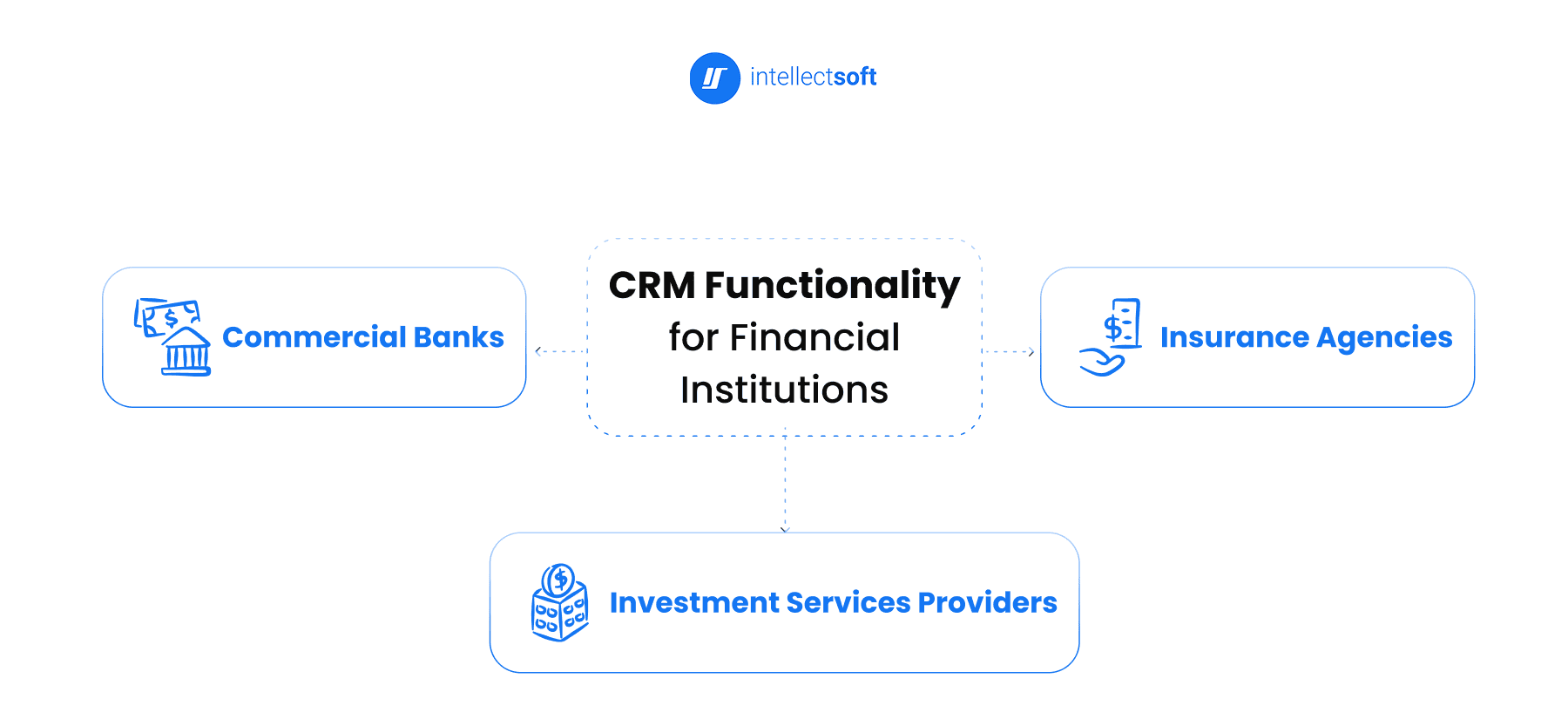
Commercial Banks
Commercial banks manage the full customer lifecycle within a single framework. Let’s take loan lifecycle management. Within CRM software for financial services industry, these processes will be laid out in detail, guiding each application from preliminary questions to the last repayment. Meanwhile, default management will be responsible for tracking payment trends and alerting risk officers when predetermined thresholds are exceeded.
Investment Services Providers
Wealth managers and investment advisory teams demand more than standard profiles; they need embedded portfolio management within the relationship module. The CRM for finance brokers
Insurance Agencies
Purpose-built nodules of the CRM for financial services industry merge seamlessly with policy admin and claims workflows. This is necessary in order to meet the nuanced needs of the insurance sector. Let’s take a close look at how CRM can function within the domain:
- Recommendation algorithms cross-reference applicant age, policyholder assets, and risk factors to propose the most relevant coverage tiers.
- Workflows streamline the full policy lifecycle, from automated quote assembly and electronic submission validation to underwriting flagging and final policy delivery.
- Billing engines align premium record-keeping with schedules, trigger reconciled payment reminders, and initiate autorenewals when required.
Common Finance CRM Integrations
CRMs used in the finance domain have to comply with a set of requirements. That is why these platforms combine several third-party tools and integrations that ensure the ecosystem will be functioning properly.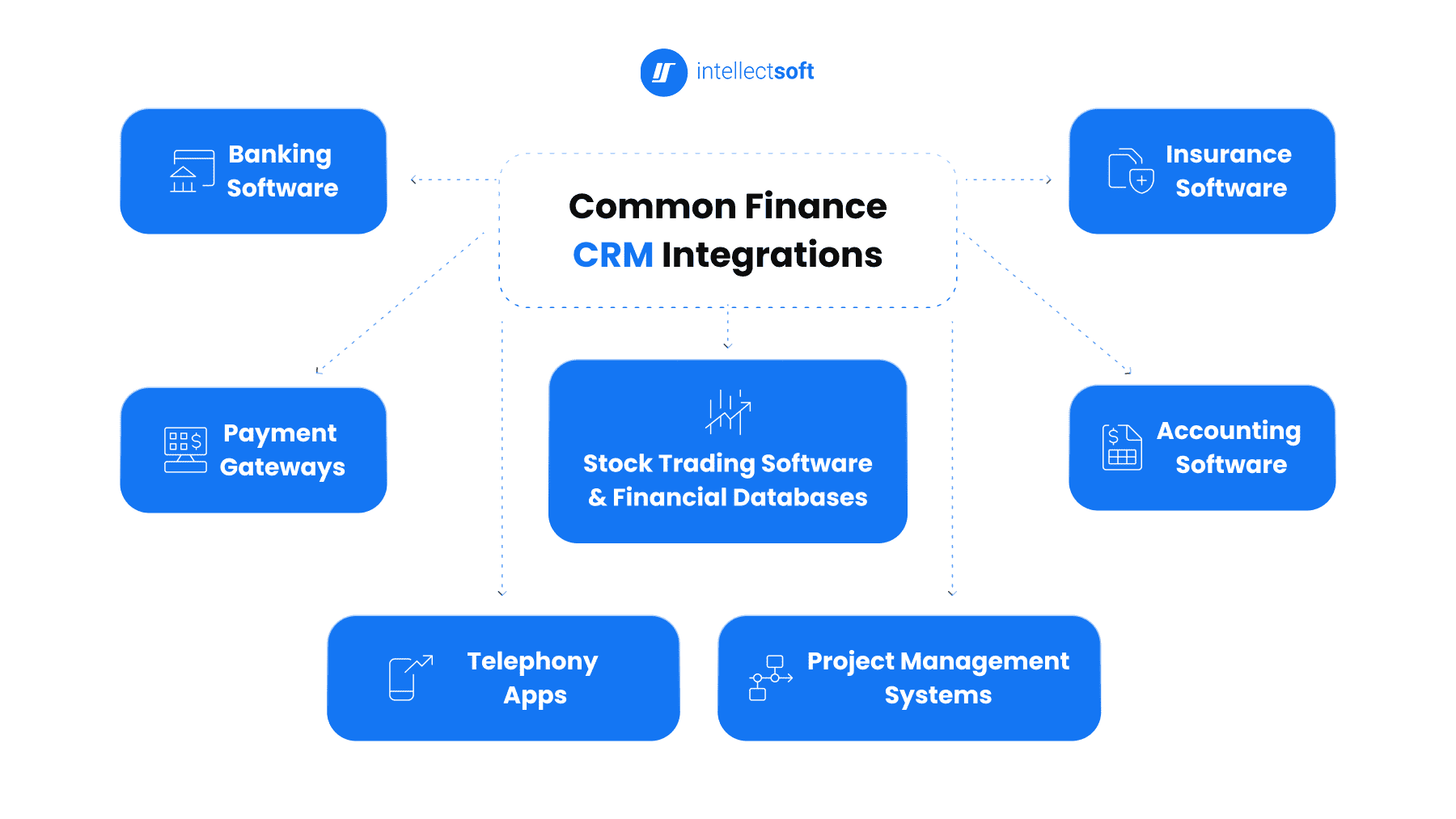
Banking Software
Linking the core banking system grants a live view of customer balances, deal history, and risk perceptions. Advisors can resolve most queries in a single call, bypassing multiple log-ins. Ongoing background sync reconciles the CRM with the latest counterparty data, keeping all team members aligned.
Insurance Software
A connection to the policy administration system aggregates customer information for onboarding, servicing, and renewals. Additional ties to claims, policy issuance, and underwriting modules present complete claim history and risk details, empowering agents to explain coverage and pricing with confidence.
Stock Trading Software & Financial Databases
Investment platforms need a continuous flow of market data to refresh client holdings, risk, and performance metrics. Security master feeds supply macro indicators, consensus estimates, and company profiles. Trading modules, when embedded, allow portfolio adjustments and compliance order entry without leaving the CRM view.
Accounting Software
An integrated accounting suite comprehensively serves client financial needs by joining revenue capture, expense assignment, and profitability insights in a single workflow. By generating invoices and processing receipts automatically, the solution cuts hands-on administrative time and optimizes cash flow in parallel.
Payment Gateways
Integrating payment gateways securely embeds transaction handling into the CRM workflow. By automatically posting receipts, the solution lowers manual reconciliation effort and promptly refreshes customer account balances. Support for diverse payment types and for settling international transactions enables flexible and global processing.
Telephony Apps
Telephony integration enriches voice communication by adding click-to-call and automatic call journaling. Within CRM software for financial services industry, recordings help enforce quality and comply with regulatory standards. During incoming calls, a screen pop brings forward the relevant customer record, accelerating agent preparation and response.
Project Management Systems
Project management integration enables processing for sophisticated financial services, such as loan origination, wealth planning, and insurance claims. By routing tasks and tracking progress, the solution guarantees clear, scheduled communication across the long duration typical of such services.
Best CRM Software for Financial Services Industry
Choosing the right CRM software for financial services demands a thorough look at what each platform can do, how well it works for your sector, and what it will take to get it up and running. The following four products stand out, and each offers a different take on serving financial professionals.
Salesforce
Salesforce Financial Services Cloud has the broadest industry coverage and handles the greatest number of sector-specific requirements out of the box. Its architecture is built on the core Salesforce CRM but layers in features for banking, managed investments, and insurance.
Microsoft Dynamics 365
Microsoft Dynamics 365 is a dedicated CRM delivering valuable features for many domains, including finance. Delivering robust financial services modules, it creatively merges advanced capabilities with traditional ones. It does represent some adoption hurdles, predominantly linked to a steep interface learning curve and occasional API friction with external vendors.
Creatio
Creatio offers no-code app development with modular CRM for finance, marketing, sales, and client service, focusing on financial service use cases. The platform also delivers a library of industry-validated process maps. This unique attribute is aimed at reducing the design burden on finance operations.
Vymo
Vymo CRM software for financial institutions targets client-facing professionals in banking and insurance with a mobile-first engagement package. The design prioritizes field representatives.
Key offerings are:
Create high-end software solutions for your company with Intellectsoft
Get in touch
- AI-fueled prompts: Scans tasks and cues what to do next, sharpening productivity and engagement.
- Opportunity funnel: Guides lead capture, nurture, and outcome measuring to lift closing rates.
- Process robot: A free-flow device that records calls and meetings, freeing personnel from data entry.
- Cell-first setup: Gives traveling teams full features without a desk.
- Pre-connected CRMs: Offers inserts with major CRMs, including Salesforce.
- Outcome lens: Pages that fetch current performance in moments.
Finance CRM Platform Selection Factors
To select a CRM software for financial services, assessing critical functions and growth-related elements is paramount. Companies need to select the one that has all the attributes likely to drive both smooth deployment and durable adoption across multiple stakeholder groups.
Capabilities
Robust CRM solutions for financial industry should incorporate a full suite of industry-related features:
- finance-specific components (e.g., lending, investment, or underwriting modules) alongside standard CRM functions.
- Low-code interfaces that allow non-programmers to revise processes related to shifting product or compliance landscapes.
- Seamless integration and an intuitive, self-service API toolkit should be available to technical teams.
- Mobile functionality, a responsive web experience, and offline access for uninterrupted meetings in no-service areas.
- Inherent scalability and predictable performance for a coherent working experience.
Reliability
Security infrastructure must match or surpass financial services benchmarks for safeguarding data and governing access. So it’s vital that a good financial CRM software offers users multifactor authentication, encryption of their data, and log audits. These strategies can help protect sensitive information while keeping the system in line with regulatory obligations.
Deployment
This one is important as it will define the future user experience with the system. You can go for a cloud implementation, which, if done right, guarantees effortless expansion and administrability. Utilizing tier-1 cloud platforms allows organisations to consume enterprise-level security services while remitting the majority of infrastructure upkeep to the provider.
Terms & Conditions
Pricing architectures differ markedly among suppliers. Common constructs include per-user subscriptions, all-encompassing per-instance licenses, and tiered feature-based pricing. To calculate total cost of ownership, acquisitions teams should compute not only initial licenses but also implementation services, longtime maintenance fees, and reasonably forecasted scale-out costs.
Benefits of Finance CRM for Business Growth
Implementing CRM software for financial
Data-Driven Decision Making
By collating a complete view of relationship history, product affinities, and risk profiles, a CRM for finance industry empowers executives and frontline teams to make strategic choices. Embedded analytics surface emerging trends, flag latent customer needs, and recommend optimal spending across client acquisition, retention, and servicing.
Superior Operational Efficiency
CRMs digitize and codify standard operational processes, reallocating employee hours from rote tasks to customer-facing priorities. Predictive analytics score prospects based on purchase probability, while an intelligent call routing engine assigns cases to the most suitably skilled resource by case complexity and value. This orchestrated approach preserves uniform service quality, aligns headcount to demand, and reduces overtime.
Increased Revenues
One scenario that can offer a revenue increase is data-guided marketing. It delivers campaigns that resonate, and referral partners are enlisted systematically, swelling the initial prospect pool. Rigorous qualification steps, underpinned by real-time risk and propensity scores, lift conversion ratios. Moreover, the detailed financial history and behavior signals collated by the CRM reveal rich cross-selling and upselling scenarios, which the system models and prioritises for the relationship manager’s next conversation.
Stronger Client Relationships
Hyper-personalization is now the ruler of customer relationships in every domain. The finance sector is no exception, and a good CRM should be able to deliver that. Companies need their clients’ interactions tailored to each individual profile. This way, they can boost ties and loyalty, paving the way for long-lasting relationships. For instance, by serving timely alerts and personalized insights at the earliest signals, firms illustrate their value well beyond routine banking tasks.
Seamless Collaboration
When departments convene around a single, up-to-the-moment customer record, silos dissolve and messaging remains unwavering. Joint planning around marketing, selling, and servicing threads the same narrative through every channel. Teams gain efficiency through synchronized task oversight and transparent performance dashboards.
Including Emerging Technologies in CRM Development for Financial Services
Plugging new technologies into customer relationship management is what flips old-school systems into agile rocket drafts for banks and insurers chasing the future. Below are some of the most vital tech trends for CRM software financial experts should follow.
Artificial Intelligence (AI)
AI is conquering many industries. Fintech was one of the first to wonder how to develop CRM for financial
AI-powered CRM suites that sit at the frontline draw together machine learning, natural language, and predictive modelling to cut waste, score each brief interaction, and push the most relevant, timely decisions.
Blockchain
Blockchain technology promised us a secure, intermediary-free world of transactions. It delivered on its promises. The distributed ledger documents every change, every approval, every product sale on a dispersed node structure and can’t be altered. Smart contracts that execute operational rules keep every ratio, every counter, every margin programmatically tethered to the most stringent version of the regulator’s wording.
Cloud Computing
Cloud-native CRM platforms empower banks and insurers of any scale with extraordinary scalability and responsiveness. By eliminating cumbersome on-site servers, they absorb automatic upgrades and continuously bolster security. Core applications are delivered through the Internet, enabling dispersed teams and mobile personnel to operate as if they are sitting shoulder to shoulder.
Automation
Intelligent process automation merges a plethora of advanced technologies, all with the aim of improving business systems. It grows, adapts, and learns to make decisions that can be strategically and financially beneficial to the financial industry. So it no longer just automates document management or inquiry classification. It learns to harmonize sales, marketing, and customer service into a continuous and instant orchestration.
Data Privacy and Security Innovations
Sophisticated protection architectures place sensitive financial records behind ironclad, multilayer barriers. Powerful security measures, such as biometric and multifactor authentication, encryption, work in concert to combat malicious actors’ attempts to carry out their cyber attacks. While these innovations are so far effective, the finance industry is now tasked with a new concern: AI-assisted fraud.
Challenges in Developing CRM Software for Financial Services
Wondering how to develop CRM for finance? Before you begin planning, consider the challenges you may encounter. Your team may confront layered technical, compliance, and organizational difficulties. We’ll list the most pressing ones.
Data Privacy and Security
At the forefront of every CRM development is the protection of data privacy and security. As threat actors evolve, incident response teams should
- routinely schedule vulnerability patches
- conduct penetrative testing
- analyze audit trails
- transform reactive security tests into disciplined, continuous practice.
Customization vs. Standardization
The question of customization and the promise of standardization, and how to make CRM for finance balanced, is creating tensions in the industry. Features such as consolidated account aggregation, client-facing fiduciary audit trails, and tiered fee-scheduling models are too peculiar to the sector to be captured in a generic CRM. However, building each component can triple the original licensing and architecture budgets and delay implementation timelines.
Integration with Legacy Systems
Many banks and wealth management firms are still anchored by platforms created decades ago, designed without thought for interoperability with today’s technologies. These environments rely on obscure proprietary data formats, meaning even a modest task of linking or upgrading a CRM quickly becomes a multifaceted project. Safe migration of data hinges on eliminating any potential loss or corruption, which demands choreography of the tiniest detail.
User Adoption
Even a powerful CRM will not deliver any benefit if users decide to circumvent its features. For advisors and operations staff, complexity and fear of conflicting with established workflows can breed resistance. If training sessions are cursory, employees will use only a fraction of what the software can do.
Cost and Resource Management
Architecting, developing, and launching a scalable enterprise CRM devours resources by the minute. Executives first need to catalog every relevant business use case, making sure that forecasts of future return clearly include not just initial system expense but also the lasting benefits that come from tightened operations and greater customer loyalty.
Time to Implement a CRM for Finance
Any rollout plan for a financial CRM is always dependent on platforms’s size (directly depends on your business needs and data volume), necessary integrations and the domain it will serve. Mostly, it takes three to six month to create a functional solution. Howevr, when advanced capabilities, like NLP and ML are being considers, the timeline can stretch to up to twelve month.
Future Trends in CRM Software for Financial Services
The financial services ecosystem is still shifting, pushed by widespread digital transformation and newly rising customer benchmarks.
AI-driven Customer Service
As AI matures, it will deftly manage even the most nuanced customer dialogues. Cutting-edge NLP will let virtual agents sense mood, track nuance, and grasp underlying objectives. Ever-learning machine intelligence will refine every reply, drawing lessons from feedback loops after every call, chat, or email.
Enhanced Customer Experience
Hyper-personalization will mine every relevant insight, serving financial solutions customized to the minute. Merging short-term situational data with long-term client objectives, a CRM can hep boost many processes, like green-lighting loans, suggesting investments avenues, and recommending products on the spot.
Automation and Self-Service
Self-service will evolve, confidently handling intricate transactions and holistic guidance. Intelligent digital assistants, or simply chatbots, will shepherd customers through intricate regulatory regimens. Thus, CRM for financial industry
Predictive Analytics
Machine learning algorithms can compute the precise moment to surface mortgage repricing, auto-refinance offers, or investment upsell invitations. Meanwhile, macro-level analytics will relate deposit product performance to interest-rate environments, underpinning responsive pricing and collateral consumption.
Regulatory Changes
Finally, a metamorphosing regulatory backdrop is driving customer relationship management software into continual re-configuration. Concurrently, tightening data-privacy statutes are necessitating granular data-partitioning and military-grade encryption within centralized customer profiles. This way, regulatory representatives alike can retrieve relevant, compliant intel.
FAQs
What Features Should a CRM for Financial Services Include?
A good financial-services CRM should zero in on the sector’s requirements: 360° Client Profiles consolidating every relevant data point; Relationship Mapping revealing family or corporate ties; Portfolio Tracking, Loan Management, or Policy Management aligned to individual lines of business; Advanced Analytics supplying predictive insights and compliance summaries; and Multi-channel Tools that unify email, SMS, voice, and social communications.
How Does CRM Software for Financial Services Improve Customer Relationships?
A purpose-built CRM strengthens bonds by
- analyzing client data to generate personal interactions
- foreseeing and addressing client needs ahead of requests
- standardizing messages and tone across every channel
- trimming response times through automated workflows
- and nurturing confidence via open and documented dialogue.
Can CRMs Be Customized for Financial Institutions?
Yes, it can. If you’re wondering how to build CRM for finance that has tailored features for banks specifically, you should study the domain necessities first. For instance, banks’ operating models differ, so a CRM has to be flexible in order to align with each. For retail banking, seamless process management is important since they provide services to the general public, which can be time-consuming. Wealth managers look for CRMs that merge portfolio management systems. For insurance firms, automation is paramount for their vital functions, which are policy quoting, policy issuance, and underwriting cycle compliance.
What Should We Budget for a Custom Financial CRM?
Building a custom CRM for financial institutions starts with a careful look at the numbers. Each project varies in pricing, but there are three determining factors to consider. These are the necessary features which will predominantly depend on your niche; the necessary integrations to link a new CRM to current tools, such as accounting software, financial data providers, and relevant third-party APIs; and scalability depending on your growth objectives.
Final Word
Creating a CRM from the ground up for any industry would be a resource-consuming endeavor. Given the variety of ready-to-use options on the market, consider whether you really need your own platform. Blueprinting a financial CRM is a strategic choice, but it demands simultaneous attention to your current operational pressure and the future strategy.
However, innovation holds potential and quite often brings value. Regardless of the hurdles the development process may trigger, your unique vision may solve real-world problems, and that’s what matters. We welcome new ideas and are eager to help you bring them to life.




Source link