








Machine learning in the finance industry has evolved from being a futuristic concept to becoming an essential present-day tool. Financial institutions use machine learning in finance to maintain their competitive edge while managing increasing data volumes, complex regulations, and changing customer needs. Combined with advanced financial software development services, machine learning transforms financial operations through applications in fraud detection, credit scoring, algorithmic trading, and customer personalization—delivering faster, smarter, and more precise results.
This article examines the contributions of ML in finance, while discussing its practical applications, obstacles, and future prospects for an industry transformed by intelligent algorithms within the broader machine learning in finance industry landscape.
What Is Machine Learning in Finance?
Machine learning functions as a system of AI algorithms which learns from data patterns to generate predictions and decisions through minimal human involvement. Machine learning in finance plays a key role as the financial industry uses this technology to automate sophisticated operations which include risk modeling and credit scoring and fraud detection and investment forecasting.
So, is machine learning used in finance? Machine learning exists in finance and its adoption continues to expand at a fast pace. Financial institutions use this technology to obtain real-time insights while enhancing operational efficiency and delivering hyper-personalized services.
Wondering how can machine learning be used in finance? Machine learning applications in finance exist as a solution. The most prevalent applications of machine learning involve analyzing large datasets to detect fraud and predict market trends and assess loan risks. Machine learning in finance has emerged as a vital innovation driver because of rising data complexity. The evolution of ML in finance establishes new benchmarks for speed and accuracy and customer trust.
Understanding Machine Learning in Finance & Banking
The finance industry’s machine learning sector experiences rapid change because organizations need smarter operations with faster speeds and enhanced security measures. Financial institutions — including global banks and fintech startups — use machine learning in finance to improve their decision-making processes, risk management, and customer service delivery, as demonstrated in this banking web portal case study.
Machine learning applications in finance extend past basic automation capabilities. The technology allows systems to detect fraud instantly while modifying investment approaches automatically and evaluating creditworthiness through non-traditional data points. These technological advancements deliver better performance while creating brand-new service possibilities.
Machine learning in finance delivers three primary advantages which include better accuracy and operational efficiency together with reduced manual errors. The development of ML in finance continues to spread throughout all banking sectors including compliance and underwriting as well as trading and customer support.
Key applications of ML in finance and banking:
- Fraud detection
- Credit scoring
- Algorithmic trading
- Risk management
- Customer segmentation
- Personalized financial services
- Regulatory compliance
The machine learning in finance industry transforms financial institutions by making them more responsive and predictive and resilient in their operations.
Why the Finance Industry Needs Machine Learning
In today’s rapidly evolving landscape, the machine learning in finance industry is not simply a competitive advantage-it’s becoming the standard. Traditional financial systems struggle to keep up with the sheer volume, speed, and complexity of modern data. That’s why machine learning in finance is now seen as an essential tool for achieving efficiency, accuracy, and predictive power across financial institutions.
Five essential reasons prove finance depends on machine learning for its operations.
Processing Massive Financial Data Sets
Financial data generation produces an overwhelming amount of information each day through customer profiles, transaction records, real-time market feeds, and social sentiment analysis. As part of broader digital transformation services for finance, machine learning algorithms outperform humans in analyzing such large-scale data due to their advanced processing capabilities. These algorithms enable organizations to detect patterns across millions of data points in real-time, allowing them to act faster and with greater confidence.
Reducing Human Error in Transactions
The nature of manual financial processes including accounting and auditing and data entry leads to errors in their operations. The processing of tasks becomes automated through ML algorithms that eliminate routine and rules-based work. Organizations achieve better calculation accuracy and compliance while human teams gain the opportunity to shift their efforts toward strategic work at higher levels. The requirement for accuracy becomes essential in highly regulated environments because machine learning ensures sustainability.
Improving Fairness and Reducing Bias
Financial decision-making has faced bias issues throughout time especially when it comes to credit approvals insurance underwriting and investment recommendation processes. ML models achieve discrimination reduction through data-pattern-based decision making when they receive proper training and monitoring. Organizations achieve better regulatory compliance and build more inclusive systems through this approach.
Delivering Accurate Financial Forecasts
The prediction of market fluctuations along with credit threats and future market requirements has traditionally relied on historical forecasting approaches and professional human evaluation. Machine learning creates improved forecasting capabilities through its self-improving system which learns from fresh data in real time. Financial institutions can use machine learning to identify patterns that traditional models miss such as early warning signs of default risks and fraudulent behavior and new market developments which enables better and faster decision-making.
Lowering Operational Costs Through Automation
The most immediate cost-saving benefit of ML exists in its ability to lower operational costs. The automation of customer onboarding and fraud monitoring and portfolio management and claims processing allows financial firms to achieve significant reductions in operational expenses. The cost reduction holds exceptional value for banking and insurance sectors because they operate under tight profit margins while facing increasing regulatory requirements.
As financial institutions adapt to new challenges, the machine learning in finance industry will remain central to driving scalable innovation, ensuring resilience, and delivering measurable business value.
Top 10 Machine Learning Use Cases in Finance
As digital transformation accelerates across the financial world, machine learning is becoming a foundational element of strategy, execution, and innovation. The machine learning in finance industry is no longer just about speed or automation-it’s about enabling smarter decisions, deeper insights, and faster adaptation to change.
Below, we explore the most prominent machine learning use cases in finance, showing how ML in finance is shaping services, security, and success across the board.
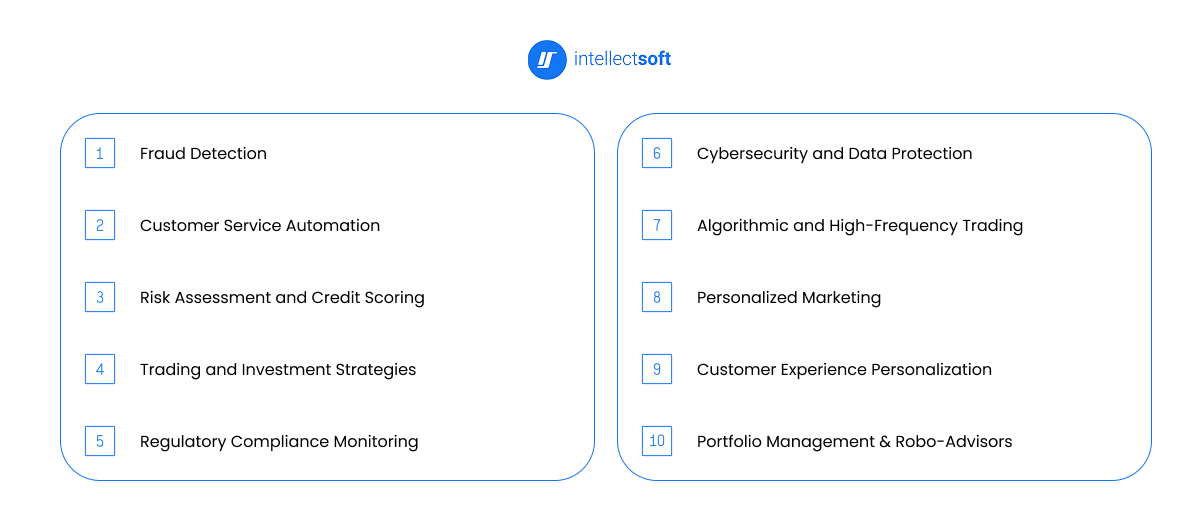
1. Fraud Detection
The detection of fraud represents a fundamental and advanced field where financial institutions apply machine learning techniques. In the rapidly evolving machine learning in finance industry, this area remains one of the most impactful. Financial crimes have become more complex which causes traditional rule-based detection systems to fail in their protective role. Large volumes of historical transaction data allow ML in finance to learn continuously about fraud patterns and subtle deviations which both human analysts and traditional detection systems would probably miss. This makes machine learning in finance an essential tool in modern fraud prevention strategies:
- The application of machine learning by finance professionals for fraud detection functions as follows;
- The implementation of advanced anomaly detection with real-time transaction scoring helps organizations minimize security breaches;
- The analysis of user behavior across digital platforms uses behavioral methods to identify irregular patterns;
- Credit scoring analysis receives support through the identification of inconsistencies in the data provided by applicants;
- The system provides investment strategy suggestions after filtering out both suspicious and manipulated financial signals;
- The resulting system takes a preventive approach to fraud reduction which both identifies threats before they lead to losses and responds to new threats automatically.
2. Customer Service Automation
The modern finance industry requires instant customer support which operates nonstop. The major portion of client interactions including balance inquiries and mortgage consultations now falls under the responsibility of ML-powered chatbots and voice assistants. These systems learn from user interactions to provide accurate human-like responses which improve with each exchange. Customer service automation decreases operational expenses and produces better user satisfaction and faster onboarding while cutting down response times to seconds. Leading banks together with fintech companies continue to make major investments in front-line support systems which use intelligent technology.
3. Risk Assessment and Credit Scoring
Financial institutions have started to change their risk assessment methods through the implementation of machine learning technology. The use of machine learning for risk assessment moves beyond traditional scoring models because it examines hundreds to thousands of variables through alternative credit data including mobile payments employment history and online behavioral information.
Risk profiling becomes more precise when institutions use a broader analysis approach because they can identify concealed risk factors which leads to better credit opportunities for underserved population groups. The system allows institutions to perform loan approvals in near real-time while simultaneously making adjustments to credit limits and developing more effective underwriting procedures.
4. Trading and Investment Strategies
The market’s high volatility makes timing a vital factor in all operations. Financial institutions use machine learning to process enormous data streams from stock prices and economic indicators and global news sentiment and social media signals in real time. The system enables predictive modeling that detects trading opportunities at a pace beyond human manual analysis capabilities.
ML-based systems provide tools for portfolio diversification together with automatic rebalancing functions and risk-hedging strategies. In the evolving machine learning in finance industry, the combination of market insights through these systems allows institutional traders and hedge funds along with robo-advisory platforms to surpass market benchmarks with better consistency.
Create high-end software solutions for your company with Intellectsoft
Get in touch
5. Regulatory Compliance Monitoring
Financial institutions face the highest level of regulatory attention today because non-compliance leads to penalties that exceed millions of dollars. Machine learning tools for compliance allow financial organizations to automate their complex monitoring requirements, detecting suspicious deals and insider trading activities. These capabilities are often integrated into robust enterprise software development solutions that reduce manual workloads and human oversight errors while improving audit transparency. ML systems track behavior against active compliance rules, helping institutions remain compliant with evolving regulatory requirements, including AML, KYC, GDPR, and Basel III.
6. Cybersecurity and Data Protection
The rise of digital transactions has led to more sophisticated cyber threats which become both more numerous and complex. Real-time threat detection and neutralization become possible through ML models that use system behavior analysis to identify unauthorized access attempts and detect data exfiltration patterns.
The ability of ML solutions to learn from past breaches and attack simulations makes them both adaptive and resilient against modern threat vectors including phishing attacks and credential stuffing and ransomware. Protecting both consumer data and institutional reputation has become essential because of this development.
7. Algorithmic and High-Frequency Trading
Machine learning technologies have transformed trading speed and accuracy through the development of algorithmic and high-frequency models in financial applications. These systems process real-time data streams through predictive analytics which enables them to perform thousands of micro-trades during milliseconds. Through machine learning optimization the system determines optimal market entry and exit points while minimizing slippage and modifying trading approaches according to new market data. The system uses processed data points to enhance its performance in a continuous manner while maintaining high speed capabilities.
8. Personalized Marketing
The market saturation requires customers to receive individualized outreach for conversion success. The application of ML technology allows for highly specific marketing campaigns through user segmentation using behavioral and demographic and transactional data. Financial institutions now use predictive analysis to determine which products or services customers need at their most critical moment for example a student loan or premium card or savings tool. The approach improves conversion rates while strengthening brand loyalty and extending customer lifetime value.
9. Customer Experience Personalization
The financial industry depends on machine learning to deliver customized digital services in addition to its marketing applications. The combination of machine learning systems adapts financial services through individual user-specific custom financial dashboards and real-time budgeting recommendations and proactive alerts about unusual spending.
The banking environment becomes more intuitive when customers experience this personalized service. Financial applications can transform into personal financial advisors through understanding user preferences and behavior and intent which builds trust and deepens user engagement.
10. Portfolio Management & Robo-Advisors
Through robo-advisors, investment management has become accessible to everyone. These platforms use ML algorithms to construct and manage portfolios for users based on their financial goals, market information, and tolerance levels. The system provides affordable services at scale and continues to attract growing interest from digital-born investors. The optimization of asset allocation strategies, market condition simulations, and tax efficiency becomes possible thanks to advanced ML models that protect long-term wealth creation. Many of these innovations are powered by custom software development for financial tools, enabling robo-advisory platforms to deliver institutional-level intelligence to individual users exploring financial planning for the first time.
Use Case Comparison Table
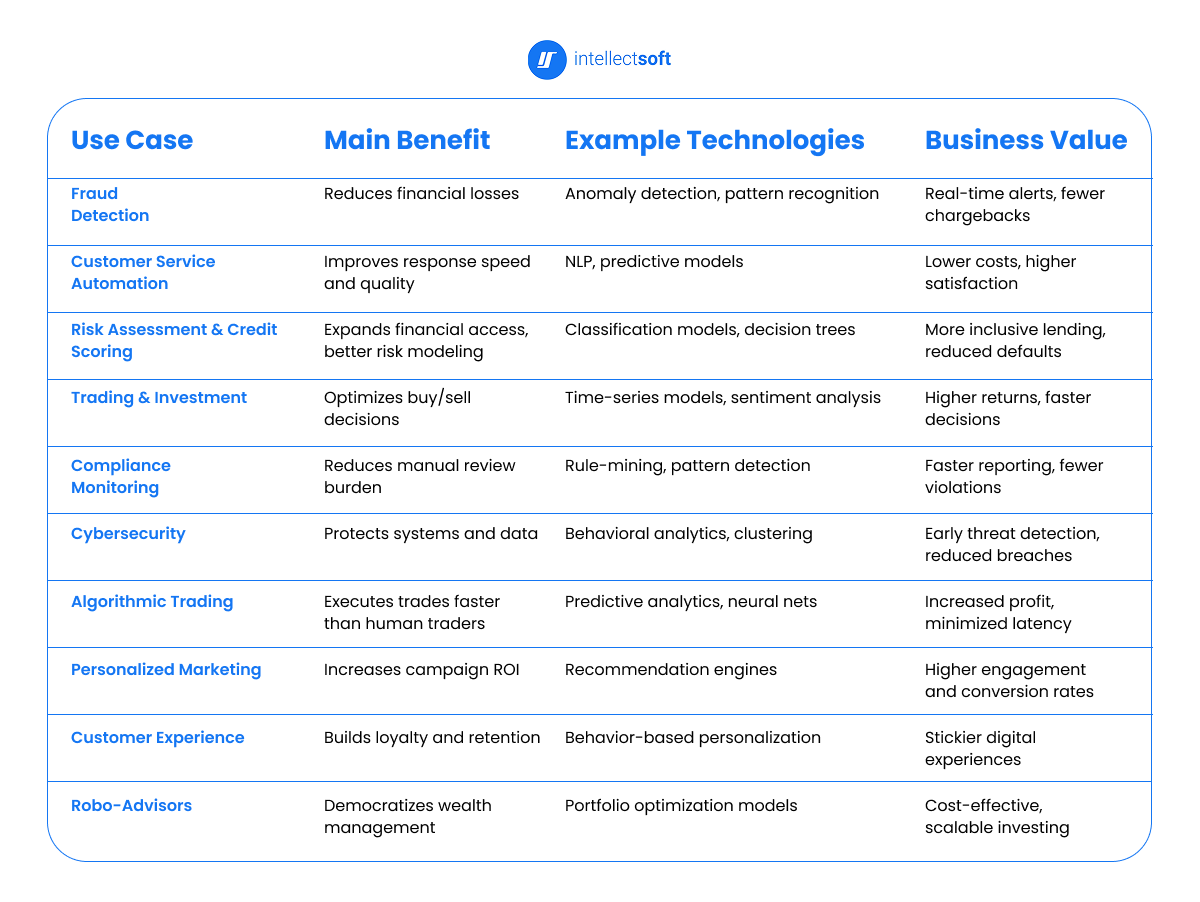
The provided use cases demonstrate how machine learning operates in finance and how to apply machine learning to finance operations. The front, middle and back-office operations of financial organizations benefit from ML in finance which enables them to extract value from all levels. The advancements showcase the extensive effects of machine learning on finance industry trends while demonstrating its ongoing role in driving innovation and efficiency throughout the sector.
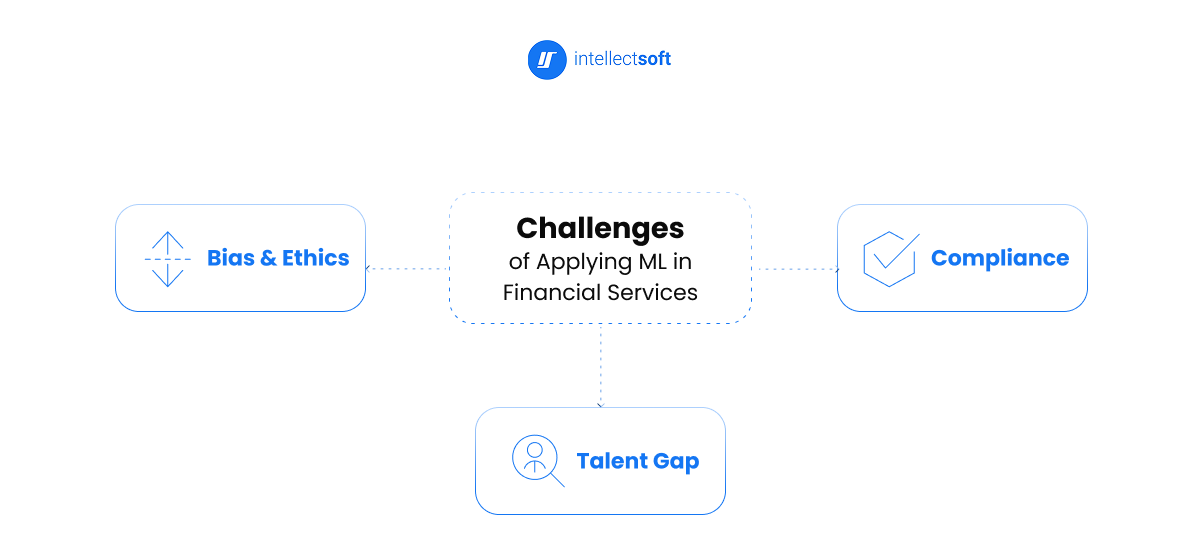
Challenges of Applying ML in Financial Services
Machine learning has proven its impact in finance but its implementation requires solving essential challenges to achieve responsible and scalable deployment. Financial institutions must overcome these obstacles while ML in finance advances toward its future development.
Data Bias and Ethics
The implementation of ML models in financial operations can perpetuate biases found in historical data which results in discriminatory decisions particularly during credit scoring and lending processes. The reduction of ethical risks depends on achieving diverse datasets and transparent model operations.
Complexity and Regulatory Constraints
The black box nature of ML systems creates difficulties for compliance teams because they cannot understand the decision-making processes. Organizations need to maintain a balance between innovative model development and transparent model explanations to fulfill regulatory requirements.
Talent Shortage in Advanced ML Roles
The market demand for ML professionals exceeds the available talent pool particularly for experts who combine finance expertise with machine learning capabilities. The current situation demands both employee skill development and purposeful recruitment strategies. Machine learning in finance delivers enduring value to institutions when they implement it with strategic planning and responsible practices.
Key Machine Learning Technologies and Algorithms in the Finance Industry
Financial services operations transform through machine learning, especially as part of the broader machine learning in finance industry, but understanding the fundamental technologies remains essential. The financial sector now employs machine learning in finance alongside advanced machine learning tools which provide greater flexibility and enhanced power compared to traditional models.
Which machine learning algorithms serve as the primary tools for financial industry applications? Different use cases require various models but several fundamental models remain dominant because they deliver reliable and accurate results.
- Decision Trees & Random Forests: Frequently used in credit scoring and fraud detection thanks to their interpretability.
- The classification tasks of transaction labeling and risk assessment use Support Vector Machines (SVM) as their preferred tool.
- Gradient Boosting Machines (e.g., XGBoost): Known for high performance in structured financial datasets.
- The complex financial applications of algorithmic trading and sentiment analysis and portfolio optimization use Neural Networks and Deep Learning.
- The K-Means clustering algorithm serves as a useful tool for both customer segmentation and behavioral analysis.
The role of machine learning algorithms extends beyond tools in finance. The algorithms enable automation while reducing manual work and allowing real-time decision-making across large scales. The analytical engines of ML algorithms power all financial operations starting from loan approvals to investment models.
The combination of big data with cloud computing and AI regulation has led to new developments in machine learning finance through federated learning and explainable AI (XAI) and reinforcement learning in dynamic trading environments. The innovations enable institutions to maintain compliance while achieving scalability and staying at the forefront of industry developments.
Advanced machine learning in finance extends beyond prediction because it delivers precise results at high speeds while adapting to new situations. These technological advancements establish new benchmarks for risk management and customer intelligence and financial innovation capabilities.
The Future of ML in Finance
The future of machine learning in finance lies in deeper integration, greater transparency, and smarter automation. As adoption grows, financial institutions are moving from isolated use cases to ML-driven ecosystems.
Recent advances in finance machine learning-like explainable AI, generative models, and federated learning-are helping firms make faster, safer, and more customer-centric decisions, further reinforcing the impact of machine learning in finance across the industry.
Knowing how to use machine learning in finance effectively means aligning it with goals like financial inclusion, fraud prevention, and dynamic pricing. As firms learn how to use machine learning in finance across the value chain, ML will shift from an innovation tool to a business essential.
Strategic Impact of Machine Learning in Finance Industry
The adoption of machine learning in finance has moved beyond experimentation-it’s now a strategic necessity. Institutions that integrate ML not only improve speed and accuracy but also gain a long-term competitive edge in risk management, personalization, and operational efficiency.
The machine learning in finance industry transforms banking and insurance and investment operations through enhanced customer trust and real-time decision capabilities. The expanding adoption of machine learning in finance drives organizations to develop smarter systems and predictive services which benefit all financial functions. The finance industry uses machine learning to transform operational processes which previously relied on manual or inflexible methods. Machine learning serves as a fundamental element which supports business expansion and regulatory flexibility and customer-oriented innovation. If you’re ready to explore how ML can elevate your organization, contact us to discuss tailored digital solutions.
FAQ
What is machine learning in finance, and how does it differ from traditional analytics?
The financial sector employs machine learning algorithms to process data while automatically improving their operational capabilities. The innovations in the machine learning in finance industry are quickly becoming standard within the broader field. The financial industry uses Machine learning in finance to provide real-time data-driven services at large scales. The ML in finance systems perform beyond traditional financial analytics because they process large complex datasets instantly while adapting dynamically. Through machine learning systems businesses achieve more precise forecasting together with fraud detection and credit scoring and automated decision-making across various financial sectors.
How can machine learning be used in finance to improve customer experience?
Machine learning technology delivers customized financial services to customers through intelligent system recommendations combined with automated financial analysis and real-time data access. Banks along with fintech applications apply behavioral information to create customized dashboard views and detect suspicious actions while predicting customer requirements for delivering adaptive responsive financial services. The use of machine learning for customer-centric financial innovation stands as one of the most functional applications of this technology.
Which machine learning algorithms are commonly used in the finance industry, and what role do they play?
The finance industry relies on four fundamental machine learning algorithms to achieve its operations which consist of decision trees, random forests, support vector machines (SVM) and deep learning models. These systems function for credit scoring applications along with fraud detection systems and portfolio optimization and trading processes. The operational foundation of current financial institutions depends on machine learning algorithms which perform automatic decision-making and risk reduction and provide real-time analytical data at large scales.
What are the benefits of machine learning in finance, and what challenges should firms expect?
The finance industry benefits from machine learning through quick data processing and enhanced prediction accuracy together with automated workflows and reduced human errors that enable expansion. Through this technology institutions become better at lending decisions and anomaly detection and user engagement personalization. The implementation of machine learning in finance faces three main obstacles which include data bias alongside regulatory complexity and the lack of skilled professionals in advanced ML roles. Financial organizations must establish transparent ML strategies with ethical standards and proper governance to reach maximum return on investment.




Subscribe to updates

Source link