







Financial markets create more data than almost any other industry. Banks have millions of transactions to process every day, investment firms have countless market indicators to track, and insurance companies have thousands of risk factors to analyze.
But most organizations barely tap into the potential of their data.
Predictive analytics turns this equation on its head. Using advanced algorithms and ML techniques, financial institutions can create value out of their data. That being said, they can make decisions that directly affect profitability, risk management, and customer satisfaction.
This article uncovers how predictive analytics in finance gives companies a tremendous competitive edge. We will also take a look at industry giants, vivid examples of how to make the most of external and internal data.
Financial Analytics Market Trends
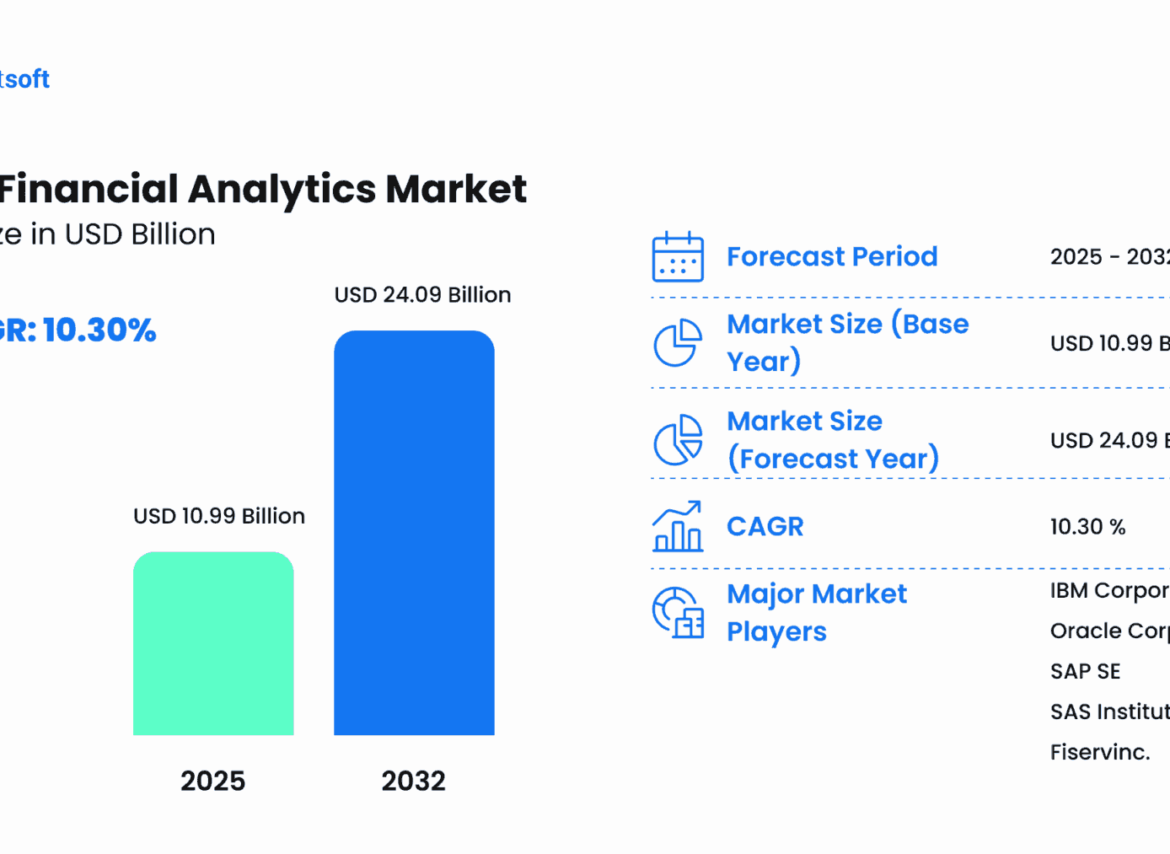
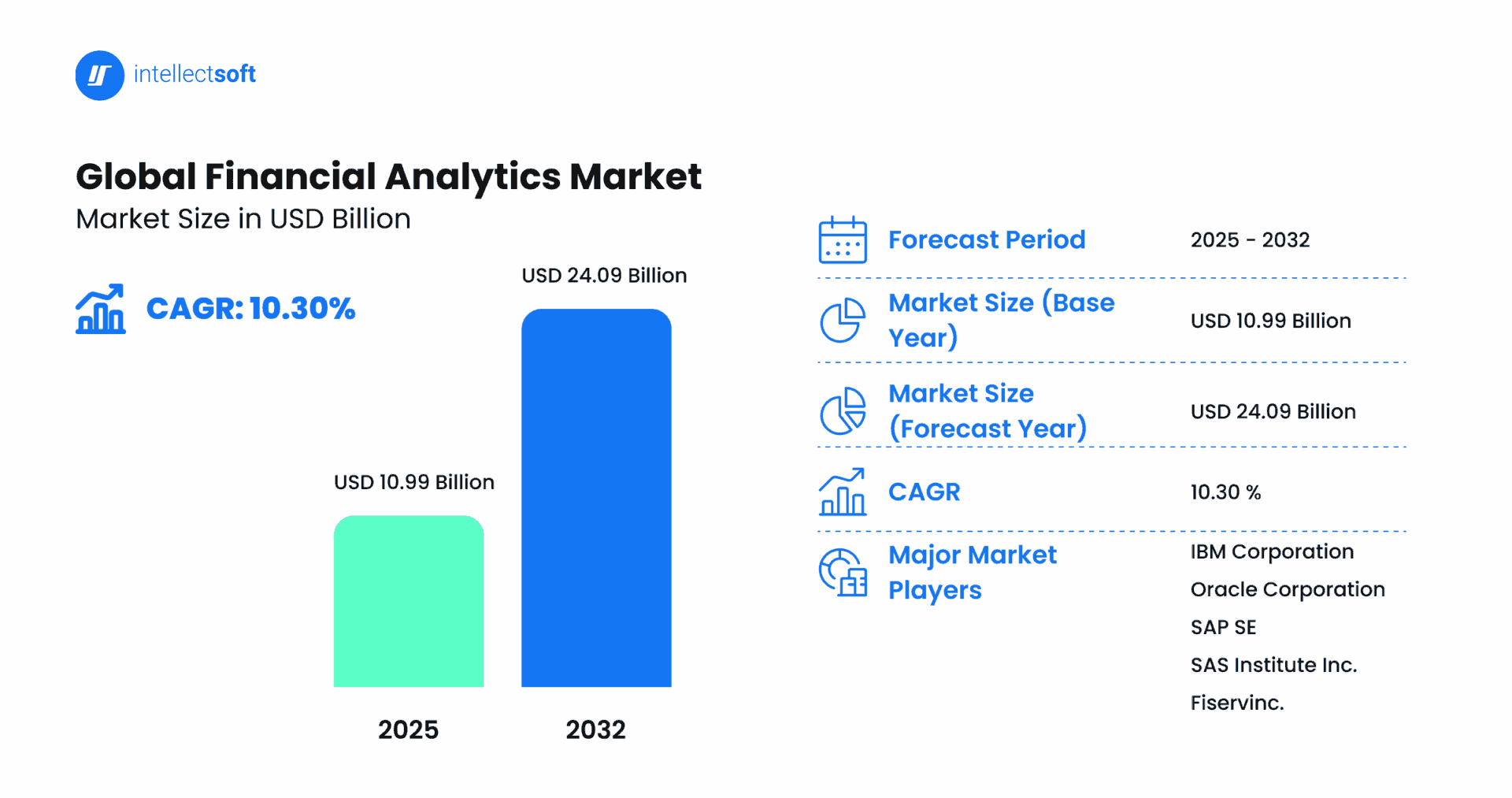
The financial data analytics market is in a state of continuous growth. As per Data Bridge Market Research, market valuations amounted to $10.99 billion globally, with projections to reach $24.09 billion by 2032. This expansion is happening due to institutions recognizing the strategic value of data-driven decision-making.
Several key trends in fintech software development are shaping this landscape:
- Large platforms for cloud-based analytics are bringing sophisticated tools within reach for midsize organizations.
- The ability to process in real-time allows for a faster time to market response.
- Integration with AI/ML is now automating complex analyses that once took significant manpower.
- Adoption is being driven by regulation, as well.
- Banks are being asked for more evidence of risk management and fraud prevention. Predictive analytics offers the detailed documentation and analysis that regulators require, and it delivers operational efficiency as well.
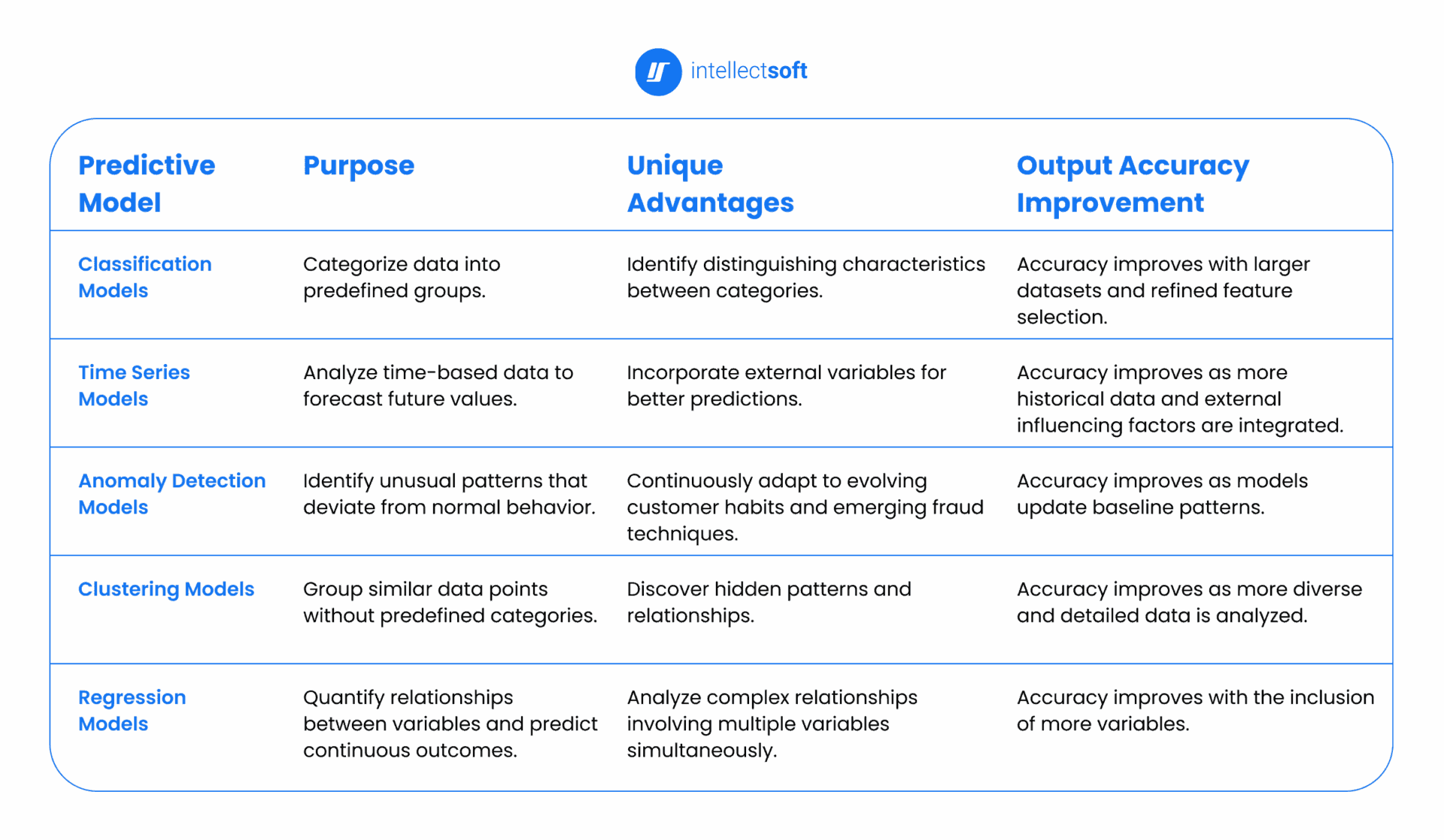
Top 5 Predictive Analytics Models in Finance
To understand which analysis is the right fit for your datasets, you need to know the core model types of predictive analytics in finance.
Classification Models
There’s no better way for models to classify data into different types of groups. When used in finance, these models can predict
- if a loan should be granted
- if a transaction might be fraudulent
- to which segment a new customer belongs, etc.
Classification models study past trends to infer unique traits for different classes. For instance, the credit approval model considers income levels, employment history, debt-to-income ratios, and credit score indicators. It uses those as criteria for the categorization of applications into low-risk and high-risk applications.
Classifiers perform better as the size of the data and feature selection become more refined. When properly implemented, financial services are capable of producing classification accuracies of over 90%.
Time Series Models
Time series models generate forecasts from historical datasets. These models are handy for investment strategies and risk management, as financial markets generate a continuous stream of time-based data. They reveal trends, seasonal dynamics, and cycles in the data.
Time series analysis is useful in analyzing stock price movements, interest rate movements, trends in economic indicators, etc. Sophisticated models of predictive analytics in finance (ML-powered) can also account for external real variables that affect financial metrics. Systems for currency exchange rates, for example, could take into account economic reports and commodity prices, in addition to historical currency exchange rate values.
Anomaly Detection Models
These models are heavily used by financial institutions to prevent fraud and monitor risk. They set a standard pattern of normal behavior and then identify transactions or other behaviors that violate the standard. Put it simply, if an account that usually holds small withdrawals suddenly holds a large one, or if there are several high transactions in quick succession, the model will mark it as an anomaly.
What’s more, anomaly detection models continuously improve through computational learning for every piece of collected data. As your customer habits change or new fraud strategies arise, the models respond automatically without manual reconfiguration.
Clustering Models
The clustering models group together similar data points that have no predefined labels. Unlike the classification model, clustering is based on revealing hidden patterns and dependencies from a data source.
A striking example in this particular case would be the customer segmentation procedure. With transaction histories, account balances, and service usage, the banks can segment their customers based on shared needs and characteristics into definable groups. This enables the banks to tailor marketing and individual service offerings, as well as devise risk assessment strategies.
Regression Models
In portfolio valuation, modeling of interest rates and revenue forecasting, regression models excel. They explain the relationship of one variable with another. For example, a regression model can be constructed to estimate the demand for loans based on interest rates. Or on the portfolio performance based on the volatility in the market.
What’s important is that multiple regression methodologies can evaluate multiple relationships among many factors. This feature is especially important to consider when financial successes depend on several interrelated aspects.
Why Use Predictive Analytics In Finance?
Predictive analytics in finance helps modern orgs overcome several significant hurdles stemming from the following issues:
- The world of finance is dynamic. To stay in the game, you need to keep your hand on the pulse of the future.
- Customer expectations regarding personal experience have risen. Financial institutions constantly struggle to implement hyper-personalization.
- Regulatory requirements continue expanding. Banks need tools to keep their data and processes coherent and compatible with regulatory laws.
- Fintech fraud is still a painful topic for the industry. Every financial organization should be proactive in trying to find new solutions to withstand malicious actors and defend their clients’ assets..
The power of predictive analytics lies in using up-to-the-minute data to offer better risk evaluations. Rather than finding solutions to problems and repairing damages, the finance industry may finally be able to predict and avert them.
Use Cases of Predictive Analytics in Finance
So, how to use predictive analytics in finance? Where can it deliver the most?
Stock Trading & Portfolio Management
Predictive models seem like a perfect add-on for designing algorithmic trading systems. In stock market, detecting valuable opportunities and managing the risks associated with them is probably trader’s major pain. ML can analze large volumes of market data swiftly. So, predictive models recognize patterns traders lean on at lightning speed, altering the entire investment process.
Diversification models for portfolio optimization bring together expected returns, risk levels, and covariance structures in order to form an optimally diversified portfolio. They rebalance positions automatically according to market conditions and investor goals.
Budgeting & Accounting
With dynamic budgets (that is, resilient to market shifts), organizations are able to predict revenue streams, expense types, and cash flow needs. No old-fashioned budgeting models can deliver the precision that predictive analytics in corporate finance can. Plus, automated variance analysis highlights performance gaps so that you can take action faster. This provides greater financial control and reduces the risk of budget overruns.
Marketing & Sales Personalization
Prediction of customer behavior carries significant meaning for targeted marketing initiatives. Predictive models go through purchase history, browsing behavior, and demographic information to determine the perfect final offer. Banks thus can offer the right products or services at the right time. This is one way to boost client satisfaction and, perhaps, strengthen relationships.
Meanwhile, customer lifetime value models help make marketing investment decisions. Based on estimates of future customer life cycles and the costs incurred by acquiring and servicing them, these models can predict the long-term profitability of various customer segments.
Credit Scoring
Predictive analytics play a special role in credit scoring within thin credit histories. See, predictive models can consider non-traditional aspects. These include social media activity, cell phone use, or online behavior. Together, these indicators can be used to model credit risk. This is a way for predictive analytics in corporate finance to serve those who have little to no credit history but still comply with decent risk management practices.
Fraud Detection & Prevention
This is one of the most important predictive analytics use cases in finance. Cyber attacks evolve, so should the systems that deflect them. Real-time fraud detection systems analyze patterns of transactions to identify potential malicious behavior. They give banks an opportunity to spot fraud before it incurs damage. These systems consider all details of a single transaction, such as its size, types, location, etc.
What’s great about ML is that it adapts and learns from new fraud tactics. So it remains effective as fraudsters innovate. Meanwhile, behavioral analytics builds an individual profile for each customer, meaning it can detect account takeovers and other types of ID theft that wouldn’t necessarily set off more traditional rule-based systems.
Real-World Examples of Predictive Analytics in Finance
We’ve collected several examples of predictive analytics in finance that signify revolutionary possibilities of this technology.
- JPMorgan Chase relies on predictive models to assess which loan applicants are the best bets. Their algorithm has 85% accuracy in predicting the probability a loan will default, which allows approval decisions to be quicker and risk exposure to be minimized.
- Carbon, an African digital bank, selected DataRobot’s cloud-based AI platform to automatically evaluate the credit risk of customers. Their complex systems take into account things like credit inquiries, cash in hand, allowable income, tax returns, payment history, and a host of other factors to more accurately determine creditworthiness. The result: better lending decisions and lower default rates.
- PayPal enables over 20 billion transactions yearly, cryptographically secure from the client’s browser to a data center. They apply predictive analytics and machine learning to analyze transaction behavior, device, and user to detect potentially fraudulent tones.
- At Bank of America, customer lifetime value algorithms determine how best to tailor product offerings as well as retention efforts. Additionally, transaction history, customer demographics, and engagement patterns enable the bank to project which clients would likely require ancillary services.
- At Morgan Stanley, investment advisors use predictive analytics to gauge and anticipate shifts in market volatility. Portfolio allocations can thus be optimized. Forecasting the market direction requires incorporating world economic events, geopolitical shifts, and historical market trends.
Top Predictive Analytics Platforms for Finance
The right platform choice is vital for optimal deployment. The following are ranked best in terms of how well they’ve been tailored for use in financial use cases:
- SAS Advanced Analytics is a fully-fledged predictive analytics system. Tailored for compliance and risk management, it covers fraud detection and even regulatory obligations.
- For financial analysts who prefer not to code, IBM SPSS Statistics offers a powerful, user-friendly interface alongside robust algorithms for more complex analytics.
- With Tableau and the help of R or Python, one can create and design interactive dashboards and visualizations that fetch data from intricate predictive models.
- Microsoft’s Azure Machine Learning is a predictive analytics service that offers cloud-based predictive analytics as a service that is now part of the Microsoft ecosystem.
- Palantir Foundry provides big data analysis and integration, and so is best suited for large financial firms working with complex multi-source datasets.
Advantages of Implementing Predictive Analytics in Finance
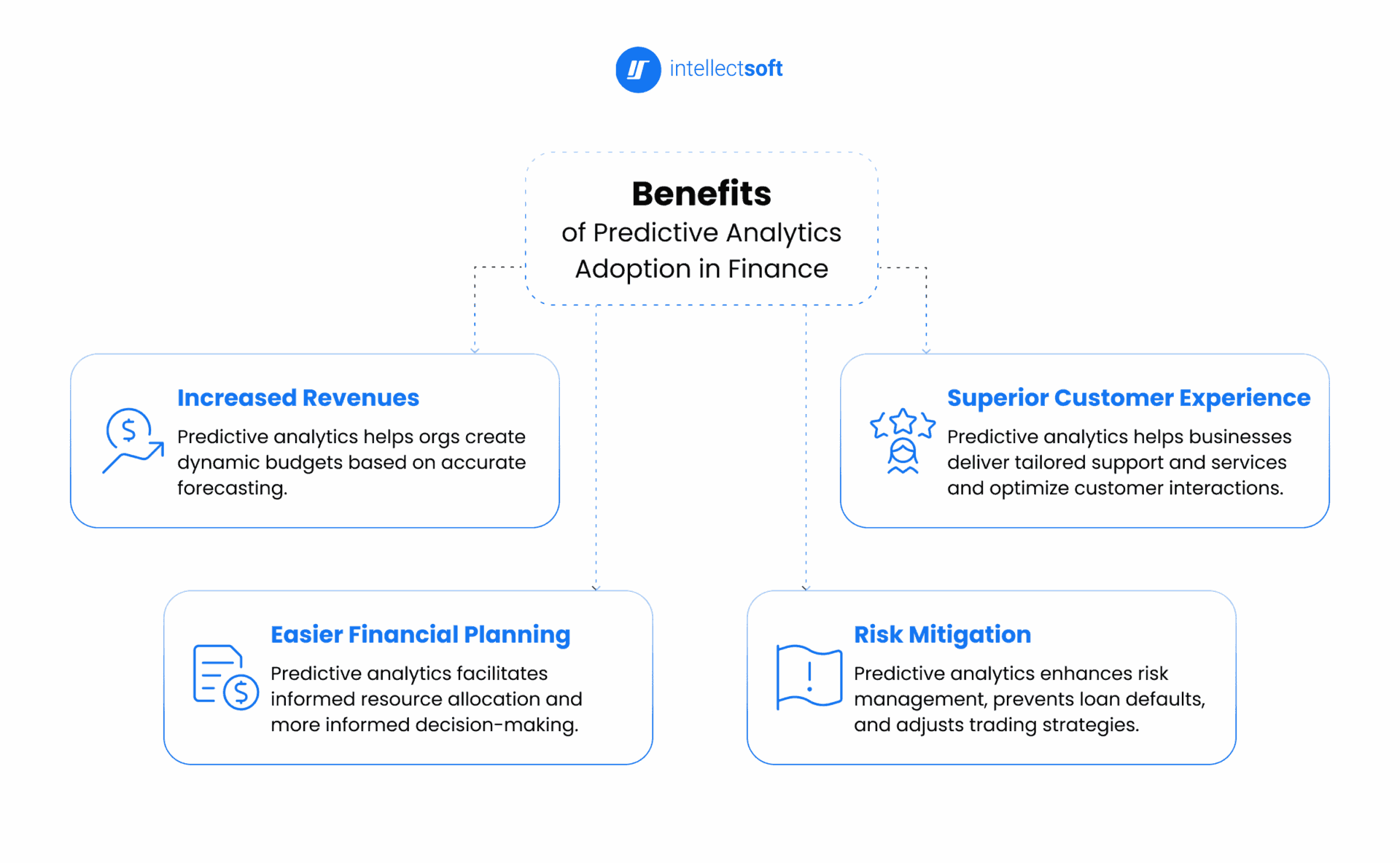
Now, let’s say you decided to head for predictive analytics solutions and adopt them across your processes. What are the potential pros you could anticipate?
Increased Revenues
Predictive analytics has direct effects on revenue growth, primarily through accurate forecasting. It enables organizations to anticipate market fluctuations, create dynamic budgets, and plan for future investments, among other benefits. No less important is the ability of predictive models to predict loan defaults, taking into account payment history and income.
Easier Financial Planning
Historical trends are the cornerstone of traditional financial planning. Meanwhile, predictive analytics in accounting and finance looks at a wider scope of factors, yielding more precise results. Such accuracy enables optimal resource allocation, better decision-making, and enhances stakeholder trust in the reliability of forecasts.
Risk Mitigation
Risk management is one of the most critical use cases of predictive analytics in the finance world. We are not assuming that even advanced models can predict black swan events, but they are more effective than traditional ones. Credit risk analytics can help lenders prevent defaults by identifying high-risk applicants early on. Traders can adjust their trading positions using market risk analytics, ahead of unfavorable movements in the market. Operational risk models help identify internal gaps that could lead to non-compliance or financial losses.
The measurable effects are significant: financial houses using predictive risk models report 20-40% less in unexpected losses than their counterparts who use traditional means of risk measuring.
Superior Customer Experience
Hyper-personalization is the ultimate goal for businesses across many domains. Yet, it is still far from being reached. Predictive analytics, in combination with other technologies, of course, can help provide the level of support and service that customers desire. Banks leverage ML-based predictive models to make personalized recommendations to customers, optimize customer service interactions, and resolve issues preventively. Model-driven predictions enable support reps to anticipate client needs and prepare the appropriate solution before they even resort for help.
Final Word
So, it is evident that predictive models are important, but how to use predictive analytics in finance correctly and gain measurable results? Many start with tactical use cases that solve short-term business problems and grow their analytics capabilities from there. The trick is to begin with a clear understanding of your goals and the data resources to which you can apply.
Also, you can collaborate with an experienced analytics provider with a deep understanding of the financial services industry’s diverse requirements and regulatory limitations. The right people can help drive deployment faster and help to make certain that predictive analytics can be implemented in such a way that real business value is harnessed.
Contact us
Want to unlock the power of your financial data? Intellectsoft assists companies across domains in designing and implementing predictive analytics systems aligned with business needs and growth aspirations.
FAQs
1) How does predictive analytics work in financial risk management?
Predictive analytics in financial risk is based on historical facts, finding patterns, and generating unique predictive models. It involves forecasting market volatility, identifying operational risks, and detecting fraud. The ultimate goal is to foresee risks and take action before the damage is done.
2) How to carry out a predictive analysis?
The process includes several vital steps:
- Collecting data from multiple sources
- Cleaning and preparing data
- Modeling and training models
- Validation testing
- Deployment
3) Why use predictive analytics in finance?
Predictive analytics is a must in finance. It’s a difference between reactive decision-making and proactive strategy. Every second counts in a fast-paced financial market, and predicting change is still the key to success. It enables better risk assessment, improved client service, more precise financial planning, and ultimately, higher profitability.
4) What are the main elements of predictive analytics?
Data preparation, statistical modeling, and deployment are three foundations of predictive analytics. The quality of data guarantees credible inputs for the analysis. Statistical models allow for mathematical forecasts. Domain expertise and deployment are what help models actually solve real business problems and make them actionable.
5) What method is most commonly used in predictive analytics?
Linear regression (a statistical method) is the most popular technique for predictive analytics today. Nevertheless, models based on machine learning techniques, including random forests, neural networks, and ensemble methods, are gaining increasing attention. However, they are more useful for complex financial applications that involve large, multi-dimensional data analysis.
The post Predictive Analytics in Finance: Models, Benefits, Use Cases appeared first on Intellectsoft Blog.
Source link