








Software development outsourcing has transformed into a strategic business method which enables fast growth and flexible operations and worldwide expertise acquisition for companies. Businesses at every stage can accelerate market entry and reduce operational expenses through selecting an appropriate development partner. Knowing how to successfully outsource software development helps ensure you get the right results while minimizing risks and maximizing long-term value.
What steps can you take to guarantee that the process runs efficiently while staying true to your business objectives? The following guide provides complete information about outsourcing models and remote team development and management for successful results.
5-Step Proven Process to Outsource Software Development Successfully
The process of outsourcing software development work creates significant challenges for organizations. Organizations that execute outsourcing properly gain access to skilled talent while delivering projects faster at reduced costs. Organizations experience delays and misaligned expectations and technical debt when they lack a proper process framework.
The proven five-step framework allows startups and enterprises to successfully outsource software development for bringing their ideas to life. Whether you’re focusing on software development for startups, which demands agility and speed, or navigating the complexities of enterprise software development with its focus on scalability and integration, learning how to outsource software development effectively can make the entire process smoother, more cost-efficient, and aligned with your business goals.
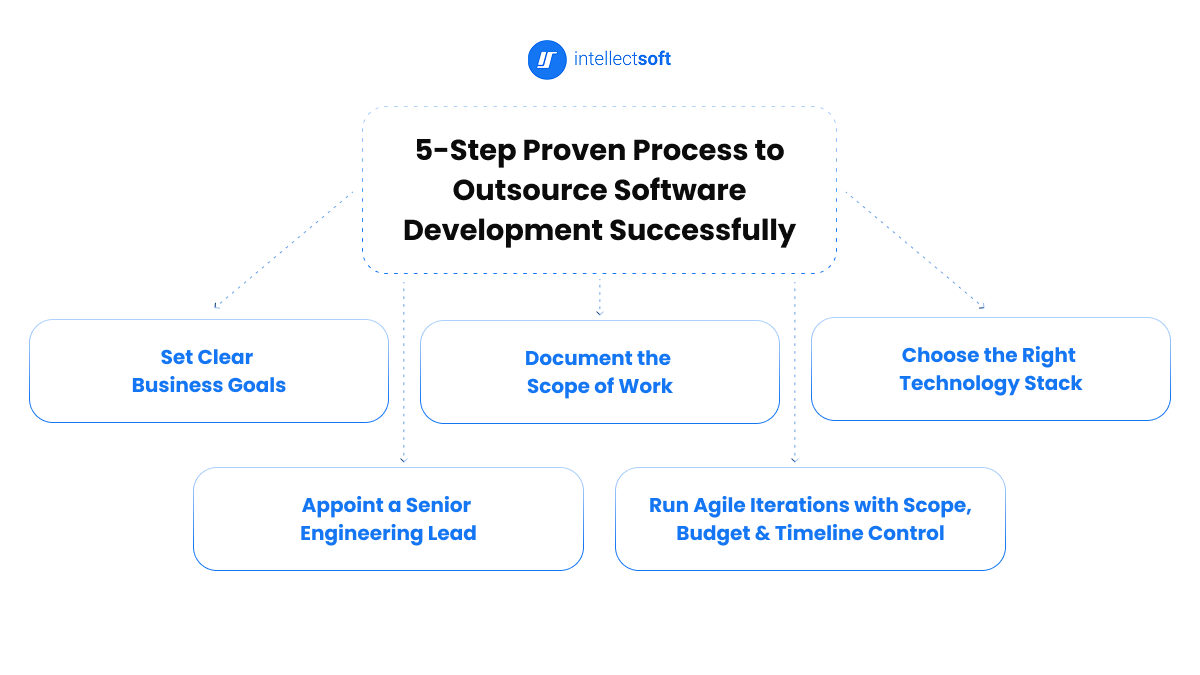
1. Set Clear Business Goals
Start with clarity. Clearly define the business problem you aim to address and establish measurable success criteria from the outset. If your current focus is on MVP development, it’s essential to align the product vision with market expectations while ensuring scalability for future growth. Whether you’re building a minimum viable product or modernizing legacy systems, aligning internal team efforts with an external vendor’s strategy requires a shared understanding of project goals. The more precisely these goals are articulated at the start, the fewer misunderstandings will arise throughout the development process.
2. Document the Scope of Work
A properly structured Scope of Work (SoW) functions as your project foundation. The project documentation must include complete requirements together with user stories or use cases as well as technical constraints and essential milestones along with their corresponding deadlines. Your outsourcing partner will probably develop incorrect project understanding because of the missing document which leads to unnecessary delays and additional costs for rework. A Scope of Work document creates immediate agreement between all project stakeholders.
3. Choose the Right Technology Stack
The selection of technological components determines how fast development happens alongside system efficiency and both current and future operational scalability and workforce capabilities. Your in-house team along with your CTO has existing preferences yet it becomes vital to assess whether those tools fit the requirements of this project. An experienced outsourcing vendor provides you with contemporary efficient solutions that match your business goals as well as product roadmap and user requirements.
4. Appoint a Senior Engineering Lead
Leadership plays an important role in projects regardless of the quality of the team. A technical leader who has extensive experience should oversee projects to maintain consistency and architectural integrity and make decisions swiftly. This person connects your stakeholders to the development team by converting business requirements into technical instructions while avoiding miscommunication between parties.
5. Run Agile Iterations with Scope, Budget & Timeline Control
Each project should divide into three-week sprints which include specific objectives and deliverables. The validation process through sprint reviews combined with demos allows you to provide feedback early instead of finding issues at the end. The iterative approach enhances project adaptability while providing exact management of project scope alongside budgetary and timeline control. Through Agile outsourcing you can handle changes effectively without compromising on either quality or project speed.
Understanding Outsourced Software Development
The digital economy demands speed and agility together with talented personnel to develop scalable software solutions. Companies can fulfill their demands through software development outsourcing services by partnering with external vendors who deliver specialized skills and proven delivery processes and new perspectives.
The process of outsourcing software development involves hiring a third-party vendor who operates from a different location such as a different city or country or continent to complete some or all parts of your software development project. External teams perform various tasks including product design and frontend and backend development and quality assurance and DevOps and support and infrastructure management.
This model is used across the board:
- Startups looking to build their MVPs faster
- Mid-sized businesses scaling up without over-hiring
- Enterprises digitizing core processes or launching new platforms
By leveraging external expertise, companies can reduce time-to-market, control development costs, and improve technical outcomes – without the burden of full-time hires.
Why Do Companies Choose to Outsource Software Development?
Multiple strategic operational and financial elements determine why companies select software development outsourcing. Companies use software development delegation as a competitive strategy to maintain quality standards when their internal resources reach their limits.
Here are the top motivations:
- Access to global talent. The approach enables organizations to recruit professionals from a broader spectrum of skilled workers. A Berlin startup can work with Eastern European machine learning experts at the same time a U.S. healthcare provider collaborates with Polish mobile developers.
- Cost efficiency. Development rates vary significantly by region. Outsourcing can reduce total engineering costs by 30–60%, especially when hiring from countries with strong technical education systems and lower labor costs.
- Faster delivery. External vendors often have teams ready to start immediately. The combination of Agile practices with this approach allows for faster development cycles and quicker go-to-market strategies.
- Focus on core business. The external team develops the tech foundation while internal stakeholders dedicate their time to product strategy and user acquisition and operational growth.
- Scalability and flexibility. The project phases determine the scaling needs of outsourced teams which eliminates the requirement for extended employment contracts.
Real Example
A U.S.-based fintech company required a secure mobile banking app launch within six months. The company achieved their deadline through nearshore development with Eastern European partners while avoiding full in-house team hiring and maintaining compliance and performance standards.
Common Software Development Outsourcing Models
All software development outsourcing models differ from one another. Your partnership structure depends on your project scope together with your internal involvement level and your timeline and budget requirements. The selection of an appropriate model proves essential because it determines whether the partnership will succeed or fail.
Here’s a breakdown of the main models used when choosing software development outsourcing:
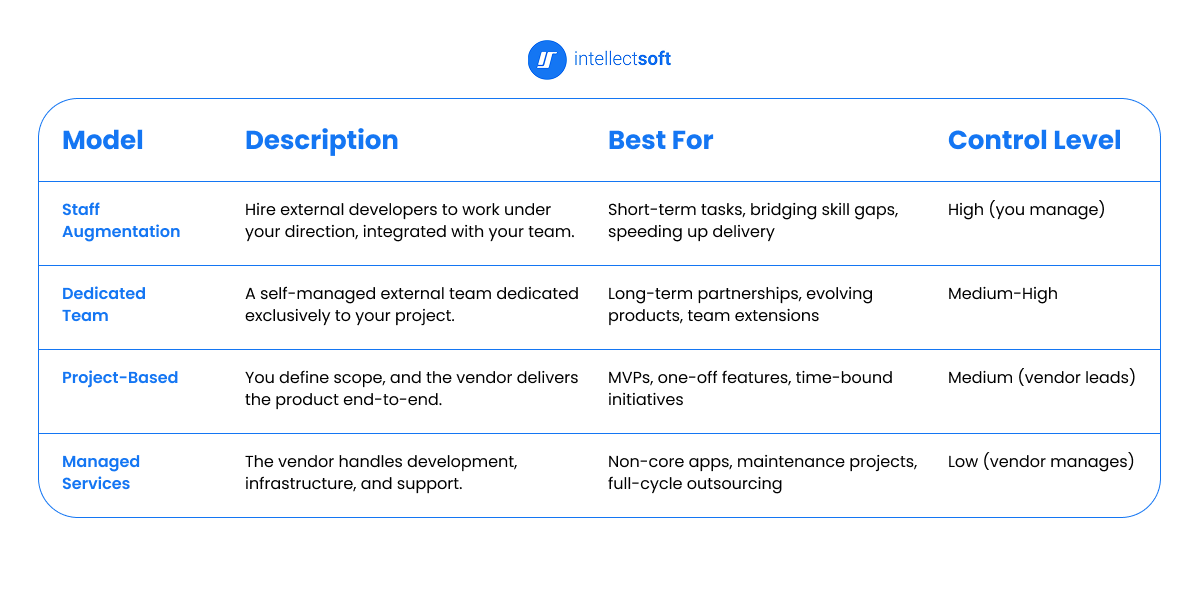
Each model has trade-offs:
- Need tight integration with internal teams? Go for staff augmentation.
- Need a long-term product partner? Choose a dedicated team.
- Need a turnkey solution with minimal oversight? Consider a project-based approach.
You should include technical and business stakeholders in the process of determining which model best fulfills your objectives. Delegating outsourcing software development requires clear ownership, open communication, and alignment across teams to deliver real business impact.
Planning Your Software Development Outsourcing Project
The foundation for successful execution depends on effective planning before selecting vendors or entering into contracts. The main reason behind project failures stems from the mismatch between business objectives and technical specifications and vendor delivery expectations rather than technical execution problems.
This stage is all about internal preparation. You’ll define your vision, document your needs, select the right tools, assign leadership, and build a framework for managing outcomes.
Here’s how to outsource software development with confidence – starting from the inside out.
Set Clear Goals and Expectations
Every outsourcing initiative needs to start with one fundamental question about its intended objectives.
Effective goal-setting begins with identifying the specific problems your product is meant to solve, the target audience it serves, and the outcomes you aim to achieve. Whether you’re launching an MVP to validate market demand or rebuilding a legacy system to improve performance, clearly defined goals are essential. If you’re planning to scale efficiently, investing in SaaS development services enables the creation of a modular, platform designed for long-term growth and flexibility. Aligning product vision with technical execution ensures your solution remains adaptable as business needs evolve.
The SMART criteria of Specific, Measurable, Achievable, Relevant and Time-bound should be used to establish goals which will direct vendor conversations and maintain internal team alignment. The more clarity you provide upfront, the more likely your outsource software development partner will deliver what you actually need.
Example
Instead of saying “We want to build a mobile app,” say “We want to develop an iOS/Android app for freelance consultants that supports scheduling, payments, and push notifications – and launch it in 14 weeks.”
Prepare a Detailed Scope of Work Document
The Scope of Work (SoW) is the document that defines your project’s requirements, boundaries, and deliverables. It acts as a reference point for everyone involved – from developers and designers to QA and project managers.
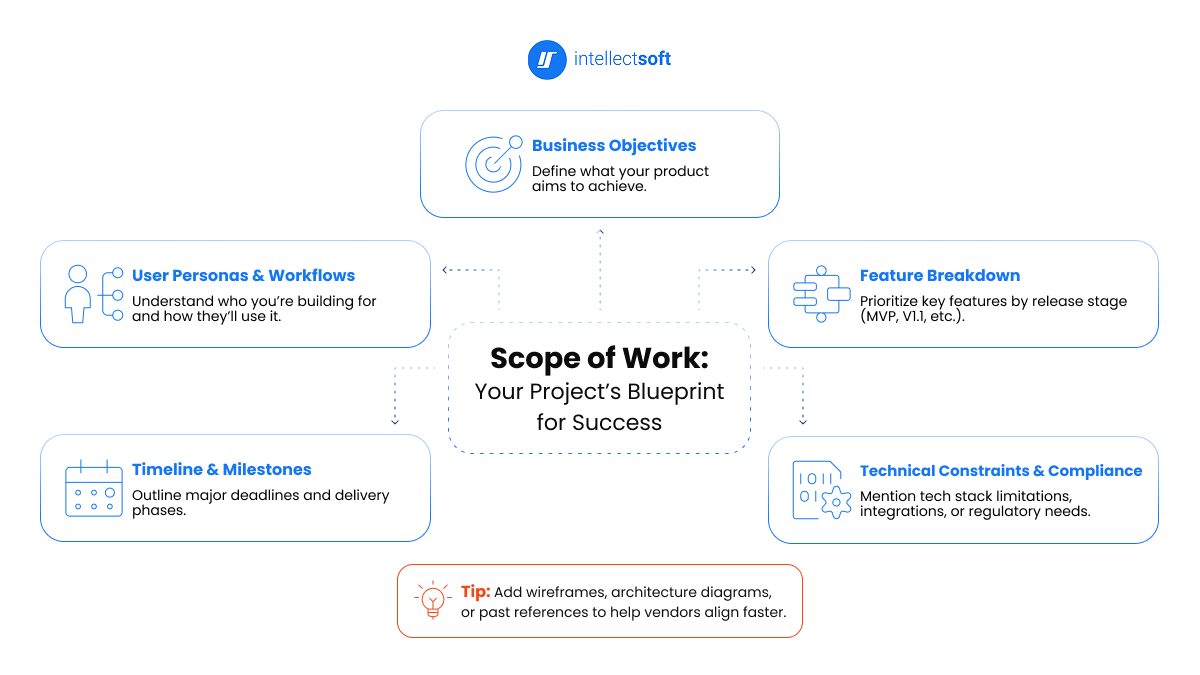
A strong SoW includes:
- Business objectives
- User personas and workflows
- Feature breakdowns (with priorities: MVP, V1.1, etc.)
- Timeline and key milestones
- Technical constraints and compliance requirements
- Budget range or fixed-cost expectations
Without a clear SoW, outsourcing software development often leads to missed expectations, vague estimates, and shifting priorities. It’s your contract’s best friend – and the clearest signal to vendors that you’re serious.
Choose the Right Technology Stack
Your technology stack should serve your product – not the other way around. Yet many businesses default to legacy tools or popular trends without evaluating fit.
When considering software development outsourcing, work with your internal tech team (or prospective vendors) to choose a stack that:
- Aligns with long-term product vision
- Matches your team’s internal expertise
- Is scalable and secure
- Has strong community and vendor support
- Supports your infrastructure (cloud-native, microservices, etc.)
The choice between React Native and Firebase for a lightweight MVP differs from the selection of.NET, PostgreSQL and Kubernetes for an enterprise-grade product. Selecting the correct technology stack during the initial phase minimizes development work and decreases your overall product maintenance expenses.
Tip: Request vendors to demonstrate their recommended stack through performance benchmarks or case studies from comparable projects.
Involve a Senior Engineering Leader
Even with great planning, your project still needs a strong technical anchor. Involving a senior engineering leader – either from your side or as part of the vendor’s team – ensures architectural decisions are sound, risks are spotted early, and communication flows smoothly.
A senior leader will:
- Translate business goals into technical priorities
- Review architecture and code quality
- Act as a single point of contact for developers
- Mentor junior engineers and ensure process discipline
- Flag technical debt and advise on trade-offs
In many outsourced software development scenarios, having a named engineering lead reduces misalignment and dramatically boosts efficiency. They don’t just “manage” – they lead with context.
Manage Scope, Budget, and Timelines Iteratively
The final piece of the planning puzzle is setting up a framework for managing change. Even with the best SoW, priorities shift. That’s why agile project management – with short iterations, regular demos, and backlog grooming – is crucial.
Break your development into 1–3 week sprints. Each sprint should include:
Create high-end software solutions for your company with Intellectsoft
Get in touch
- Sprint planning (goals, scope, estimates)
- Development & QA
- Demo to stakeholders
- Retrospective + next sprint adjustments
This method enables you to track progress while verifying features and making immediate adjustments to your project. The approach helps protect your software development outsourcing budget by detecting scope creep at an early stage. Use burndown charts or Kanban boards (like Jira or ClickUp) for transparency across all teams.
Step-by-Step Guide to Outsourcing Software Development
After establishing your goals and scope and internal strategy you can proceed to execution. The process of outsourcing software development requires more than hiring a team because it demands building a partnership which matches your organizational goals and cultural standards.
The following section explains effective software development outsourcing through vendor evaluation and proper question asking and legal and financial structure setup. The main objective is to reduce risks while accelerating onboarding processes to create a solid delivery foundation.
How to Select the Right Software Outsourcing Partner
Your selection of the right vendor represents the most important choice you will encounter throughout your outsourcing experience. A wrong vendor selection will result in project delays and poor code quality and communication breakdowns which may eventually cause project failure. A successful partner transforms into a valuable addition to your team which drives sustained business achievement.
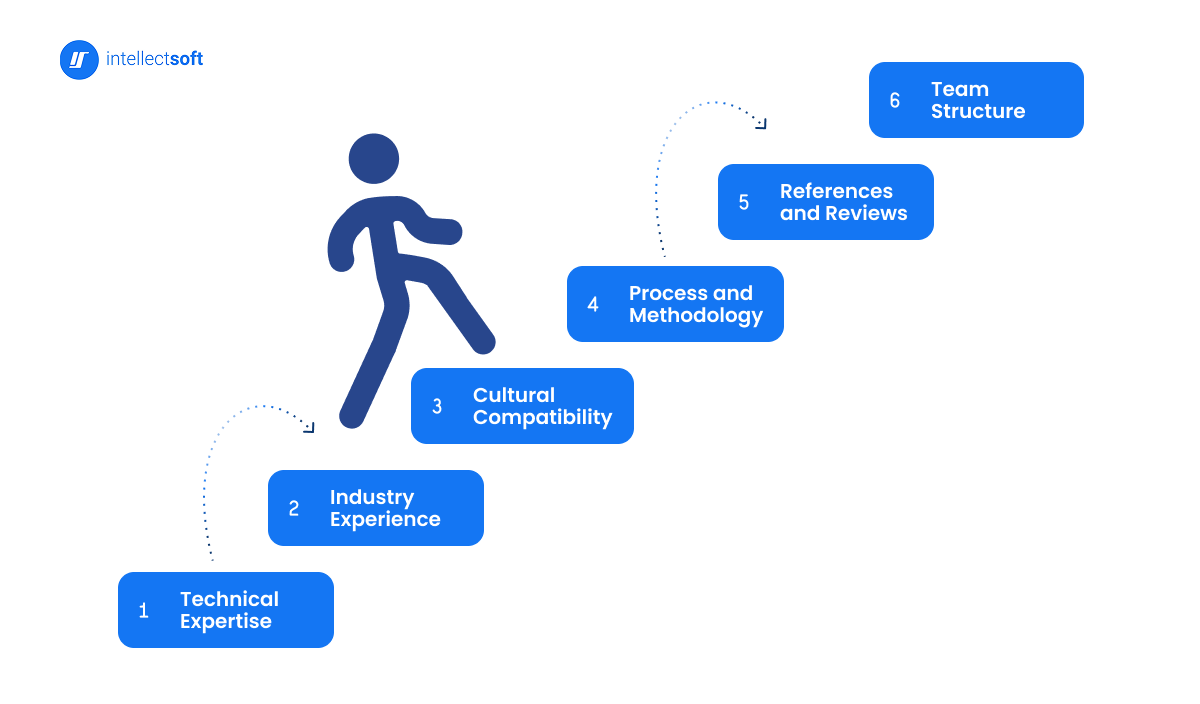
Here’s what to consider when evaluating potential partners:
- Technical Expertise
- Do they specialize in your tech stack (e.g., React, .NET, Node.js, AWS)?
- Can they show relevant experience with similar projects?
- Industry Experience
- Have they worked in your industry (e.g., fintech, healthcare, logistics)?
- Do they understand your compliance and user requirements?
- Cultural Compatibility
- Are their working hours, values, and communication styles compatible with yours?
- Process and Methodology
- Do they follow Agile, Scrum, or Kanban?
- Do they provide visibility into sprint progress and issue tracking?
- References and Reviews
- Can they provide case studies, client testimonials, or Clutch/G2 ratings?
- Team Structure
- Will you get direct access to developers, or will communication be filtered through managers?
By combining technical due diligence with cultural fit and communication habits, you can better understand how to outsource software development to a partner who will go beyond task delivery – and become a true collaborator.
Key Interview Questions for Software Vendors
After selecting your potential vendors you should use structured interviews to evaluate their capabilities. The questions move past basic answers to show how vendors perform when under stress and solve issues and deliver value.
Here are 10 questions to include:
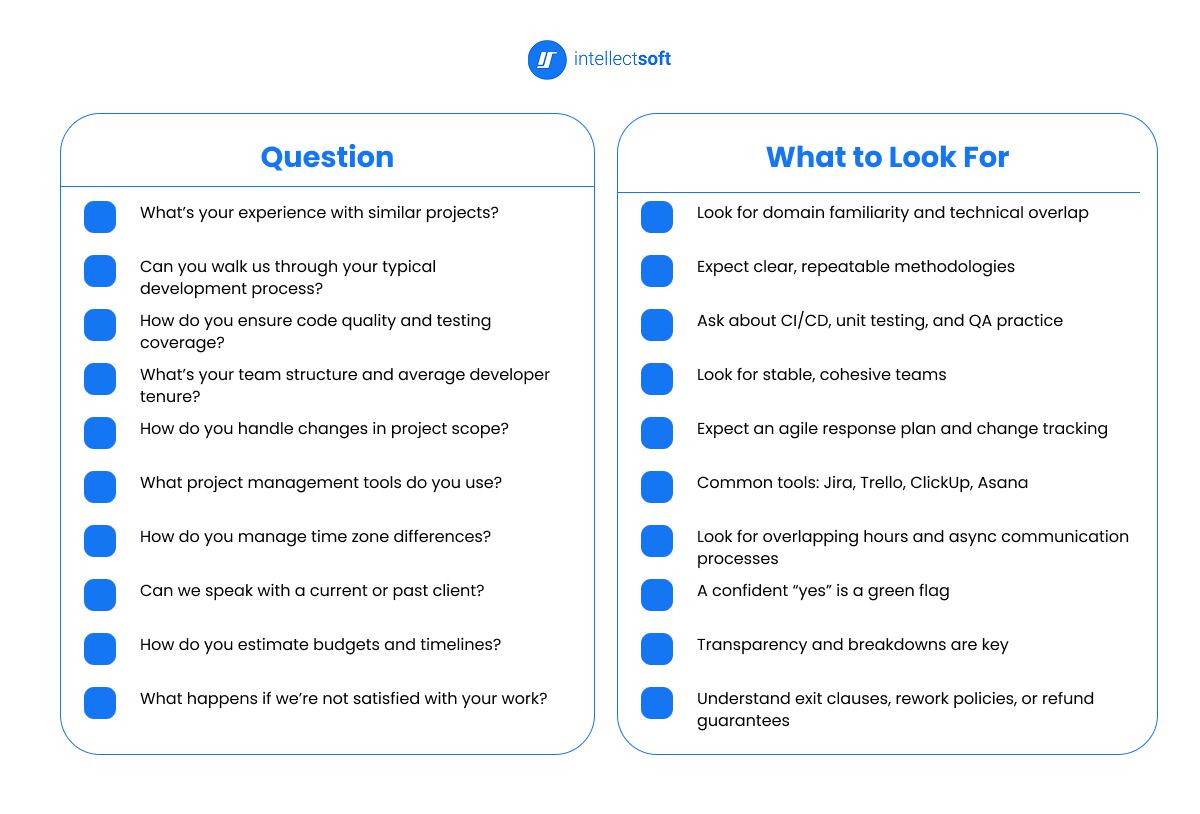
These questions uncover process maturity and transparency – two cornerstones of strong software development outsourcing relationships.
Contracts and Pricing Models for Software Development Outsourcing
After choosing your vendor you should proceed to establish a formal agreement. The contract structure should protect both parties while matching project complexity levels and supporting the delivery model.
Most common contract types
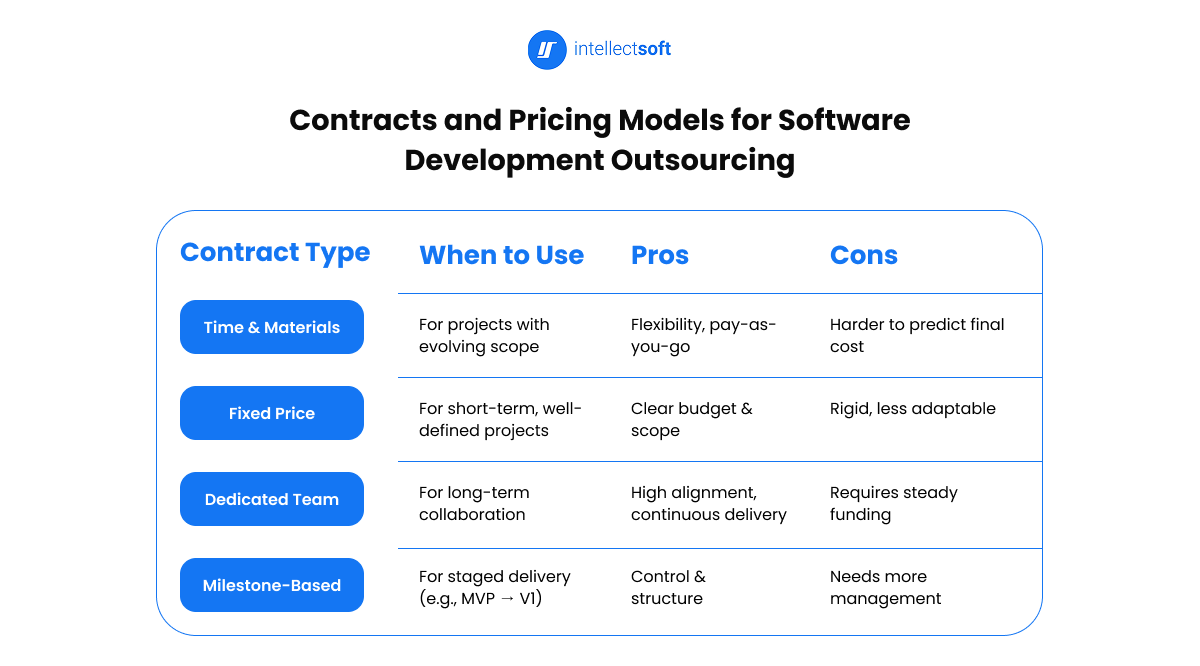
Legal Considerations
- NDA: Ensure protection of IP, data, and business strategy
- IP Rights: Clearly define code ownership
- Payment Terms: Link payments to milestones, not vague dates
- Dispute Resolution: Include jurisdiction and arbitration terms
- Termination Clauses: Define conditions for exiting the agreement
Pricing should also align with the engagement model. For example, outsourcing software development via a dedicated team often includes monthly rates per role, while project-based work may follow a flat fee or milestone billing.
Tip: Have contracts reviewed by legal counsel familiar with international software agreements – especially if you’re working with offshore or nearshore partners.
Why Outsource Software Development?
The initial reason to outsource software development involves obtaining speed and flexibility together with specialized skills yet the actual advantages extend past cost reduction. The fast-moving competitive environment requires businesses to deliver products quickly without sacrificing quality standards. Software development outsourcing functions as a strategic business advantage.
Through outsourcing you gain access to engineers and designers and QA professionals from all around the world who specialize in AI and cloud-native architecture and embedded systems. The pre-established Agile workflows and continuous delivery pipelines enable faster results than newly built internal teams thus accelerating time-to-market. The model enables you to adjust your resource capacity according to needs without making permanent hiring decisions.
Your internal team gains freedom to concentrate on vital matters such as product strategy growth and customer experience while your outsourcing partner executes the technical work. The model allows you to move between staff augmentation and full-cycle delivery based on changing business requirements.
The practice of outsourcing software development provides your business with an intelligent rapid development approach which outperforms internal teams at achieving speed-quality-efficiency balance. When executed properly outsourcing transforms your company’s approach to innovation and expansion.
Partner with Intellectsoft for Outsourced Software Development
The selection of an appropriate partner for outsourced software development stands equally important to the development of your product strategy. Intellectsoft provides strategic long-term collaboration through technical expertise which integrates perfectly with your internal team and business objectives.
Our company has operated for more than 17 years to assist startups and scale-ups and Fortune 500 companies throughout their entire digital product development process. Our software development outsourcing method follows a structured approach that scales through outcomes instead of deliverables from concept validation to post-launch optimization.
Here’s what partnering with Intellectsoft means for your business:
Engage Top-Tier Tech Talent
We give you access to engineers, designers, and QA experts with deep knowledge in modern tech stacks – including cloud-native development, AI/ML, mobile, and enterprise systems. Every team is built with your domain and goals in mind, whether you’re developing a complex backend system or a consumer-facing app.
You don’t just hire developers – you engage skilled professionals who take ownership, provide input, and deliver code that performs in the real world.
Results-Driven Design Thinking
Intellectsoft’s in-house design unit helps you create digital products that are not only functional but also intuitive and impactful. We apply design thinking to clarify user journeys, reduce time on task, and drive adoption across platforms. Every design decision is grounded in your business objectives – and validated through user feedback. We bridge the gap between design and development, ensuring your product experience translates seamlessly from concept to code.
Business-Minded Engineering
What sets Intellectsoft apart in the software development outsourcing space is our ability to think beyond technical specs. Our engineers and project leads operate with a business-first mindset – evaluating trade-offs, suggesting alternatives, and helping you balance speed, quality, and cost. We help you measure the business value of technology decisions when you scale your product or enter new markets.
With Intellectsoft, outsourced software development becomes a partnership – not a transaction. We plug into your workflow, adapt to your delivery model, and bring the structure, leadership, and technical depth needed to help your product thrive.
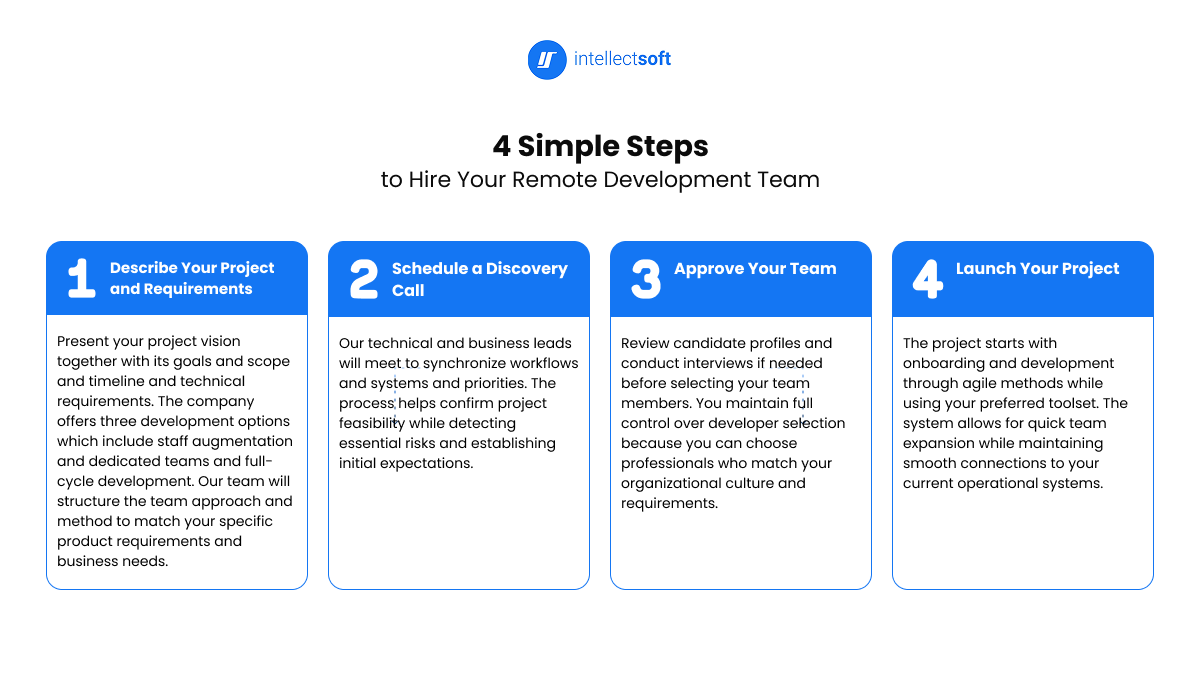
Hire Your Remote Development Team in 4 Simple Steps
Hiring a remote development team doesn’t have to be a long or complicated process. With the right structure in place, software development outsourcing can be quick, smooth, and fully aligned with your internal workflows.
At Intellectsoft, we’ve streamlined team onboarding into four simple steps – designed to help you build momentum fast while staying in full control of the process. Whether you need to scale quickly or bring in niche expertise, here’s how we help you get started:
Build Smarter, Scale Faster with the Right Outsourcing Partner
The correct outsourcing partner will help you develop smarter solutions while enabling faster scale.
Product development in today’s digital world needs more than quality code because it requires proper structure and the right personnel along with fast adaptation capabilities. Software development outsourcing stands out as the best solution. Through outsourcing software development companies gain speed in innovation while decreasing operational costs and accessing worldwide talent without making permanent hiring decisions.
All partnerships differ in their level of quality. To achieve maximum value from outsourcing software development you need a vendor who shares your objectives and knows your industry sector and produces results instead of just delivering work. The correct approach to outsourcing transforms it into your company’s most powerful growth driver by providing strategic planning and technical leadership and agile delivery and long-term support.
The framework in this guide provides a practical proven path for both first-time MVP launches and global platform expansions.
Frequently Asked Questions
What steps should I take to safeguard my intellectual property assets when using outside developers?
The protection of intellectual property stands as the most prevalent concern for organizations which outsource software development work.
Protect your assets by following these measures:
- A comprehensive Non-Disclosure Agreement should be signed as the first step to protect sensitive information before disclosure.
- Your contract must include precise definitions of intellectual property rights to confirm all code and design elements and project deliverables belong to your organization.
- Secure communication tools must be employed for file sharing and code repositories through platforms like GitHub that implement access control measures.
- Select vendors who demonstrate strong data security protocols and maintain a clean legal record to work with.
- Limit the number of employees who access crucial system areas to only those who need it for delivery purposes.
Your innovation protection together with risk elimination can be achieved through experienced partner selection and legal counsel support.
How to Effectively Manage Offshore Development Teams?
Teams working remotely across time zones and cultures need a strategic implementation to succeed. The correct implementation of offshore teams enables them to perform at the same level or better than traditional in-house developers.
Follow these steps to achieve successful management of your remote team:
- Set up specific protocols to ensure all parties can communicate effectively. Utilize Slack together with Zoom or MS Teams for team communication while establishing preferred times for stand-ups and check-ins and weekly review sessions.
- Document everything. The process of documenting both project objectives and technical choices creates consistent results between different locations and handoffs.
- Use Agile frameworks. The process includes sprint meetings at least daily or twice weekly together with retrospectives and demos which maintain tight feedback loops while keeping timelines on schedule.
- Choose either a dedicated local tech lead or an embedded tech lead to serve as the connection between your internal stakeholders and the offshore team for faster alignment.
- Focus on outcomes, not hours. The correct way to measure offshore productivity is through deliverables combined with velocity instead of monitoring time spent at work.
Proper management of offshore teams leads to equivalent productivity levels and innovative capabilities as internal teams while offering superior flexibility and quick response times.
What Does Agile Outsourcing Involve?
The practice of Agile methodologies such as Scrum and Kanban exists to enable distributed outsourced teams through Agile outsourcing. The methodology emphasizes iterative development while providing transparency alongside continuous feedback and shared ownership between stakeholders. This method decreases risk and enables rapid adjustments while preserving product quality throughout the development process.
Can I Outsource a CTO Role?
Startups together with expanding businesses often select CTO-level outsourcing for their initial stages and periods of transformation. A fractional or outsourced CTO provides expertise to organizations through services that include product architecture definition and development stack selection and engineering talent recruitment and management and development roadmap construction.
When you need software development outsourcing but do not have internal technical leadership you can hire a CTO expert at a fraction of the cost of full-time employment to receive strategic guidance. The position should be filled by someone who possesses both technical expertise and business understanding.



Subscribe to updates

Source link