








Be candid — hiring a great app developer has never been easy. With demand surging, skilled and capable specialists are highly sought after. Bringing them on board comes at a premium. If you’re a founder or tech leader, you’ve probably asked yourself: “Where do I even begin?” In-house? Freelance? Outsource? It’s one of those decisions that can determine the trajectory of building a successful digital product.
The app development industry just hit $585.7 billion in global value and is projected to grow to $756 billion by 2027. Top companies are in a game, increasing their digital investments. Budgets are exploding into the hundreds of billions each year on technology like app development, AI, Data, and automation.
These massive figures point to an ever-growing hunger for tech talent. Especially in niche areas. Take technologies like AI. No longer just ballyhoo, AI now appears in nearly every product roadmap. All signs point to one thing: it’s only going to keep evolving. And to train and build this technology, you need the right tech specialist or a team of developers.
Which brings us to the big question: where to find an app developer? How do you make the right choice — in-house, freelance, or outsourcing? How do you spot those rare specialists in a crowded market and find someone who’s also a great cultural fit for your company?
This article breaks down all the nuances and points out how to find an app developer. Keep reading.
How to Hire Capable App Developers in 7 Steps
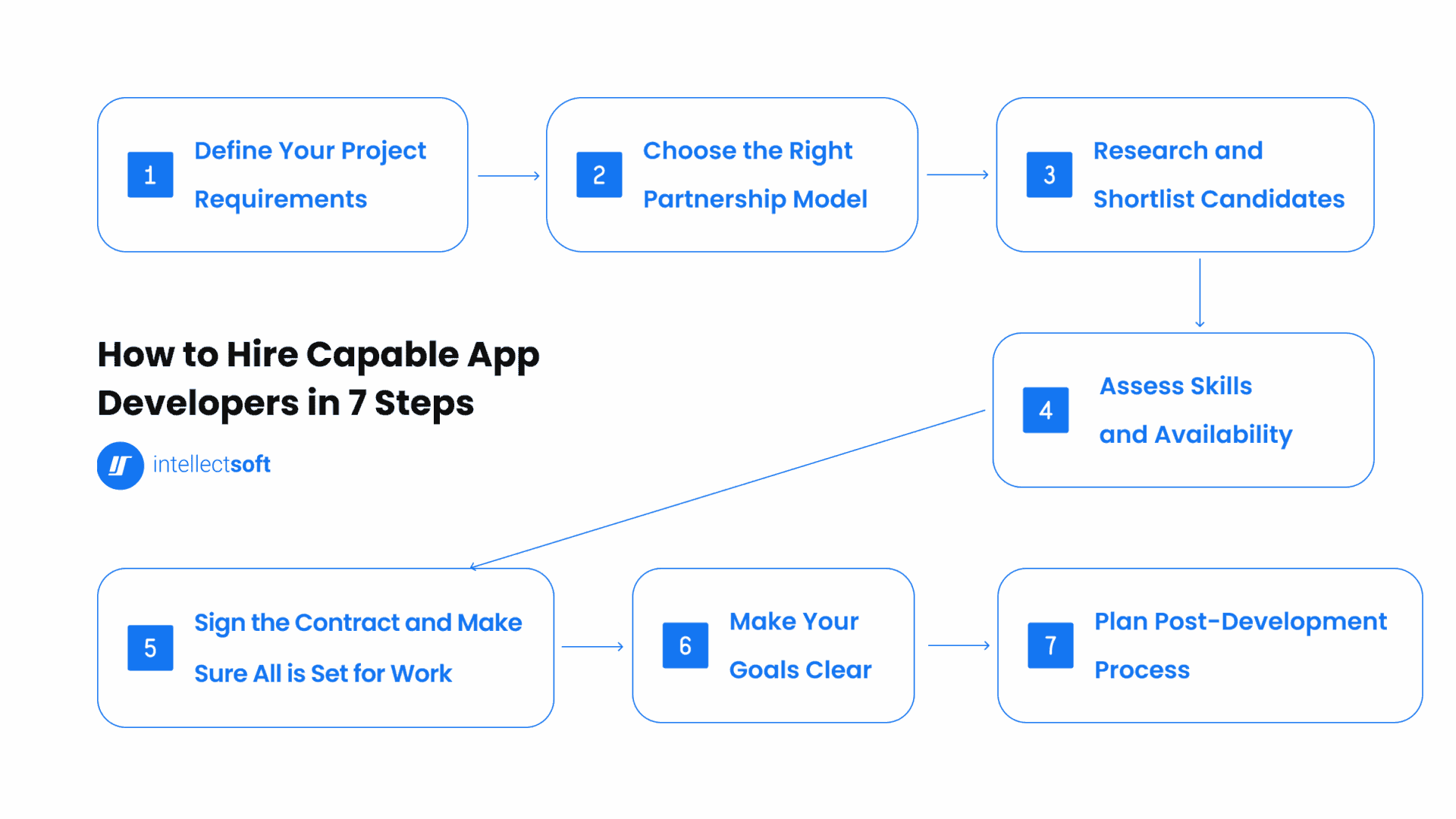
Step 1. Define Your Project Requirements
Until it’s written, it’s not real.
First things first — start by outlining a brief for your project. It’s useful to puzzle out your main goals, what the app should do, and how complex you expect it to be. This doesn’t need to be perfect — just enough to guide the conversation. A short document or a few slides can be very helpful. You might want to include:
- The problem you’re solving
- Your target audience
- Preferred tech stack
- Desired seniority of developers
- Apps you admire or want to take inspiration from
- A shortlist of features for your first version (MVP)
Trust us, this document will serve you well and make your life and your partner’s much easier. It will greatly help guide communication with developers later on, giving you a sense of how specialised or technical your app might be.
What else to look at? Check the platform at this point. The options include iOS, Android, or both. If you happen to want to reach both platforms, we recommend working with a developer who is experienced in React Native. It’s a framework that enables you to build cross-platform applications. Because it’s written from a single codebase, it significantly reduces development time and costs.
“Clearly written requirements are an absolute must. If it’s vague from the very beginning who exactly you’re looking for, you can end up running in circles and, in the end, getting nowhere. This can leave you without a product and wasting time. But when all the parts are defined, including the tech stack, tasks, seniority level, and budget, your life becomes much easier. Both candidates understand what they’re signing up for, and the recruiter doesn’t waste time. A straightforward profile means a faster search, fewer misunderstandings, and a higher chance of finding ‘the one.”
– Tymur Chystiak, HR Analyst at Intellectsoft
Getting this first step — the most important one — right defines the future of all development stages. Clear requirements save you time, money, and effort down the line.
Step 2. Choose the Right Partnership Model
Once you’ve shed light on your idea, it becomes more straightforward how to approach development. So, how do you choose the right partnership model? It largely depends on many factors. There are three widespread approaches: hiring in-house, working with freelancers, or partnering with an outsourced team. Of course, each comes with its advantages and drawbacks.
Option 1: In-House Developers
Bringing someone on board full-time offers continuity and close collaboration. The good: you can share your company culture with new team members, and since you’re sitting in the same room, it’s easier to oversee both the process and the results.
The bad — it can take time (sometimes an average of 50 hours) to find a developer for an app. There’s always a chance a candidate might decline an offer, or even if you onboard the perfect candidate, they may leave sooner than you ever imagined. In many cases, hiring is built on mutual trust, or so-called good faith, with no absolute guarantees.
Option 2: Freelancers
Many turn to freelancers for a reason — it’s very flexible. And many find that, in terms of development, it’s ideal for shorter projects or specific tasks. Depending on your preferences, you have room for choices. You can agree on hourly, project-based, or bi-weekly payments, which is not the case when working with companies (they have different commitments). Developers with strong portfolios and senior-level experience can be found on platforms like Upwork, LinkedIn, and Fiverr.
If you’re not quite sure about the tech stack, there is a way. It might be helpful to connect with someone who has already held roles like CTO or tech advisor. This professional brings to the table both technical expertise and a broader business perspective.
Well-built processes, clear communication, and mutual understanding are especially important when working remotely. This applies to all the approaches we described above.
Option 3: How to Find Developers As An Outsourced Team?
Before delving in, it’s helpful to figure out the meaning behind the term. Outsourcing means hiring a third-party company (we call it a tech partner) to handle a variety of tasks that fall outside your in-house team’s capacity or expertise.
If you’ve been thinking about how to find a developer to build an app without overstretching your internal team or hiring full-time staff, outsourcing is often the answer.
It has become a widespread and smart practice, with many global companies, including Microsoft, Siemens, and Samsung, outsourcing parts of their development to countries like Ukraine, known for its strong engineering talent.
Outsourcing continues to grow for good reason. It offers measurable benefits such as cost savings, flexibility, and access to deep expertise, including knowledge of very niche technologies, to businesses of all sizes.
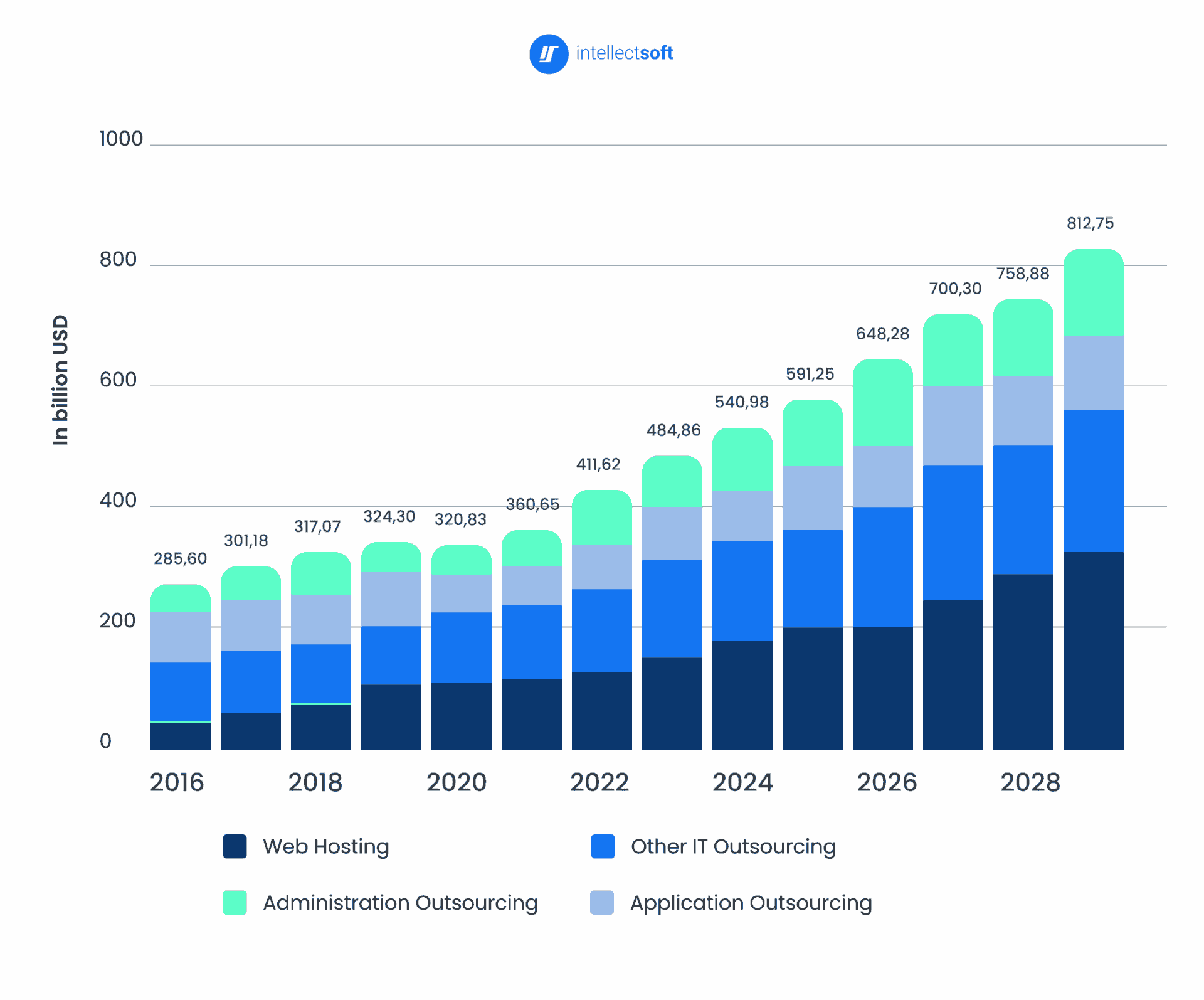
Resource: Statista
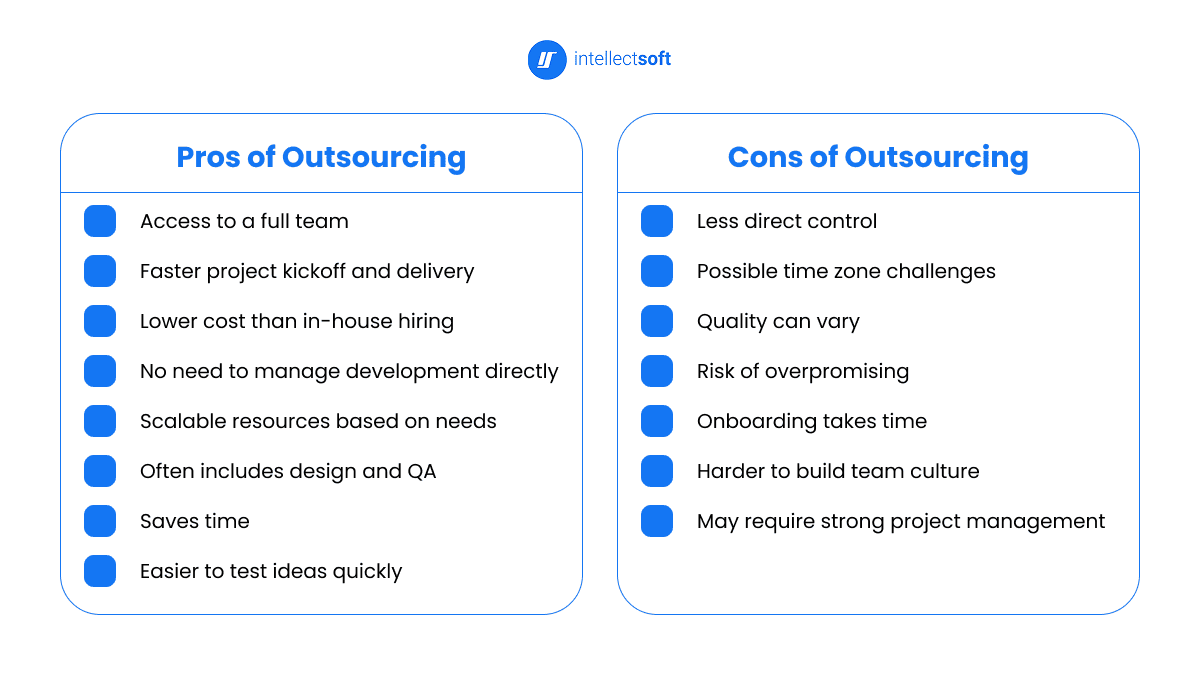
Pros of Outsourcing
Here are a few advantages of the outsourcing model for your attention:
- Saves money and time
- Easy to adjust team size as your needs change
- No need to manage the team yourself; your provider (partner) takes care of it
- Gets your product ready sooner
- Work is done by people with years or even decades of experience
- Provides honest input; a good provider will flag issues and help you set the right priorities
- You avoid the long and slow hiring process, which can take up to 50 hours
- You are supported by people who have worked in your industry and have solved similar problems.
To summarize everything above, outsourcing lets you focus on your business while your development partner handles the technical part. It can include agreed projects, training, hiring, and onboarding. Often, they deliver results faster and more efficiently than hiring in-house.
What our PM, Yuliia Bilyk, says about outsourcing:
“Outsourcing helps clients greatly save time, which is one of their most valuable resources. A major challenge in hiring is that technical interviewers often spend over 50 hours building a team. That’s time they could have used for actual project work, leading to delays and higher costs. We take over this process for our clients and take the pressure off their shoulders.”
Now, let’s flag one of the most searched and talked-about technologies today — AI. According to industry data, AI and ML specialists are among the hardest to recruit, with 22 percent of companies struggling to hire them. So, how can an outsourcing partner help you get an AI specialist? And what if you need a senior expert who can lead a team? Yuliia shares an example:
“What makes us different is that we grow our talent. As an example, we are currently helping a Python developer transition into an MLOps specialist as part of their personal growth plan. Here is another real example: a client needed to prepare someone for a Team Lead role. We provided that training to strengthen their soft skills. Our goal is to make sure that our specialists continuously learn and improve, which keeps them sharp and motivated. This takes another burden off the client.”
Cons of Outsourcing
Of course, there is no ideal model. Some companies, while partnering with an outsourcing company, worry about time zone differences or cultural gaps. These can greatly affect communication and alignment if not managed well. But with today’s collaboration tools and global work culture, these concerns are often more minor than they seem, especially when working with experienced partners who know how to bridge those gaps.
Step 3. Research and Shortlist Candidates
After you choose a model (in-house, freelance, or outsourced), the next step is to find a partner company (or people — if you choose freelance or in-house) who fit your needs.
If you’re hiring in-house or working with freelancers, look at platforms like LinkedIn, GitHub, Stack Overflow, or Upwork. They are great places to start. Review their portfolios and client feedback, and note their contributions to open-source projects — these are also worth looking at.
For an outsourcing company, it’s worth focusing on the provider’s track record:
- Have they built apps similar to yours?
- Do they have experience working with companies of your size and/or in your industry?
- Can they provide relevant case studies?
Make a shortlist of candidates or companies. You don’t need dozens of options; it will only complicate the process. Just a few that clearly align with your goals.
Yuliia adds:
“When choosing an outsourcing partner, experience with similar projects and long-term client relationships is key. One of our clients (under NDA) had worked with multiple vendors before deciding to stay with us. It’s been six years since we started working together. This speaks to our reliability as a partner. This is what we recommend you look at. Also, it’s always a good idea to check reviews from other clients and see if they would recommend the vendor.”
Another important aspect to consider. Make sure you have a clear understanding of what you’re looking for internally before engaging with partners. As Tymur points out:
“Many times, challenges come from internal misalignment. For example, the team may be looking for a specific — very demanding or hard-to-find skill set (or a broad mix of skills) — while the budget or timeline doesn’t reflect that. Or the role itself may change in the middle of the project: one week it’s backend, the next it leans toward DevOps. That’s why it’s so important to start with a shared understanding of what you’re looking to develop and who you need to make the product happen. Clarify your expectations, define roles, align on budget, and set an interview process. When everyone is on the same page from the beginning, the collaboration flows much more straightforwardly.”
Step 4. Assess Skills and Availability
Now it’s time to dig a little deeper and return to the question of how to find an app developer. A good developer or team should be technically strong — there’s no question about that. But that’s only the baseline. They should also be good at communication, have the ability to adapt to changes, see the big picture, and understand your goals and business.
Here’s what we recommend looking for:
- Technical skills: Do they know the tech stack you’ve chosen? Or have they suggested a better alternative to what you had in mind — and explained why that option is better?
- Communication: Do they ask thoughtful questions? Listen carefully to understand your needs? Can they explain their thinking and point of view in plain language?
- Availability: Are they available when you need them to be? Will they dedicate enough time to your project, if they’re freelancers?
- Team setup: If you’re working with an outsourced team, who exactly will be on the project, and what are their roles?
Note: A standard setup is typically involves business analysts, developers, QA specialists, and DevOps engineers.
Consider running a short technical task. Don’t hesitate to request a code sample, especially for long-term or complex projects. This will help align both in-house and outsourced teams, giving everyone a better understanding of the process and the code review approach.
Tymur added that when finding an app developer, technical skills are definitely the foundation. But what’s just as important as technical ability is communication. Without it, you might never get what you want. It’s crucial to assess how a person expresses themselves, explains ideas, and defends their point of view.
Another important factor is independence. Are they capable of taking ownership? Next is motivation: they should understand why the project is highly important and that neglecting deadlines is harmful to their results.
Create high-end software solutions for your company with Intellectsoft
Get in touch
Experience with similar projects is also a major advantage. Even if the tech stack isn’t identical, familiarity with the domain, approach, or complexity, or simply having an exceptional problem-solving mindset can be invaluable.
“Often, you’ll come across someone with an excellent technical profile, but communication is zero. Or the opposite: a strong communicator who doesn’t quite fit into the team culture. That’s what companies sometimes overlook — a mix of soft skills, cultural fit, and flexibility. And then customers might be surprised when someone technically solid fails to thrive.” – shared Tymur Chystiak.
Step 5. Sign the Contract and Make Sure All is Set for Work
Before any work begins, it’s highly important to clarify your expectations and agree on terms. This forms the basis of communication that protects both sides and sets a healthy foundation, making sure there are no misunderstandings later in the project.
Key points to include:
- Project scope
- Deliverables
- Timelines (you may want to include them along with milestones)
- Payment terms
- Ownership of the code and IP
- Communication process and frequency
For outsourced teams: make sure they understand the tools you are using, have access to them, and have any accounts they’ll need to begin.
Step 6. Make Your Goals Clear
Even the best professionals can’t read minds — unfortunately. So, it’s important to explain your goals and priorities as clearly as you can. This will lay the foundation for a smoother process — and a better outcome.
Try to share your vision for the app: what you want it to achieve for your users or business. Be open about nuances that are important to you — maybe that’s speed, budget, flexibility, usability, or something entirely different.
We recommend answering the team’s questions at the beginning. That’s why many companies offer discovery workshops — they are incredibly helpful. A few sessions with your partner help clarify all the details, which can save a lot of time and back-and-forth later on.
Step 7. Plan Post-Development Process
We all know that app development doesn’t end at launch. So, it’s worth thinking ahead about the following nuances:
- Who’s going to own maintenance once the app is live?
- Will you need hands-on help with fixes, updates, or user feedback?
- Are you planning to expand the features in the product or connect to another platform later?
It’s worth asking your partner if they offer post-launch support. You can find that some developers provide this service while others don’t. It’s incredibly important to understand what’s included in your contract. Whether you’ll need to bring someone in to manage ongoing updates. We recommend taking your time to read it before signing and starting the work.
Alternative Platforms to Hire App Developers: Top 5 Places
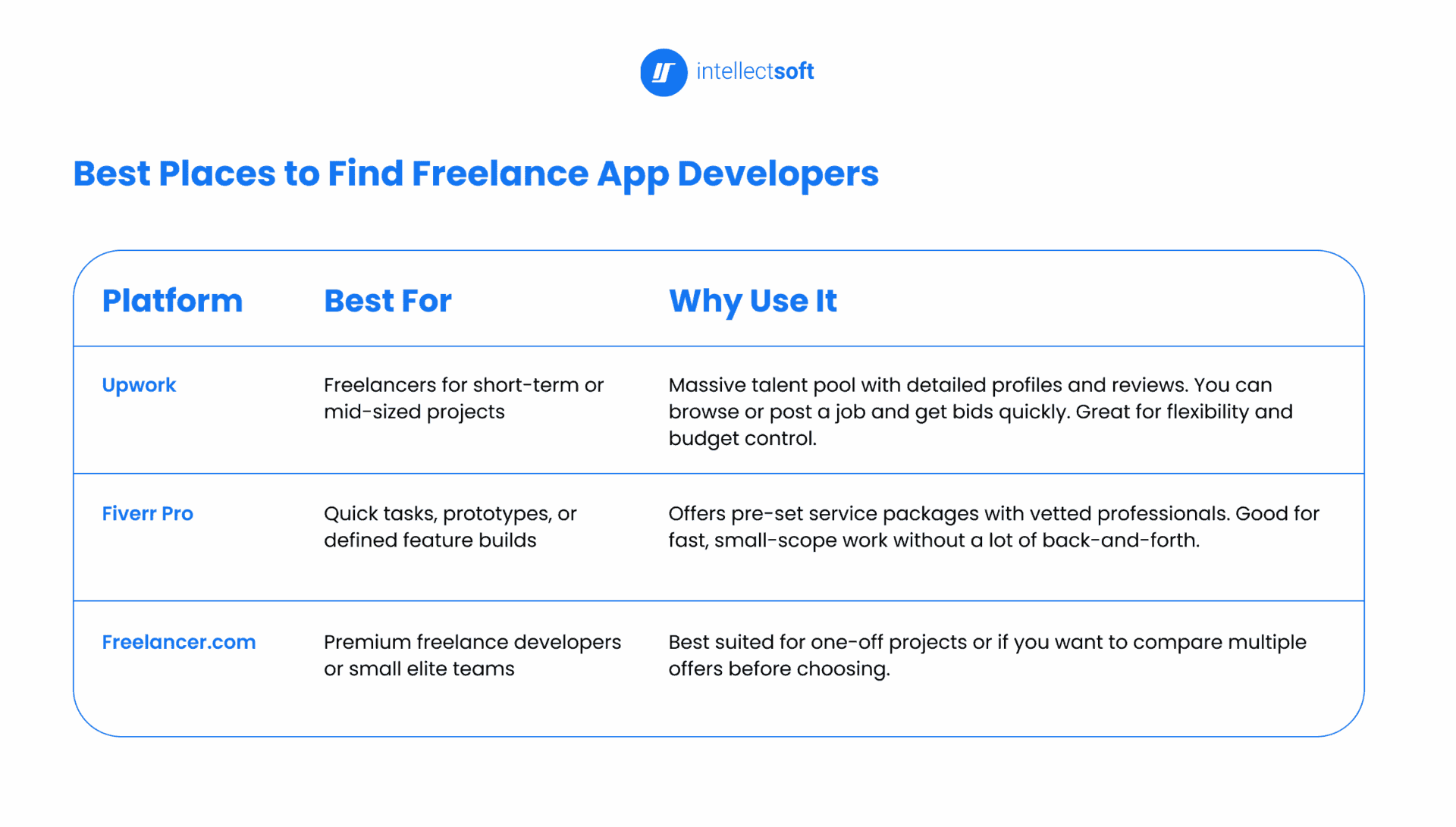
Best Places to Find Freelance App Developers
If you’re not ready to commit to a partner or full-time hire, there are flexible, budget-friendly platforms that connect you with freelance app developers. Many founders have successfully built their first version (MVP) using these options. Here are some of the most popular and tested platforms for anyone wondering how to find a developer to build an app:
Upwork
No question here — Upwork is one of the largest freelance marketplaces. Thousands of developers across iOS, Android, and cross-platform frameworks like React Native and Flutter – are all gathered under one umbrella. All you need to do is: post a detailed job description, then browse portfolios and interview candidates before hiring.
What’s convenient is that Upwork also provides time tracking, contracts, and dispute resolution tools.
Tip from a community expert: Prepare wireframes and a basic design before hiring to avoid scope creep and save money. Adobe XD and Figma are great (and free) tools to get started.
Fiverr
Fiverr is ideal for smaller tasks or fixed-price packages, like setting up a login screen, building a prototype, or connecting an API. Many senior developers offer app development services with transparent pricing and fast turnaround times.
Tip from the community expert: For startups with limited budgets, Fiverr can be a quick way to test an idea or get a rough prototype live before investing in full development.
Freelancer.com
Wondering how to find a developer to build an app on Freelancer.com? The platform has a similar model to the ones mentioned above, using a bidding approach. It allows you to post jobs and receive bids from interested developers around the world. According to those who use this platform, it’s best suited for one-off projects or if you want to compare multiple offers before choosing. The platform supports milestone-based payments and gives you access to a wide global talent pool.
Best Places to Hire Professional App Development Companies
If you keep reading, you might be interested to know how tech partners or app development companies work and how they differ from other models. There are a few trusted platforms that can help you find and compare professional teams. They allow you to check in verified client reviews, technical expertise, and proven project outcomes or case studies. They give you a chance to analyse your options, making them a reliable starting point for anyone figuring out how to find someone to develop an app.
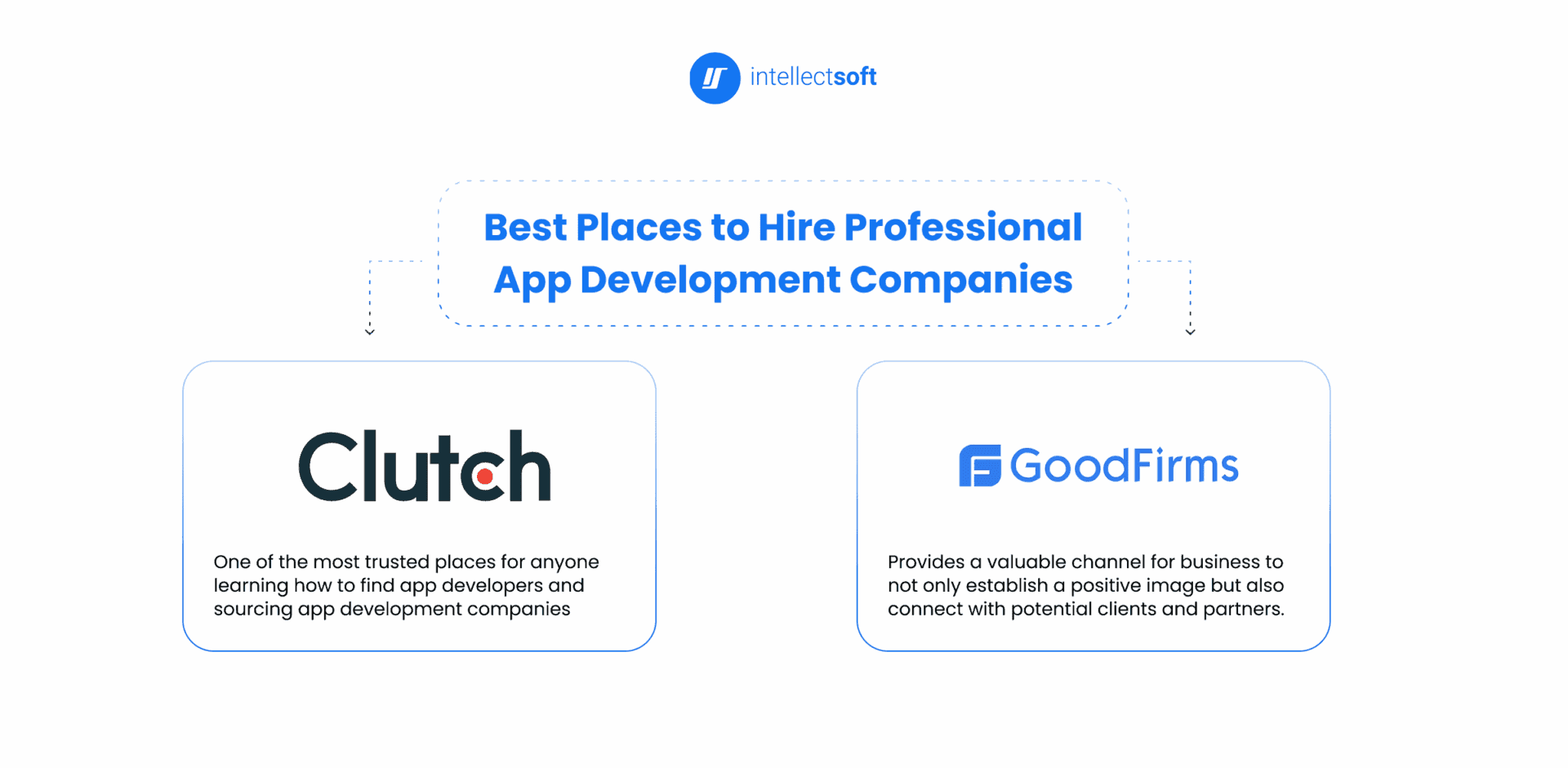
Clutch.co
The biggest platform that comes to mind is Clutch. One of the most trusted places for anyone learning how to find app developers and sourcing app development companies: you can browse companies by service, industry, location, budget, and tech stack. Each company profile includes detailed reviews from verified clients, and you can also explore their case studies, team size, hourly rates, and project focus.
Many founders recommend using Clutch to build a shortlist of agencies. Once you’ve narrowed it down, schedule interviews to find the right fit based on communication style, technical expertise, and business alignment.
Resource: Clutch
GoodFirms
GoodFirms offers a similar approach to Clutch but often highlights companies with strong portfolios and emerging technology skills. It’s helpful in comparing firms that specialise in mobile apps, AI, fintech solutions, and more. Search filters include pricing models, industries served, and company size.
Startups often use both GoodFirms and Clutch together to compare reviews and spot consistent patterns, good or bad, before reaching out.
Resource: Y Startup School (from Y Combinator)
Let’s Talk Budget: What You’re Really Paying for in App Development
Building an app isn’t cheap, and that’s not because developers are trying to drain your wallet. It’s because good development takes time, and time costs money.
In the U.S., app developers typically start at around $100/hour (source: Salary.com). That adds up fast. Even a basic app can turn into a serious investment if you’re not clear on scope.
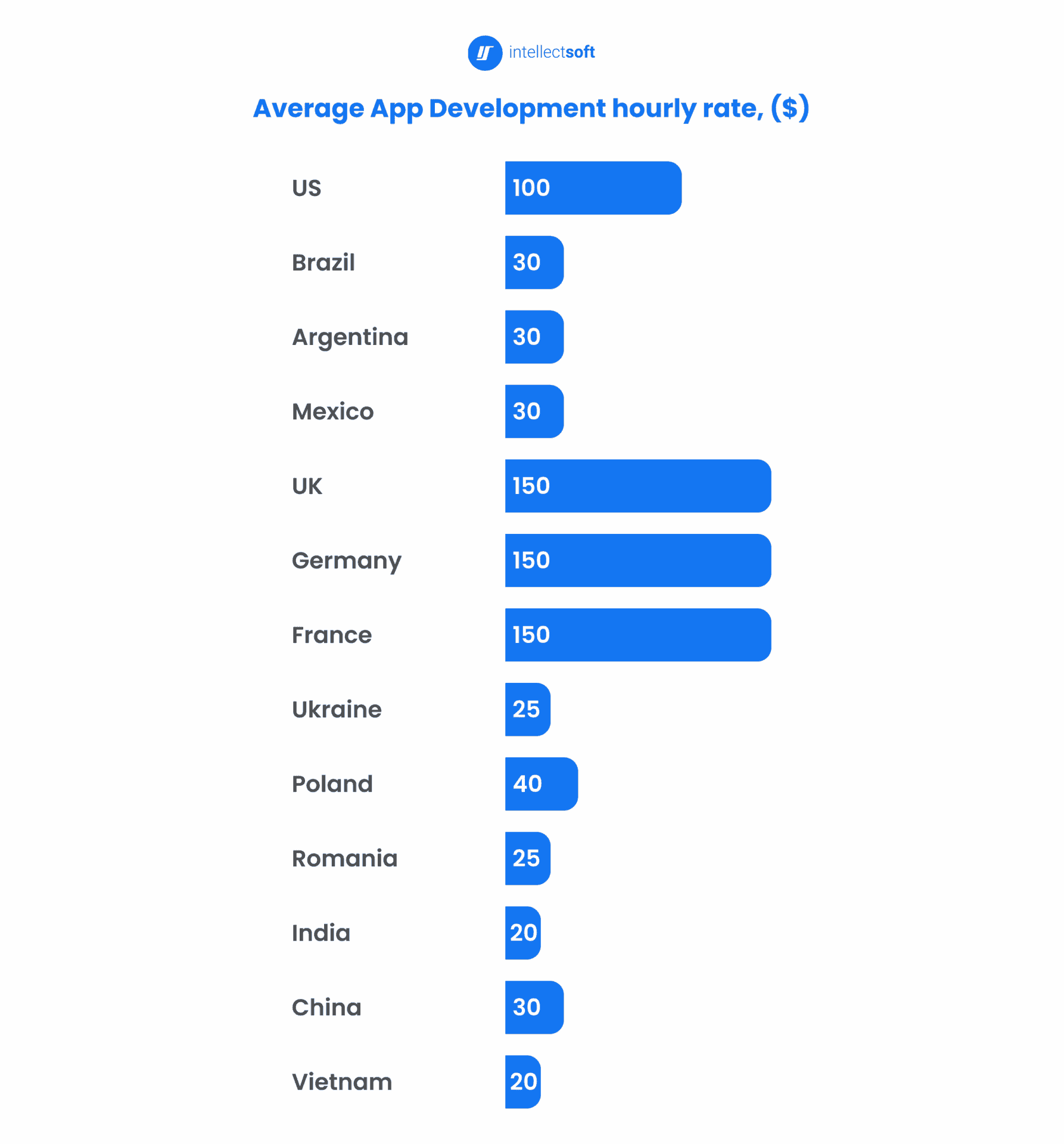
If you’re figuring out how to find an app developer without breaking the bank, outsourcing can help. Plenty of companies turn to regions like Eastern Europe or Latin America, because you’ll find seriously skilled engineers there who’ve built products for global brands. You’re still getting quality, you’re just paying for hours at a more sustainable rate.
Another factor — complexity.
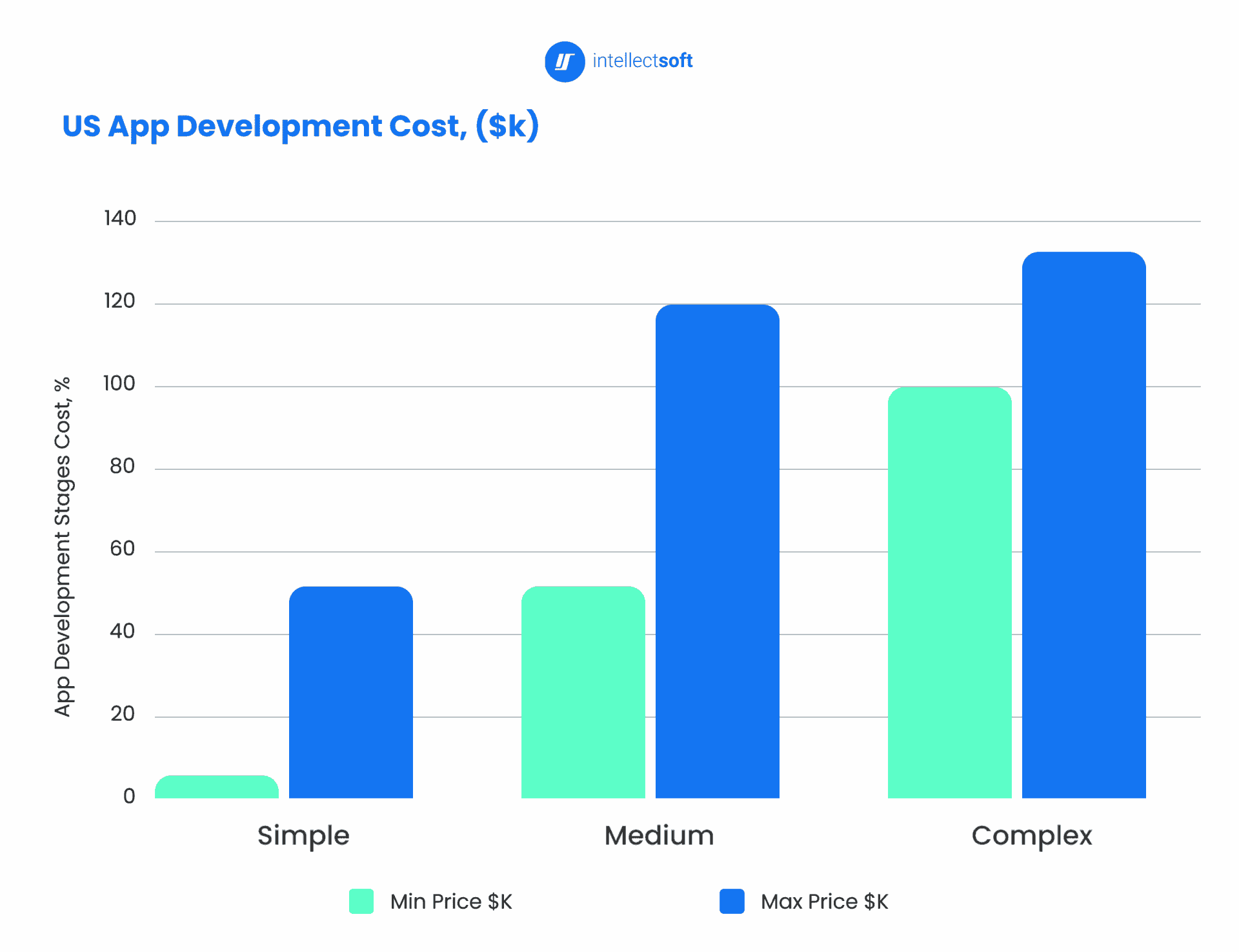
The obvious but important fact: the more complex your app, the more time (and budget) it’ll require. Here’s a quick breakdown:
- Simple apps — Think calculators, habit trackers, basic booking forms. Light features, limited screens. Usually 2–3 months of work.
- Mid-level apps — E-commerce, learning platforms, event apps. More screens, real-time data, and user accounts. You’re looking at 4–6 months.
- Complex apps — Custom healthcare systems, fintech platforms, apps with AI, or massive third-party integrations. This is a 6–12 month build, minimum. And, these need serious backend infrastructure, security, and performance planning.
Where the Money Goes in App Development
A lot of people think they’re paying for “pure development.” But in reality, you’re paying for a whole process. This breakdown shows where your budget actually goes across a typical app project:
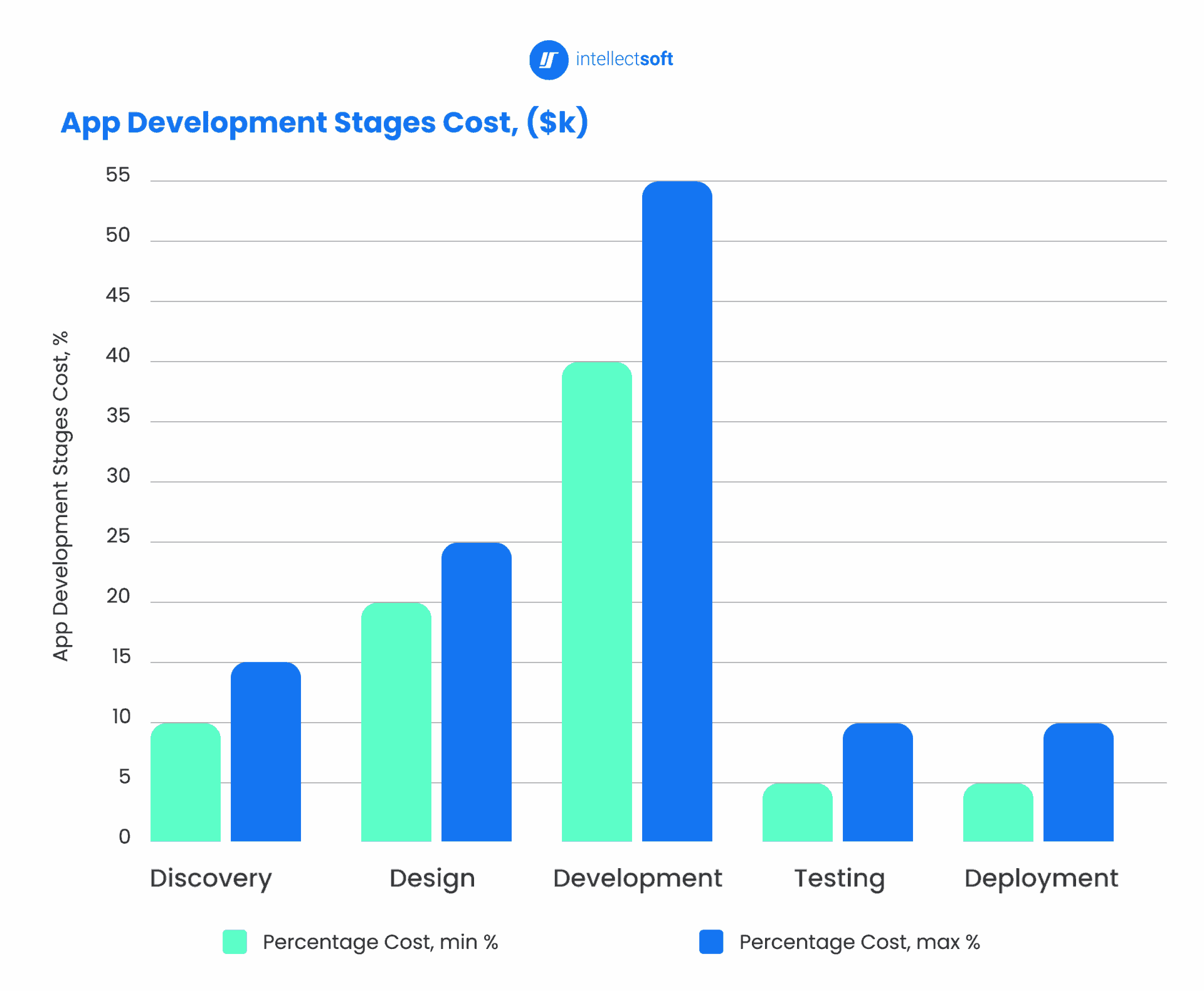
Discovery Phase (10–15%) – Understanding the problem, aligning on features, and mapping what needs to be built.
Design (20–25%) – Meaning UX and UI that shape how people will use your app.
Development (40–55%) – Building the features, integrations, and backend logic.
Testing (5–10%) – Making sure it works across devices. With actual users.
Deployment (5–10%) – Launching, configuring environments, and shipping it live.
Most development partners include all of this in the price tag. If someone’s quoting 3x less, you’ve got to ask: What are they skipping?
One more thing. It’s worth flagging: not all developers stick around after launch. If you’ll need help with updates, scaling, or maintenance, ask about that upfront. You don’t want to scramble to find someone in month three because something broke, and your original development team is long gone.
We broke down every stage and the typical cost range in this post: How Much Does It Cost to Make an App
Why Intellectsoft Might Be the Right Fit for Your App Project
How to find an app developer working with Intellectsoft? There’s no shortage of places to hire developers. But finding a team that’s experienced, reliable, and genuinely invested in your success narrows the field.
At Intellectsoft, we’ve been helping companies build and launch digital products for over 17 years. In that time, we’ve delivered more than 600 products, from early-stage apps to complex enterprise systems. We’ve also had the chance to work with clients across industries, including some Fortune 500 names.
What we’re most proud of, though, is the long-term relationships we’ve built. Many of our clients stay with us for 5–6 years, trusting us to keep evolving their products and supporting their growth.
We put a lot of care into who we hire and how we train them. Every specialist on our team is supported to grow, stay sharp, and motivated, and bring real value to the projects they join. Our focus is always on quality, collaboration, and outcomes that help your business flourish and move in the direction you envision.
In Closing
Hiring the right app developer can make or break your product. And with the app market pushing past $585 billion, there are plenty of hungry companies searching for great talent.
We’ve put together this guide to help you explore how to find an app developer who’s not just technically strong. Also, who is aligned with your goals, budget, and timeline. From in-house hires to freelancers and outsourced teams, we’ve broken it all down into seven clear steps.
We walked through how to define your scope, choose the right model, vet candidates, and avoid common missteps. We also unpacked what drives cost, how complexity shapes your build, and why outsourcing, when done right, can save time, money, and headaches, especially with trusted teams in Eastern Europe or Latin America.
Whether you choose to hire locally, go freelance, or outsource, we hope the steps in this guide have helped you uncover insights to find an app developer who delivers on quality, communication, and long-term results.
FAQs
What is the best method to contact an app developer?
It depends on who you’re hiring. For freelancers, platforms like Upwork, Fiverr, or LinkedIn are great starting points for where to find app developers. You can browse portfolios and reach out directly. For in-house hires, use job boards and recruiter networks. And if you’re looking to outsource to a team, vetted directories like Clutch or GoodFirms let you compare companies, read reviews, and schedule intro calls.
Should I opt for hiring app developers “near me” instead of looking worldwide?
Not necessarily. While local teams may offer timezone alignment or in-person collaboration, hiring globally opens the door to broader talent and often better rates. Many companies work successfully with teams in Eastern Europe or Latin America, where developers are highly skilled and experienced with global projects.
Is the concept of ‘cheap app developers’ a myth?
More or less, you get what you pay for. Cheap upfront rates often mean something’s missing, whether it’s quality, communication, or long-term support. It might seem like a deal, but it can end up costing more in rework. Instead of “cheap,” focus on value for money: teams that communicate well, deliver quality work, and genuinely understand your business and goals.
What defines professional app development?
It’s more than just writing code. Professional app development includes clear communication, ownership of tasks, technical skill, and a process that covers discovery, design, development, testing, and post-launch support. A strong dev team also asks good questions, flags potential risks, and adapts as your product evolves.
Should I additionally hire a mobile app designer?
Yes, if you want an app that feels right to customers. Developers build what it does. Designers shape how it works and feels. For most apps, especially B2C or anything customer-facing, a mobile UI/UX designer is a must. Some development teams have in-house designers, others don’t. Just make sure design isn’t an afterthought.
Is hiring a cross-platform app developer more expensive?
Not typically. In fact, cross-platform development can reduce costs, especially for apps targeting both iOS and Android. Frameworks like React Native or Flutter allow for one codebase across platforms, which cuts development time. Make sure your cross-platform developer understands platform-specific limitations and trade-offs.
Are ‘app coders’ and ‘app developers’ the same thing?
Not exactly. A coder might be someone who just follows instructions and writes code. A developer thinks through the architecture to solve the problems. If you’re building anything beyond a basic prototype, you want a developer, someone who understands the bigger picture.

Source link