




header detail 1
header detail 2
RBTechFS
  • Home
  • Who are we
  • What do we do
  • Blog
  • Contact Us
menu
close

Need Help? Talk to an Expert

+1 (758) 729-4361
RBTechFS
  • Home
  • Who are we
  • What do we do
  • Blog
  • Contact Us

Need Help? Talk to an Expert

+1 (758) 729-4361

Gamification in Banking: Building Loyalty & Engagement

Home Gamification in Banking: Building Loyalty & Engagement
  • Written by rbtechfs
  • March 12, 2026
  • 0 Com
Trends

In the past, banking was uncomplicated and straightforward. You used to deposit your salary, pay your bills, and check your account balance maybe once a week. But today, modern banking consumers do not only expect transactional efficiency. They want experiences that are seamless, rewarding, and fun. 

This is where banking gamification comes in.  

Integrating elements of gamification in the banking sector has transformed boring banking activities into more interesting and engaging experiences. Your clients earn points for saving, receive badges for reaching budgeting milestones, and progress bars track their achievements toward a specific financial goal. These features are not gimmicky. They are unique and purposeful in strengthening relationships with newly digitized brand customers, increasing product usage, and fostering digital enterprise transformation.  

Gamification in Business: What Is It and How to Use It?

Gamification is one of the most prominent banking industry trends 2025. Gamification is the application of game design techniques to enhance the user experience of products and services. Like any industry, banking relies heavily on the human need for accomplishment, social interaction, competition, and reward.

Being part of the digital transformation in banking industry, gamification is already a mainstream practice among over 70% of Global 2000 companies, including Bank of America, JPMorgan Chase, and Bank of China. It works: gamified experiences boost customer engagement with banking services.

Here are several examples of gamification in banking sector:

  • Rewards and Points systems: Customers earn points for completing specific tasks, which can be redeemed for discounts, prizes, and other exclusive offers. For example, points may be awarded for card purchases and automatic transfers to savings accounts.  
  • Progress Tracking and Levels: Customers can track their progress and see how close they are to completing a savings goal. Features of the system may be unlocked when specific goals are achieved.  
  • Challenges and Missions: Customers are rewarded for completing tasks or missions that require them to explore and learn about the bank’s products, adopt positive financial behaviors, improve their management, or complete other tasks the bank considers essential.  
  • Leaderboards and Rankings: Customers can see how they perform relative to other users, which promotes competition and fosters a community. This works particularly well for discouraging the use of the banking system or promoting savings.
  • Achievement Badges: This encourages milestones to become visual markers of accomplishments. For instance, a badge can be awarded for spending in a specific spending category, using a card abroad, or splitting bills with friends. These small wins are rewards in themselves, highly motivating and powerful in building customer loyalty over time.  

The positive impact of gamification on customer behavior goes beyond bank savings and spending. Gamified savings applications enhance savings behaviors by 22%. Meanwhile, gamified savings applications enable users to save 20% more than those with no gamification. These enhanced savings behaviors benefit both the customer and the bank. 

Benefits of Gamification in Banking

Why are banks using gamification? Because it delivers measurable results across multiple dimensions.

Customer Loyalty

Through quality custom financial software development, gamification becomes an emotionally rewarding experience, fostering deeper connections with customers rather than a purely transactional relationship. Gamified features increase loyalty, promote advocacy, and make customers stick with a brand, even to the point of refusing to switch to competitors. 

Increased Customer Engagement 

Active engagement increases app usage and client interaction with their bank. Users are hitting 60% completion rates on quizzes on gamified platforms. These are not one-off engagements. They are incremental, patterned behaviors.

Attracting New Customers

For Millennials and Gen Z, every digital interaction they encounter is designed for engagement and instant gratification. For these groups, a bank that gamifies its services is not just “hip”, it is a basic expectation. The use of gamification indicates that a bank recognizes the need to engage younger users on their own playing field.

By leveraging gameplay features, Monobank has gained over 6 million customers, while Revolut has over 16 million. They are both competing successfully in crowded markets.

Improved Use of Banking Products and Services

The use of gamification goes beyond driving engagement. It steers customers toward particular actions. For example, rewarding customers with a game badge for completing a task, such as setting up a deposit, exploring an investment account, or paying with their mobile phone, drives them to use features they might not have realized a bank offers. 

Banking apps that implemented daily streak features saw increased user engagement. Rewarding behaviors helps customers engage in a particular activity repeatedly. 

Data and Personalization 

Banks get additional insight into customer behavior through gamification. Financial institutions can see which challenges customers complete, which features they use, and the goals they set. With the help of insights from banks gamification, financial institutions can personalize products and marketing.

Using gamification increases the likelihood that customers will disclose personal information. For instance, Moven Bank uses a gamified system called CRED, which helps the bank monitor customers’ financial behavior to determine their credit scores based on social intelligence. Using this data, Moven can recommend products and offer incentives. 

Gamification in Banking Examples

See gamification examples in banking in the table below. 
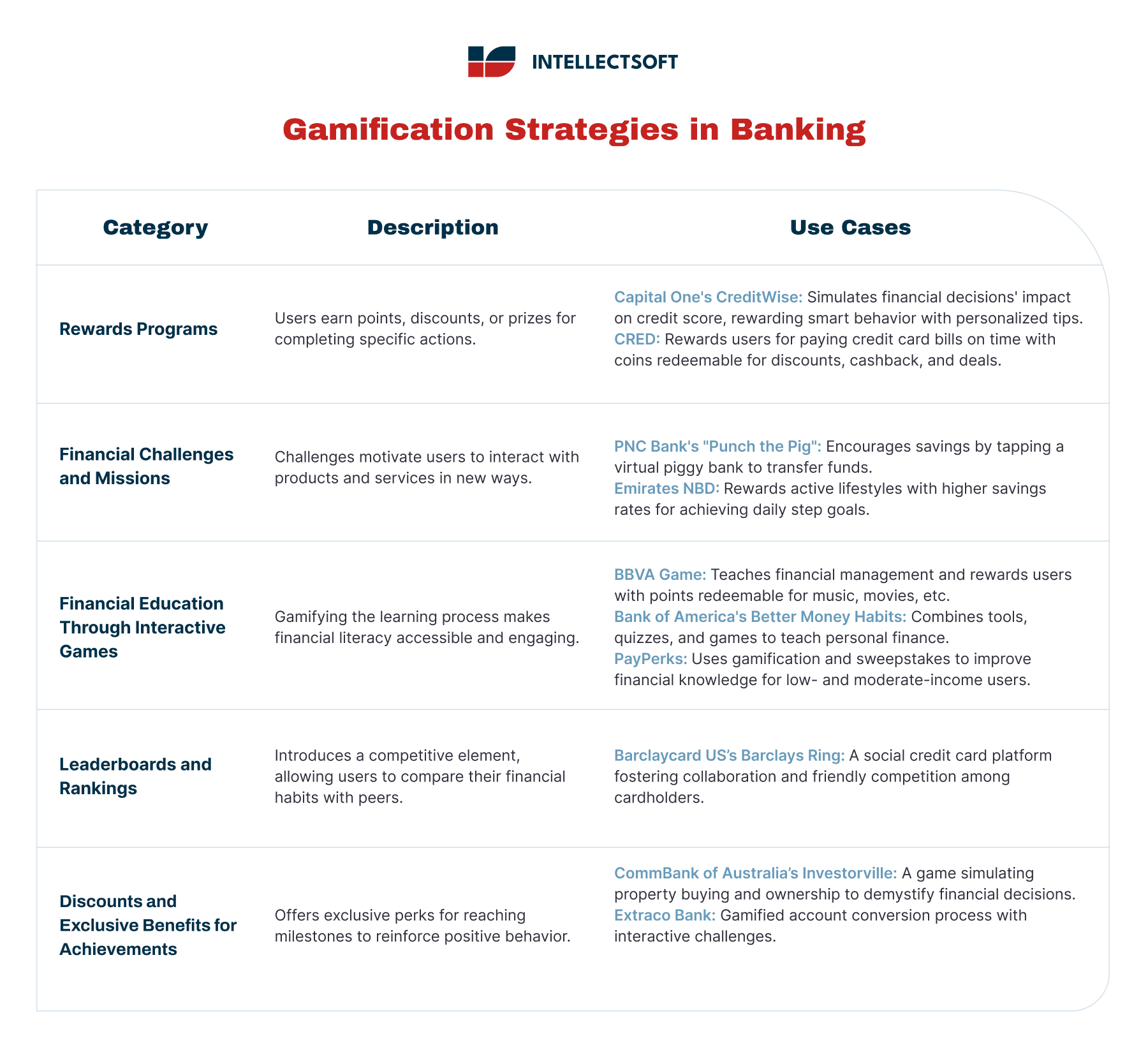
Table showing gamification strategies in banking, including rewards programs, financial challenges, and educational games

Gamification Ideas & Use Cases

Banks have tried various approaches to gamification to address the issues their customers face. Here are some gamification ideas in banking​​ that show how leading players in the sector are using game mechanics:  

Capital One  

Through the Credit Simulator in the CreditWise tool, customers can assess the financial consequences of different scenarios and how those will affect their credit score. Credit management can be stressful, and Capital One designed the tool to turn that frustration into an exploratory, scenario-testing experience. Customers can play “What if” games to see the effects of actions like paying down credit card balances or opening new accounts, and explore several other scenarios in a safe, no-risk environment.  

BBVA  

BBVA launched a web-based platform, BBVA Game, designed to teach customers financial management skills in a virtual economy where they can earn and spend currency. Customers earn game currency for engaging with educational content and completing other banking tasks, such as using the mobile banking app, online banking, or paying taxes. Customers can use their currency to purchase music or movies, or enter into raffles. This system incentivizes customers to engage in financial education, almost like playing a game.

Bank of America

The Better Money Habits program at Bank of America integrates financial monitoring tools with educational interactive games and quizzes. It offers step-by-step personal financial management lessons and assessments in gamified formats. By tackling complex issues through short lessons accompanied by games and quizzes, Bank of America helps customers who would find financial literacy daunting.

PNC Bank

PNC Bank’s gamification strategy is straightforward: a digital piggy bank that pops up during online banking. Customers are encouraged to “punch the pig” to transfer money from checking to savings. It is designed to enable customers to set and reach a savings goal and turn saving from a restrictive task into a rewarding activity. This is one of the greatest gamification of banking products.

Extraco Bank

Extraco Bank wanted to encourage customers to switch to a different account type. Instead of traditional marketing, they created a gamified app to explain the benefits of converting to bonus banking. It aligned with customers’ spending habits and outlined the different fees they could save by using online bill pay and direct deposit. 

This simulation game provides home buyers with a safe environment to practice the fundamentals of property ownership, including mortgages, renovations, property taxes, and other financial risks. It prepares new buyers to understand the financial turns a person has to make over the years, and it helps them recognize the difficulties of the real estate process before taking a substantial financial risk.  

Challenges of Gamification in Banking Industry

While the benefits of gamification in banking sector are compelling, implementation comes with significant obstacles. Banks must navigate these challenges carefully to avoid undermining customer trust or regulatory compliance. Many financial institutions resort to technology consulting for business to understand what technology best fits their needs.
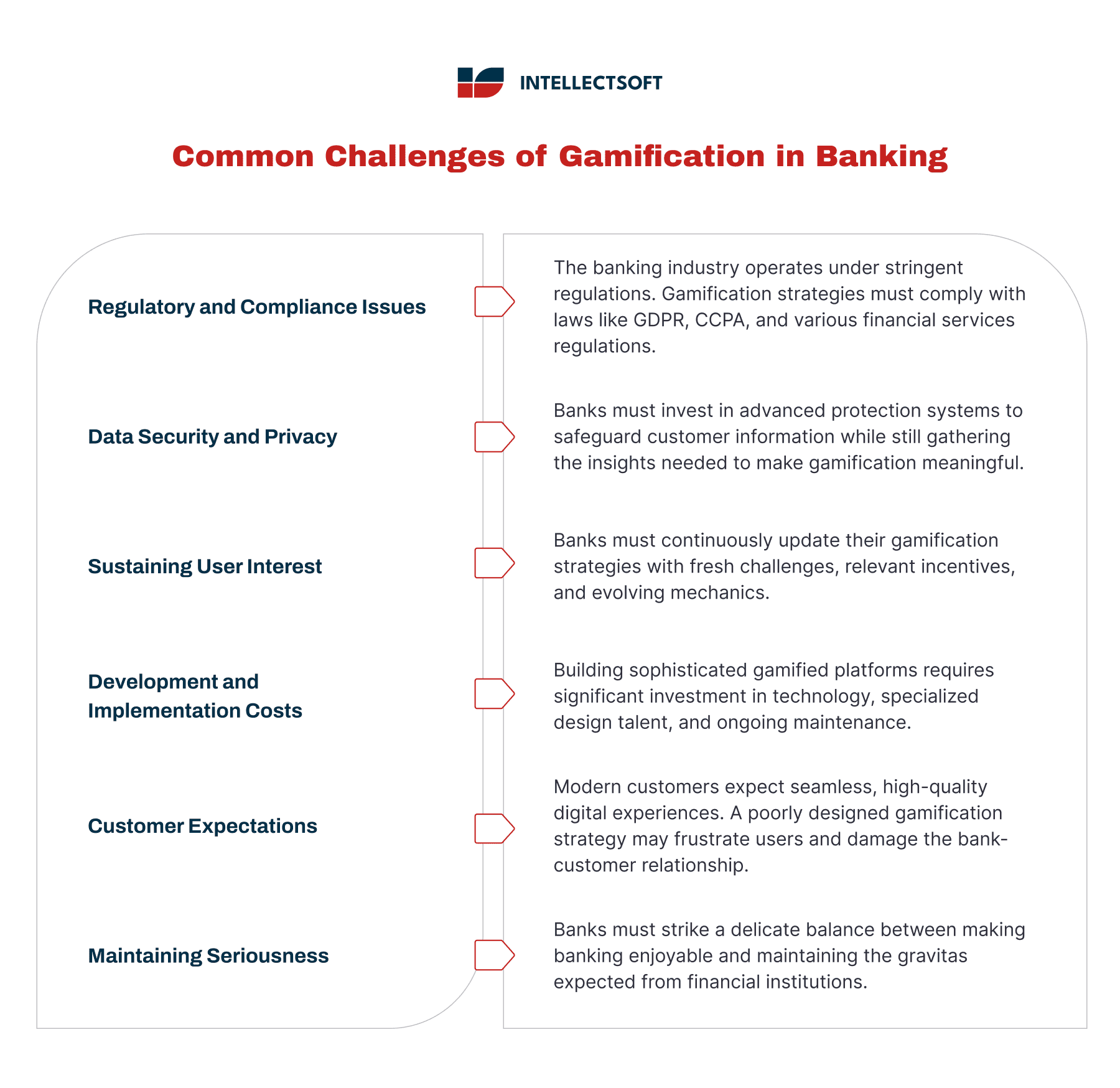
Infographic outlining common challenges of gamification in banking, including compliance, data security, user engagement, and implementation costs

How Gamification Drives Customer Growth

While it is possible to make the banking experience more enjoyable, a financial institution must maintain a certain level of seriousness at all times.

Increasing App Stickiness and Daily Usage

Incentives like daily streaks, progress bars, and completion rewards encourage customers to open banking apps for more than just checking their balance. By leveraging goal- and challenge-based motivation, banks can access products and services that users might otherwise ignore.

Some gamified financial platforms offer users five modules to complete per session, and 3/4 of users return regularly. Sustained engagement of this magnitude allows banks to deepen customer relationships by introducing new products and targeted educational content at the right time. 

Turning Users into Brand Advocates

A satisfied customer becomes a vocal advocate, primarily when they have accomplished something significant through the bank’s platform. Boosting customer engagement through achievement milestones —such as savings account milestones, badges, and cashback rewards — provides customers with countless reasons to share their stories with others. In terms of marketing, this word-of-mouth advertising is priceless. 

Leveraging Data to Tailor User Experiences

Banks can profitably develop personalized offers, refined product recommendations, customer risk prediction, and proactive churn-damping strategies. In gamified systems, bank staff and management gain insights during financial literacy tests, where completion rates reveal what customers know, what challenges they face, and what motivates them.

This active feedback system enables banks to provide tailored marketing at a level never before seen. Customer satisfaction and loyalty improve when personalization is driven by customer feedback rather than a rigid algorithm.

Selecting a Partner for a Gamified Banking Product  

Almost all banks will need external partners to build a gamified banking experience, as this is a specialized field. But why do companies outsource IT services? The main reason is cost-efficiency. However, it is vital to the launch’s success that there is a clear distinction between success and resource savings. That is why you need to do your due diligence before hiring an external partner.

Conduct Market Research  

If you’re wondering how to choose a custom software development company, start by finding firms with real experience in the appropriate niche. Also, develop partnerships with firms that have a keen understanding of the industry’s legal frameworks. It is best to target those who have worked with similar institutions and have a history of successful implementations. Look for technological capabilities, industry experience, and values that are most essential for your future project.  

Assess Portfolios and Feedback  

A portfolio communicates what your potential future partner has constructed, and references tell you the partner’s approach to the work. Request their case studies that detail not just the integrated product but also the actual development, the hurdles, and the results achieved. Inquire directly with their dedicated software development team to evaluate their communication skills, approach to resolving issues, and post-launch support.  

Check their Customer Support  

Gamification will require ongoing adjustments based on user and customer feedback. Inquire specifically about your potential partner’s bug-fix approach, feature revisions, and tracking of key business inputs. If offshoring software development​ is something you’re looking for, check their working schedule. Some companies offer relentless 24/7 support regardless of your time zone. If you want to hire a provider in close proximity, you should resort to software development nearshore.​

A good vendor will push the limits of your thinking, probe your goals with tough questions, and steer you clear of the most frequent mistakes. They should know that effective gamification serves your business goals, not just the designer’s portfolio.

The Importance of UX in Gamified Software Development

The impact of UX in software development for finance and banking is immense, especially in game development. 
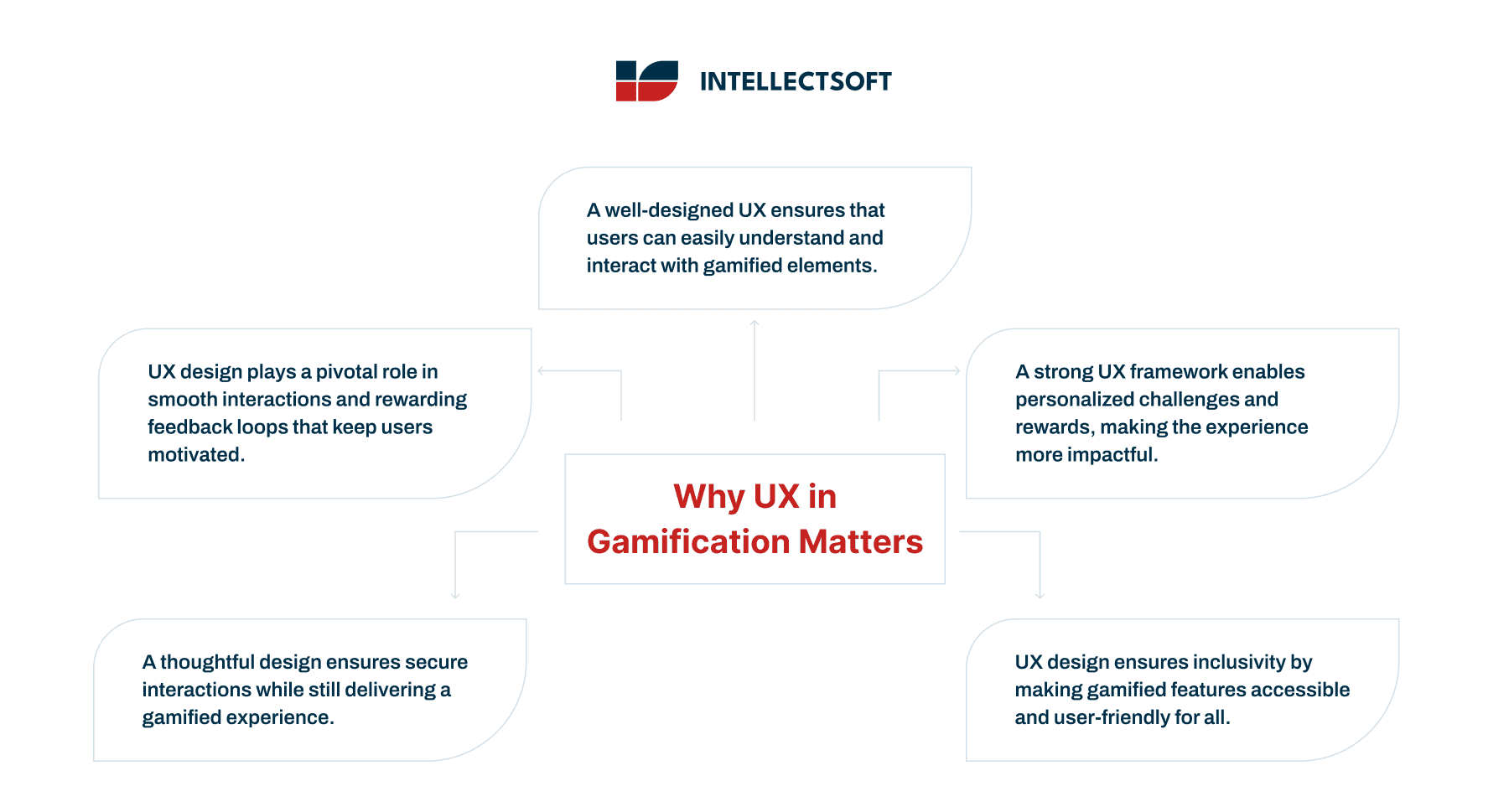
Diagram explaining why UX matters in gamification, highlighting usability, personalization, security, and inclusive user experience

Final Word

Gamification in banking sector engages customers’ lifestyles with the institution in new and innovative ways. The simplicity of banking challenges customer loyalty, as most users perceive the interactions as transactional and mundane. Interactions that are more rewarding and enjoyable foster brand loyalty and build engagement among new customers and existing users. In this regard, gamification will likely continue to shape the future of business banking.


Gamification works, and it works well. The only remaining question is, are attuned to the customer’s needs and digital transactional expectations?

FAQ

What are the key principles of gamification in the banking industry?

There are four key principles of gamification in digital banking​. The first is context and narrative, where the users’ actions are placed within a story. The second principle is visuals, which give users tangible, interactive representations of what they completed. The third principle is feedback, where users receive frequent updates on what they have achieved. Lastly, the fourth principle is reward, in which users receive recognition and rewards, ultimately promoting a sense of success and completion.

Why does gamification matter for financial institutions?

Engagement is the biggest challenge gamification solves in banking. The traditional banking systems are too dull and uninspiring. Gamification in online banking creates rewarding experiences, increases app usage, boosts financial literacy, increases customer loyalty, and provides user feedback data to inform solutions.

What are examples of gamification in banking apps?

Savings goal trackers that let users see their progress, interactive budgeting tools, and achievement badges are some examples of gamification in e-banking. Other examples include cash-back rewards, rewards, and badges for completing educational tasks and interactive quizzes.

How long does it take to develop a gamified banking app?

While the scope of a banking app greatly influences the timelines, most will take 3-4 months to complete, including design, development, and integration testing. This encompasses most digital banking apps with gamified features. Fulfilling the gamification goals, however, will require continuous enhancements to the app, informed by user feedback and behavioral analytics.

Does gamification actually improve customers’ financial outcomes?

The answer to this question is yes. Gamified finance management apps increase savings by at least 22%. Compared to traditional banking interfaces, users who save with gamified tools save about 20% more. Users’ literacy also improves with educational gamification, as they engage more with quizzes, achieving completion rates of 85% and higher.
The hospitality industry depends a lot on keeping customers happy, but it’s getting harder to attract and keep them. The pandemic hit this industry hard, and now market competition is tougher than ever, with competitive offerings swaying customers. Hospitality businesses are willing to spend big to win customers back. The main questions for many are: how can we stay ahead of the competition, keep our customers, and increase revenue? Keep reading—we’ve got some answers.

Customers today have so many options that getting their attention is a real challenge. It’s not easy to make them choose your business over others. What worked 10 years ago doesn’t work the same way now. Back then, people often chose businesses based on reputation. But with new types of businesses (boutique hotels, craft cafes) popping up or big enterprises getting a new strategy, expectations have changed. The good news is these businesses have shown what works: great customer service. They focus on personalizing the experience, making things easy for customers, offering loyalty programs, and using smart technology.

In this article, we’ll explore these tech strategies and show you how they can help your business grow, and double the revenue. Keep reading to learn more!

The Importance of Customer Satisfaction in the Hospitality Industry

Customer satisfaction, which equals exceptional customer experience, is the backbone of the hospitality industry. It plays a central role in driving revenue and loyalty, as satisfied customers are more likely to return and recommend a hotel, restaurant, or other hospitality business to others. In fact, a study by the Harvard Business Review found that a 1% increase in customer satisfaction can lead to a 0.5% increase in revenue. Moreover, loyal customers are more likely to forgive mistakes and continue doing business with a company, even if they experience a negative encounter.

Let’s quickly review the challenges the hospitality industry is facing right now so we can move on to the solutions and our case studies.

Challenges in Hospitality

As businesses navigate the changes in the hospitality industry, there are some key areas where a little improvement can go a long way. From improving customer service to embracing digital transformation and tackling labor shortages, we’ll take a closer look at today’s biggest challenges—and, more importantly, how technology can step in to help. Let’s get started!

Poor Customer Service

Even with strong and high-quality business offerings, poor customer service can drive potential customers and existing customers away. Common issues include:

  • Long wait times in customer service queues (it is worth remembering that our attention spans 8 seconds, and we live in a very busy world, so quick and efficient responses are more important than ever.)
  • Poorly trained customer service representatives
  • Lack of follow-up
  • Services not being done properly or quickly
  • Recall issues that require multiple service calls

These problems can frustrate customers. But, at Intellectsoft, we believe that the right approach, combined with technology, can address them effectively.

Digital Transformation Gaps

Approximately 50% of hotels are adopting new technologies, with 43% automating repetitive tasks and 39% upgrading existing systems.
Source: workstaff.app

Source: workstaff.app

While many businesses are adopting digital solutions, some still struggle with outdated systems and fragmented data. Legacy companies often face chaos when trying to manage their data and create new systems or add features.

Some of the recent examples include clients coming to us to create AI solutions for their services while their data simply was not ready for the advanced tasks. We advise stepping back, communicating with a company objective, and working on keeping the data clean (centralized, structured, and segmented).

When we’re asked to create advanced systems using AI, we always emphasize the importance of organized data. To train AI and build such complicated systems that truly work, you need to start from the very beginning—collecting, storing, centralizing, and organizing it. We encourage our clients to align all departments to work internally on the data so we can create a unified digital system that delivers personalized experiences.

If you’re unsure where to start with your data, we can help. Collecting feedback at various touchpoints along the customer journey is crucial for gaining insights into customer satisfaction and loyalty. Book an IT consultation with us, and our experts will guide you in mapping out a path to get more from your data and build a system that works for your business and team.

Reskilling Staff

The pandemic hit hard in early 2020, especially for the hospitality and travel industries. Even five years later, many businesses are still feeling the impact. Recruiting and retaining skilled staff has become a major challenge post-pandemic.

Reskilling to address technology’s impact is of utmost importance, as about 40% of hotel General Managers place it among their top three workforce challenges.

Source: Deloitte

We strongly believe that adopting the right technology can help. For example, creating an app to train your staff not only saves time but also ensures consistency in learning. AI assistants can also work alongside your team, helping with tasks like recruitment (providing industry insights, crafting emails) and staff training. Imagine having an app dedicated to making your team’s work easier and more efficient!

How Technology Tackles These Challenges and Supports a Customer-Centric Hospitality Culture

Automation, AI, and similar technologies may threaten many. However, the debate about replacing humans isn’t about that—it’s about cooperation and working hand in hand with technology to achieve the highest standards and establish brand-new “golden standards.” Technology is here to assist staff in listening to and collecting customer insights from data.

Let’s review some of our cases to see examples of how technology helps improve customer experience and supports customer service.

Examples of Intellectsoft projects

Property management systems (PMS)

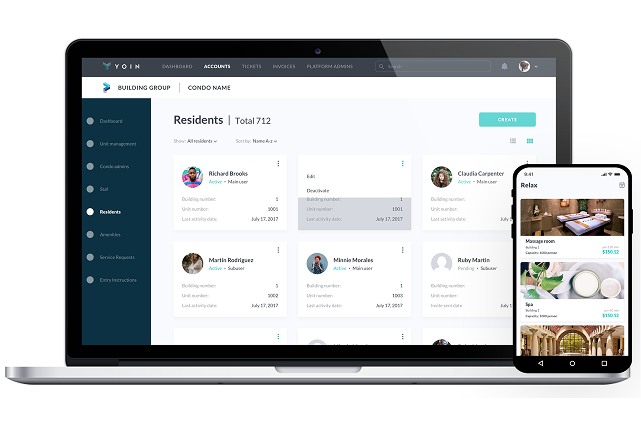
We created a web platform and mobile app that makes managing daily tasks easier and offers extra services to improve residents’ experience. It gives a clear overview of daily activities and helps with managing units and users. Residents can easily book amenities, submit service requests, and report incidents. The platform also includes features for equipment management, key instructions, workflows, and custom permissions. This makes it easier for staff to stay on top of equipment and ensure residents have all the information they need. Plus, tools like announcements, quick votes, a forum, and a community calendar help build a connected and engaged community.

Guest Experience Management App

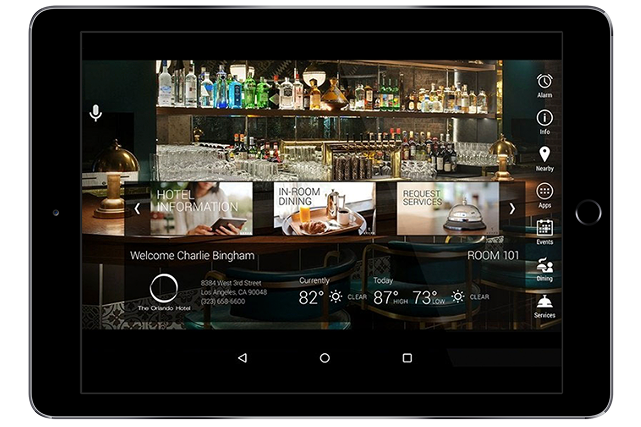
Our next app helped our client improve their guest experience by replacing printed marketing materials and the need for phone calls with a smart solution. Now, guests can easily order in-room dining, make reservations, and interact with staff— through a simple tablet in their room. The solution includes three parts: a custom in-room tablet with a variety of services, an admin panel for hotel staff and service providers, and a backend system that connects everything together. This approach makes things easier for guests and staff, improving both convenience and efficiency.

Existing Customers First: Building Loyalty with Personalized Touchpoints

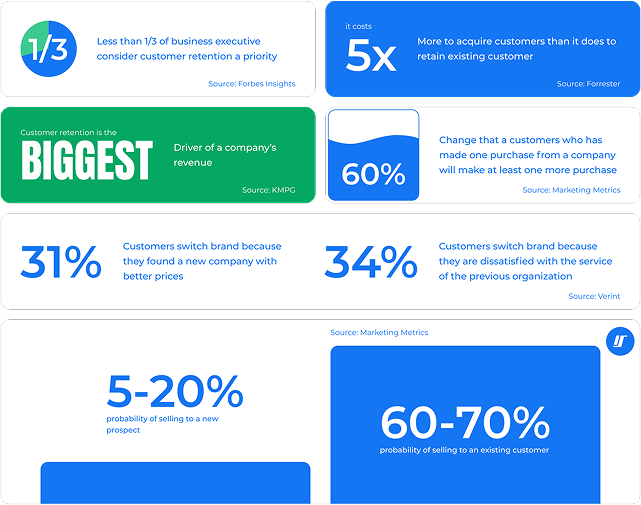
Keeping existing customers is not just a strategy; it’s well-known that retaining existing customers is more cost-effective than acquiring new ones. In fact, research shows that it costs five times more to acquire a new customer than to retain an existing one. KPMG named customer retention as the number one revenue driver for the company.

Moreover, a 5% increase in customer retention can lead to a 25% to 95% increase in profits, showing the significant impact loyal customers can have on a business’s bottom line. Retention strategies, like personalized experiences and loyalty programs, can foster long-term relationships and generate recurring revenue, ultimately making them an invaluable part of any business model.

Personalization: How Technology Can Help?

Everyone loves to feel special—it’s part of being human. In hospitality, personalization has evolved from being a luxury to an essential standard. With the right technology to manage your data effectively, you can deliver those “wow” moments that guests won’t forget.

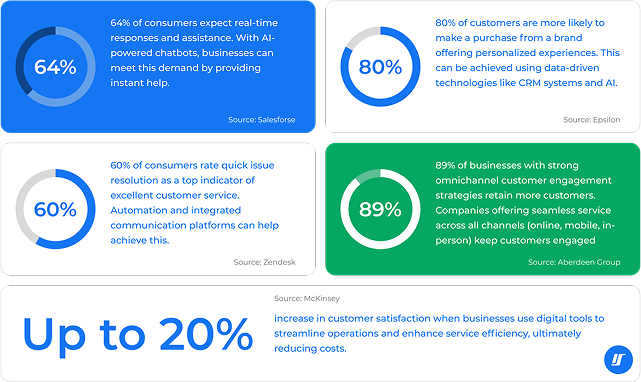
More than half of hotel chains are already using personalization features on their websites, booking platforms, and apps, and another 39% are planning to follow suit soon. They’re tailoring experiences to fit guest preferences perfectly.

Source: Deloitte

How does technology make it happen?

  • CRM Systems: They help you keep track of guest preferences, booking history, and special requests so you can offer services tailored just for them.
  • Loyalty Programs: Personalized rewards and offers show your guests that you value them, keeping them coming back for more.
  • AI Personalization: AI analyzes guest data to predict what they’ll love (from room upgrades to local recommendations) before they even ask.
  • IoT Gadgets: Smart room features like voice-activated assistants, or temperature controls adjust to your guests’ preferences, making their stay more comfortable.

With tech-powered personalization, you’re building loyalty and maximizing the lifetime value of every customer.

Our Case Study: Smart Hotel Management & Loyalty Program

For one of our clients, we created a smart room solution, complete with a custom IoT system. Guests can use a mobile app to control services, explore amenities, and find resort information– with a special touch to their suite type. For the client’s entertainment business, we improved their legacy software by running a full IT and code check, fixing issues, and making the system better for customers.

Along with that, we developed a mobile app for the loyalty program, allowing businesses to effortlessly reward their customers and keep them engaged with exclusive benefits.

Our solutions not only helped the client with special experiences for guests; it also improved operations, cutting costs by eliminating inefficiencies. Here’s what our experts shared:

“We transitioned away from ESB (Enterprise Service Bus) systems, which previously cost millions, and replaced them with more efficient, self-managed solutions. Similarly, we’ve implemented Device Farms that improved operations and saved resources.”

Leveraging Software to Increase Upsell Opportunities

Here are some examples of tech tactics that will help your team sell more and introduce new offerings to existing customers, improve overall efficiency leaving your team grateful:

Dynamic Pricing Algorithms

For finance and marketing teams, manually calculating pricing by segment to introduce your clients can be incredibly challenging. AI-powered tools can strongly optimize these strategies by analyzing your database in detail.

Upselling via Apps

Boosting revenue in the hospitality business often comes down to personalized experiences. Imagine this: a guest books a room, and then your app suggests a spa package or a room upgrade at just the right moment. Later, it nudges them to book a dinner reservation or a guided tour designed to their preferences. With apps offering these personalized recommendations during and after bookings, you’re not just increasing your revenue per guest but also skyrocketing their experience. And you do it in a sustainable way, not by speculating, but by offering what your customers desire based on their previous experiences. It’s a win-win: seamless, helpful, and far from pushy.

Inventory and Resource Management Software

Making every resource count in your hospitality business is key. Inventory and resource management software allows you to effortlessly track everything from linens to room availability, ensuring nothing goes to waste. Having real-time insights to reduce overstock, avoid shortages, and optimize operations assists sustainably keep everything under control and know what you need to focus more. It helps maximize room occupancy by aligning bookings with available resources, ensuring every room and item is used effectively. This approach leads to smarter management, better guest experiences, and a noticeable boost to your bottom line.

Adopting these strategies not only optimizes your operations but also drives business growth. Ready to discover how technology can elevate your goals? We’re here to create a tailored solution for you.

Steps For Implementing a Customer Service Technology Solution

Improving customer service in hospitality doesn’t have to be a daunting task. With the right technology, you can smooth the path of your operations, speed up response times, and elevate the overall guest experience. Here’s where you can make it happen:

1. Understand Your Needs

Start by identifying the challenges your business is facing. Are you struggling to manage high volumes of inquiries, track customer feedback, or personalize the guest experience? Pinpointing your needs will guide you to the best solutions.

2. Pick the Right Tools

Choose technology that aligns with your goals. Look for solutions that are scalable, easy to use, and integrate effortlessly with your current systems. Options like CRM software, live chat tools, or a guest experience app can make a difference.

3. Equip Your Team

Technology is only as effective as the people using it. Train your staff to make the most of the new tools, so they can deliver exceptional service and resolve issues quickly. Confident, well-equipped staff creates happy, loyal customers.

4. Keep Improving

Once implemented, monitor how well the solution works. Are response times improving? Are customers more satisfied? Regular evaluations will help you fine-tune your approach and keep things running harmoniously.

Some Tech Ideas for Hospitality Businesses

  • CRM Software: Manage customer interactions and preferences.
  • Guest Experience Apps: Delight guests with personalized experiences right at their fingertips.
  • Amenity Management Systems: Simplify operations for everything from room service to facility bookings.
  • Helpdesk Software: Resolve customer issues optimally.
  • Live Chat Tools: Offer instant support and answers.
  • Social Media Management Tools: Keep customer interactions engaging and organized.

Integrating these strategies will not only improve your customer service but also deliver unforgettable customer satisfaction, loyalty, and, ultimately, your bottom line. Ready to take the next step? Book a consultation with our experts.

Conclusion

To wrap up everything we’ve discussed, customer satisfaction and experience are at the heart of hospitality. Retaining customers is more than just keeping them around—building strong, long-lasting relationships and consistently meeting their evolving needs. By understanding their pain points and offering personalized solutions, you can inspire loyalty and drive progress. With the right technology and continuous improvement, your business can stay ahead, let go of what no longer serves you, and keep growing.

At Intellectsoft, with over 17 years of experience in software development, our expert team is ready to help. We create everything from mobile apps to full-fledged portals and systems, leveraging the latest technologies like AI, Cloud, and Machine Learning. With deep experience in the hospitality industry, we’re here to craft personalized solutions that bring your business unforgettable customer experience and retain your valuable clients.

Ready to double your revenue and level up your customer retention strategy with personalized technology? Contact our experts, and we look forward to working hand in hand with you to build or revitalize the perfect app or system for you.

author

Tetiana Borysova

Content Writer


Source link
LEAVE A COMMENT Cancel reply
Please Enter Your Comments *
rbtechfs

All Categories
  • Trends
RECENT BLOG
  • Gamification in Banking: Building Loyalty & Engagement

    0 Comment

  • Top Software Development Companies in LATAM

    0 Comment

  • Data Analytics in Banking: The Ultimate Guide

    0 Comment

  • Choose What Works for You

    0 Comment

image
image
image
image
image
Updated_RBTFS-Logo
  • Home
  • Who are we
  • What do we do
  • Blog
  • Contact Us
  • Home
    • Home 1
    • Home 2
    • Home 3
  • About
    • About Us 01
    • About Us 02
  • Projects
    • Projects
  • Blog
    • Blog Grid
    • Blog List
  • Pages
    • Contact
    • Team Members
    • Testimonials
    • Our Services

Copyright by rbtechfs.com 2024. Designed by P1 Marketing All Rights Reserved