







Manual financial management creates both time-consuming challenges and significant security risks. The increasing number of companies invests in accounting software development to maintain financial control and simplify operations while meeting regulatory requirements.
Standard commercial tools provide temporary solutions but they usually fail to match specific business needs. Custom accounting software provides the solution when standard tools do not meet requirements. The system enables you to customize its features according to your operational procedures and organizational structure and market sector requirements. The following information provides guidance on how to create accounting software and how to develop an accounting software, offering a practical perspective for teams starting from scratch.
The following article presents a detailed overview of the accounting software development process, which includes essential features and security requirements. This article functions as your essential accounting software development tutorial, which provides you with vital information before starting your project.
Why Build Accounting Software for Your Business?
The point arrives when spreadsheets together with standard tools fail to meet your needs. Your business needs to build accounting software when it expands or handles complex financial transactions.
Custom accounting software development provides maximum flexibility to users. Custom platforms offer superior functionality than standard software solutions because they automate repetitive tasks while maintaining regulatory compliance and providing full control over financial operations. The entire system is built to match your business operations rather than forcing your operations to conform to standard software features.
The development of custom accounting software provides essential benefits to businesses operating within regulated sectors and those managing multiple financial systems. Small and mid-sized businesses can achieve significant financial operational improvements through simple accounting software development, which avoids overwhelming their team members.
Streamline Financial Health and Records Management
Your financial data becomes easily accessible through custom accounting software which enables real-time monitoring of cash flow together with revenue and expenses and profit. Through automated financial reporting and recordkeeping tools you can minimize manual work and prevent potential inconsistencies from occurring. Financial health becomes both visible and traceable through custom solutions which allow better collaboration between departments along with auditors and accountants.
Prevent Human Errors
The costs of human errors in manual accounting become most significant during payroll processing and tax filing and financial reporting. The probability of data entry mistakes decreases when a custom solution executes core calculations automatically while validating inputs and detecting irregular activities. The software provides clean and reliable records because it performs fewer manual operations while implementing built-in accuracy verification systems.
Faster Response Time
Financial delays create negative impacts on organizational decision-making capabilities. The customization of financial dashboards allows businesses to view their essential KPIs at the precise time when they require them. The system delivers instant alerts about overdue invoices together with unexpected expense increases which allow you to make prompt decisions with confidence without needing end-of-month reports.
Easier Information Recovery
The process of searching for misplaced records becomes more complex when traditional accounting methods are used. The system maintains all financial data securely within one place while providing powerful search functions alongside filtering tools to quickly locate invoices reports and audit logs. Audits and reconciliations become simpler through this feature and it helps you respond promptly to vendor or client requests.
Enhance Cost-efficiency
Custom accounting software performs automation beyond task execution while also eliminating the requirement for multiple separate tools and manual labor. Businesses that unify their invoicing systems — often built through billing software development — with expense tracking, payroll management, and reporting functions can decrease operational costs while eliminating redundant work. The long-term savings from fewer errors and less manual intervention can be significant.
Improve Security and Compliance
Security is non-negotiable in finance. The customized system implements strong access controls and encryption methods and multi-factor authentication and scheduled backup processes. The solution supports financial compliance through implementation of GAAP, IFRS, SOX or GDPR regulations which depend on your geographical location and industrial sector. The implementation of audit trails together with role-based secure access reduces your exposure to data breaches and legal penalties.
Types of Financial Accounting Software
The development of accounting software development technology has expanded to provide businesses with multiple solutions to handle their financial operations. Your organization should select either a specialized tool or a complete system that consolidates all financial operations based on your size and industry requirements and specific needs.
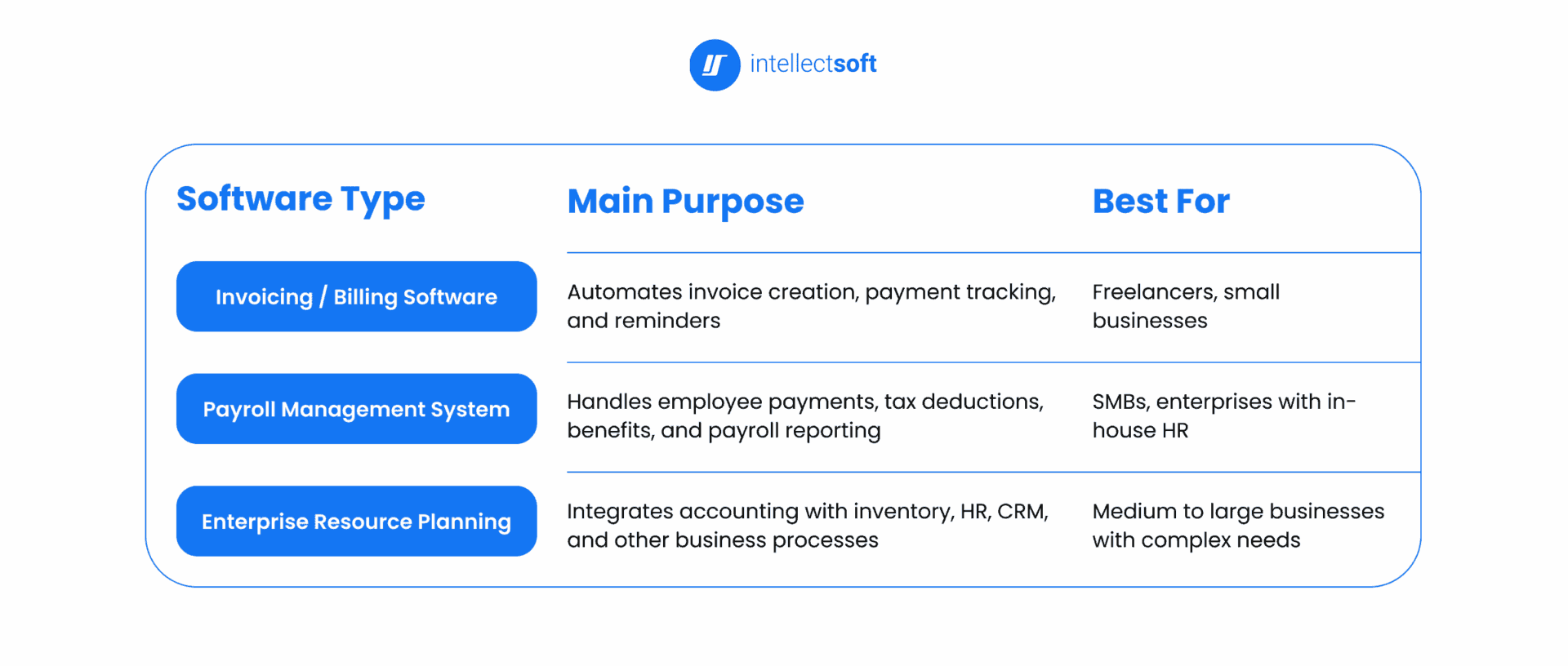
Financial accounting software exists in three main categories which handle separate financial operations.
Invoicing / Billing Software
The software system handles billing operations by producing invoices and sending payment alerts while tracking received payments. The system decreases both payment delays and human mistakes while minimizing the workload associated with manual billing processes.
Payroll Management System
Payroll systems streamline employee compensation by calculating wages, deducting taxes, managing benefits, and generating payslips. The systems help organizations meet their local labor and tax requirements on time thus minimizing legal exposure while freeing up HR staff from time-consuming work.
Enterprise Resource Planning (ERP) System
The ERP system extends past financial management because it connects financial operations with essential business functions including human resources and inventory management and customer relationship management. Large-scale businesses benefit from ERP platforms because these systems offer real-time departmental visibility and a single source of truth which enhances operational efficiency and decision-making capabilities.
Core Functions of Financial Accounting Software
The development of an accounting software solution for business needs requires focus on features which handle financial tasks efficiently and accurately while providing clear results. Developing an accounting software with the correct functionality decreases manual work duration while decreasing errors and provides better financial health understanding.
The following essential functions need to be included in your software:
- General Ledger Management
A general ledger serves as the base accounting system which tracks financial transactions to make reporting and auditing processes easier.
- Accounts Payable and Receivable
The system enables you to track payments and due dates and outstanding balances for both incoming and outgoing transactions which helps maintain cash flow and provides transparency to vendors and clients.
The system automatically matches internal records with bank statements which results in time savings and decreased discrepancies.
- Budgeting and Forecasting
The system enables users to develop budgets through smart tools which allow historical and real-time financial data monitoring for adjustments.
- Tax Calculation and Filing Support
The system provides built-in tax rules and automated calculations and reporting features which comply with your country’s regulatory requirements.
- Financial Reporting and Statements
The system enables users to produce balance sheets and income statements and cash flow reports through simple clicks which serve both internal assessments and stakeholder meetings.
The operational core of any high-performing accounting system requires these features which should receive priority status during the development of a solution for long-term growth and compliance.
Create high-end software solutions for your company with Intellectsoft
Get in touch
Benefits of Custom Accounting Software
Custom accounting software development enables you to create a solution which matches your business requirements exactly. The solution provides more than convenience because it creates a strategic advantage. A customized system provides multiple advantages which include cost reduction and enhanced compliance and transparency and operational efficiency at all levels.
Here’s a quick look at the key benefits: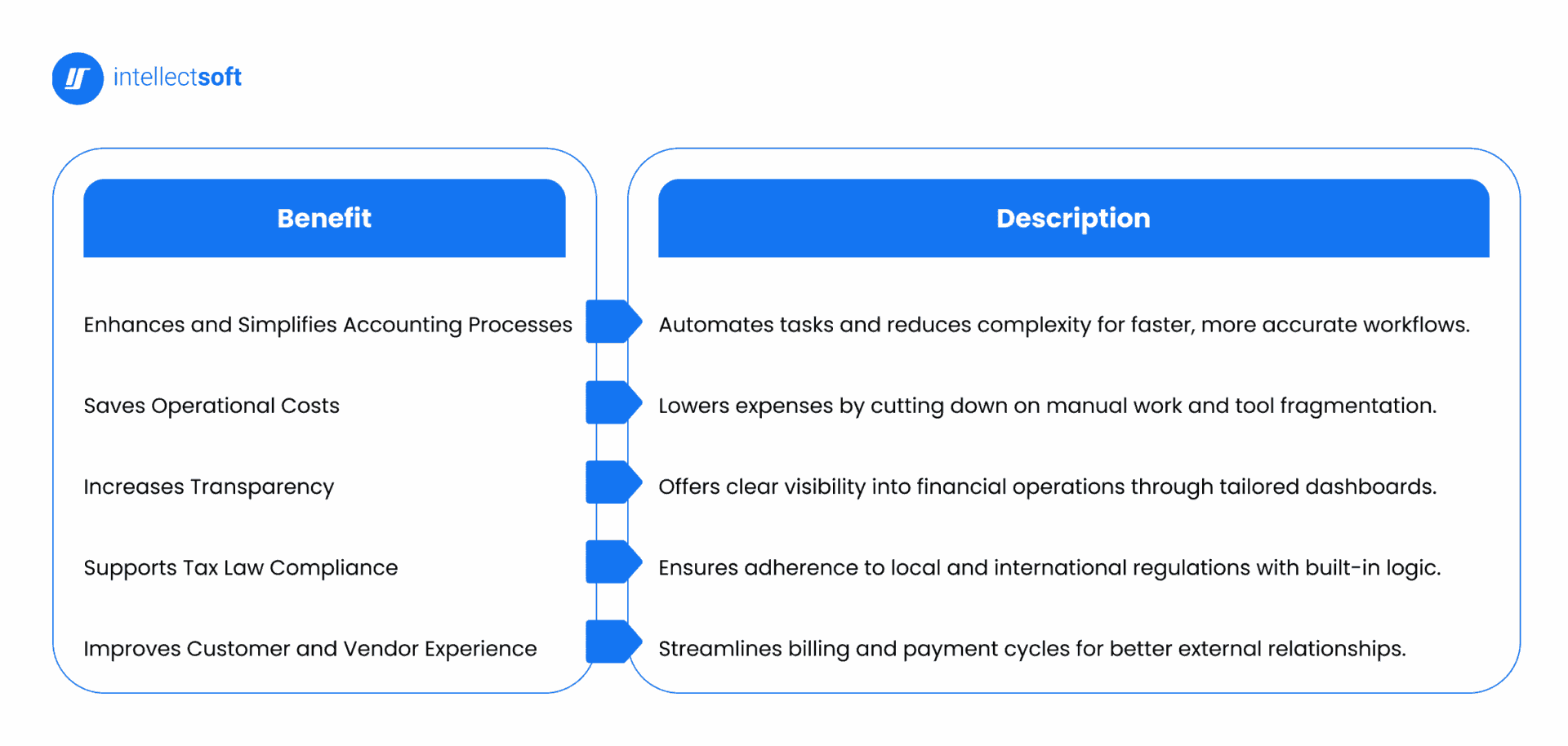
Customized accounting software development allows you to create a system which follows your business operations rather than requiring you to change to fit another system.
How to Build Accounting Software: Step-by-Step Process
To start building accounting software, you need a specific plan that guides your development process. A successful product requires more than just good code—it takes proper planning, deep domain knowledge, and the right execution strategy. The process of how to build accounting software begins with the alignment of business goals with development activities.
The development of financial platforms requires knowledge about essential software development accounting requirements such as precise data entry and banking system integration and secure access systems. The process of developing accounting software should follow these priorities especially when operating in regulated or high-stakes industries.
Let’s explore each phase:
Research and Requirements Gathering
The process of how to build accounting software begins with thorough research. The system development begins with business need identification and user role definition and compliance requirement specification and financial workflow selection. Competitive analysis and input from finance teams are critical at this stage.
Design and Prototyping
After requirements are set, wireframes and UI/UX designs are created to outline how the system will look and behave. The clickable prototype enables developers to visualize system workflows and test logic before initiating any code development.
Development
The development team starts developing accounting software using the accepted prototype. Frontend and backend development happens here, along with building integrations for banking systems, payment gateways, and reporting tools. Security protocols and role-based access should be implemented from the start.
Testing, Compliance Check, and Launch
Your software completes a complete QA testing process which includes functional testing alongside performance testing and security testing and user acceptance testing before launch. The platform needs to pass all industry regulations and data privacy laws at this stage.
A successful completion depends on your knowledge of how to develop accounting software, which includes both error management and system expansion capabilities. The last step in regulated industries holds essential value to meet software development accounting standards and prevent costly risks.
Must-Have Features in Accounting Software
The development of an accounting platform requires features that extend past standard bookkeeping operations. Modern businesses require intelligent, scalable tools which enable operational support, compliance management, and deliver immediate financial data — particularly in areas like fintech mobile app development where seamless functionality and user-centric design are essential. The correct features will boost both accuracy and productivity while improving departmental and decision-maker collaboration.
A reliable future-ready system requires these core features regardless of whether you are modernizing your finance technology or building from the beginning. The following section explains what your accounting software needs to include together with explanations of each essential feature.
IMAGE 5
Key Features and Their Business Value
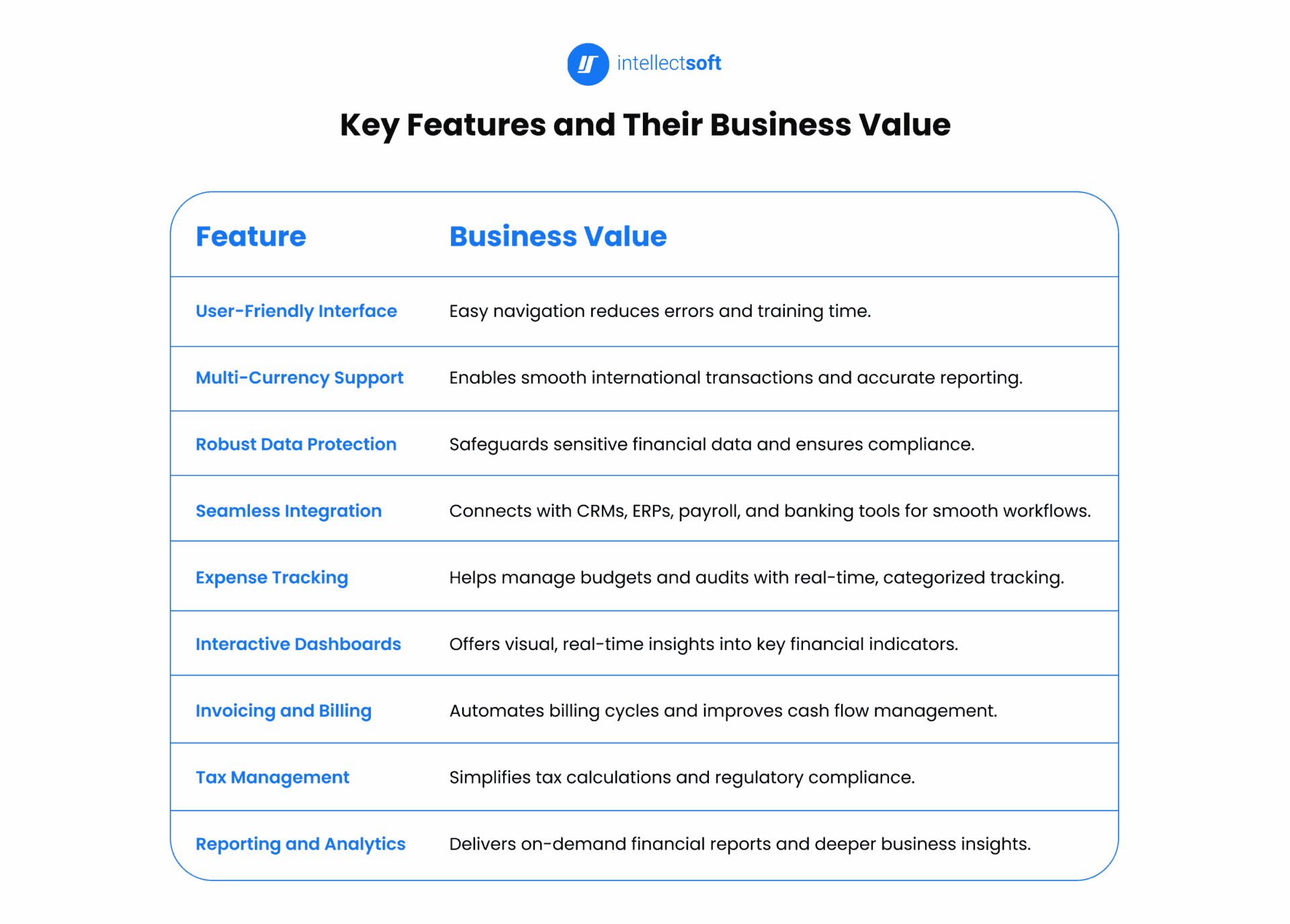
To access the full potential of these features, many companies choose to develop custom accounting software tailored to their specific workflows and goals. A well-planned development of accounting software process ensures the system matches operational needs and supports long-term growth. This level of strategic customization is a cornerstone of effective accounting software development.
Security Measures in Accounting Software Development
The security of sensitive financial data stands as an absolute requirement. The accounting software development process requires strong security implementations to defend against data breaches and unauthorized access and fraud attempts. Every system layer including login credentials and stored transactions and tax records needs protection as its foundation.
A secure accounting platform requires multi-factor authentication together with role-based access controls and end-to-end encryption and automatic data backups. The security features enable authorized users to access financial information while reducing the chances of data leaks and system compromise.
The top priority should always be regulatory compliance together with technical safeguards. Your software requires compliance with standards such as SOX, GDPR, HIPAA and PCI DSS based on your industry and regional location. The failure to meet these standards leads to major penalties and severe damage to reputation for companies operating in finance, healthcare and insurance sectors.
Businesses often choose software development outsourced accounting services to obtain expert security and compliance management. Reputable partners possess specialized knowledge about secure architecture which enables them to implement industry-standard protocols during development thus helping you fulfill both legal and operational requirements without overburdening your internal resources.
Cost of Accounting Software Development
Accounting software development expenses change based on the project complexity level. When you want to build accounting software, you need to understand how different elements affect your budget — including feature scope, third-party integrations, compliance requirements, and infrastructure setup. Factors like fintech app development cost provide helpful benchmarks for budgeting similar platforms. The implementation of real-time reporting, how payment processing works, and multi-currency support features requires extensive technical work which increases development expenses. The development of security and financial logic-heavy software components specifically requires accounting software development and careful planning around software development accounting. Organizations that create customized accounting software should view their first investment as a strategic long-term decision because automation, accuracy, and process efficiency will generate substantial returns. Teams developing custom accounting software should also consider long-term maintenance, scalability, and integration costs.
Key Cost Factors in Accounting Software Development
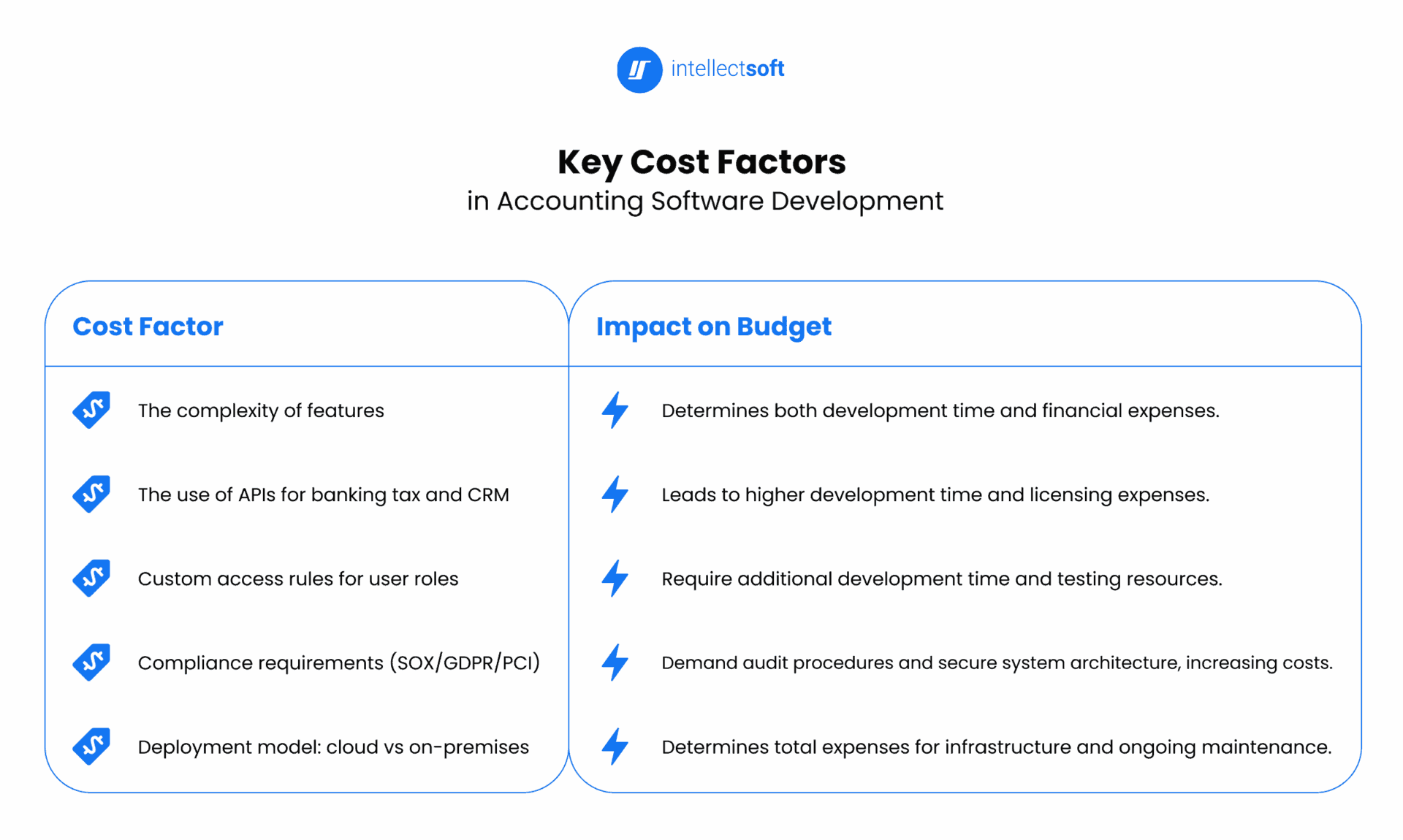
The high initial costs of development will yield substantial returns throughout the long term. Custom accounting software development for your workflows eliminates manual work while reducing errors and eliminating the need for separate disconnected tools. The development of accounting software transforms into a vital business investment which delivers quantifiable value throughout time.
Key Takeaways on How to Build Accounting Software
Businesses select accounting software development based on their need for control and efficiency and scalability. Standard accounting tools reach their limits when financial operations become complex or when industry-specific requirements need to be met. Organizations now select to develop custom accounting software which matches their operational workflows and user roles and future objectives.
The choice between building accounting software in-house or partnering with an experienced external developer should be considered by organizations seeking secure compliant scalable solutions. Financial platform specialists provide benefits to clients through their expertise which shortens development time and minimizes project risks.
The first step for new accounting software developers should involve defining business requirements and compliance needs and feature specifications. A well-defined development approach combined with a clear roadmap enables financial platform development which becomes both feasible and a significant competitive differentiator. Many beginners also ask how to make accounting software, making this a common starting point in planning the right solution.
Contact our experts to discover more about the financial services software development and the creation of accounting applications for your organization — and learn how you can get the most of them.


Source link