







In house development vs outsourcing? That’s the first question companies should ask when starting a tech solution. But the more they explore what both models bring to the table, the more doubts they raise. So, let’s try to dispel them.
When it comes to in-house development, it’s a great option that offers quality communication and control over projects. But it can be quite expensive and not scalable enough.
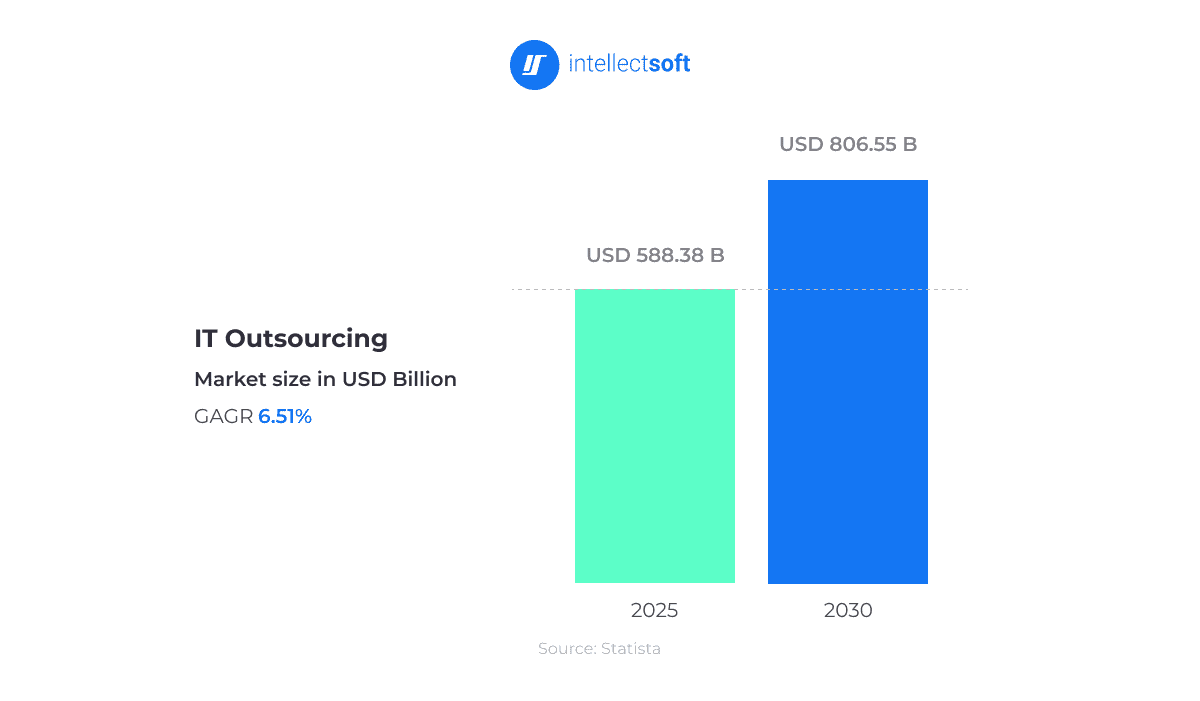
With a value of $588.38 billion in 2025, the global IT services outsourcing market is projected to reach $806.55 billion by 2030. And its annual growth rate can achieve 6.51%. Sounds awesome, right?
But why are so many companies interested in outsourced software development? First, this model speeds up project release. Second, you’ll get access to a wider pool of talent at lower costs. But don’t forget about drawbacks, like communication gaps and weak control.
We feel that now you’re confused, as you see that both options have their pros and cons. So, what variant works the best for your business?
Read our article where we’ll figure out key points related to in house development vs outsourcing and help you make the right choice.
IT Outsourcing: A Quick Market Overview
As we already mentioned above, the IT outsourcing market is booming, and we can clearly identify a few leaders in it.
In the global market, the United States leads with revenue of $218.02 billion in 2025. Latin America also doesn’t lag, thanks to close ties with the U.S. and a strong pool of skilled workforce. Eastern Europe is no less competitive due to highly qualified IT talent and lower labor costs.
All in all, the IT outsourcing market shows no signs of decline, and that’s one of the main reasons why companies choose to outsource. Add to this the access to skilled talent and budget-friendly solutions, and that combo makes outsourcing even more attractive for investors.
But many companies are still at the crossroads of in-house development vs outsourcing.
In-house Development: Benefits and Drawbacks
Before comparing software development in house vs outsourcing, let’s start with in-house development. This is when you build software using your own staff. You hire software experts as full-time employees to create tools for your company. Of course, this can be tiresome and effortful, as it’s not an easy task to find the right people.
But when completed successfully, in-house development is a great way to build a loyal, committed team that grows together with your business.
Pros of in-house development
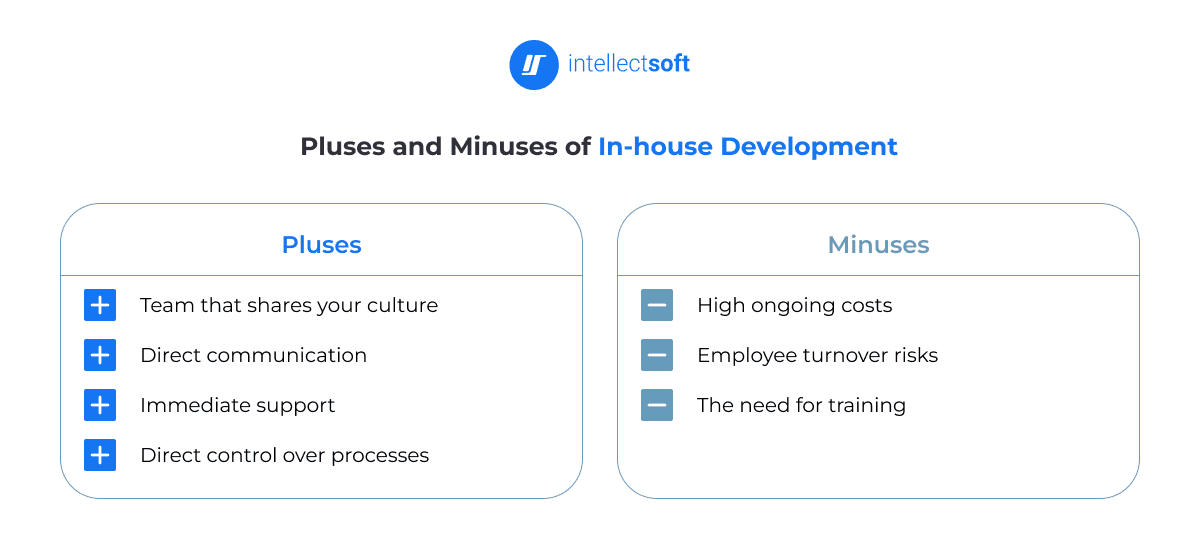
The biggest pluses of in-house development for your company are:
-
- Team that shares your culture: If you extend your internal team, you can be sure that they are on the same wavelength as you. They apply your vision and values in their work.
- Direct communication: Having your staff means that you can discuss everything face-to-face or in real-time. So you can expect faster and more informed decisions.
- Immediate support: Your internal team is always with you. If anything goes down, your developers can react and act swiftly.
- Direct control over processes: With an in-house team, you can ensure complete management of operations and timelines. As a result, you can be more flexible if any updates are required.
Cons of in-house development
Every model has a reverse side. That’s why in-house development has its drawbacks:
- High running costs: Hiring skilled staff requires investment. You need to pay not only salaries, taxes, and benefits, but also cover training costs to develop your team.
- Employee turnover risk: Another challenge you may face is retaining your developers, especially those with strong expertise. This means you may need extra time and resources to replace them if they decide to leave.
- The need for training: The tech industry requires continuous upskilling. That’s why you should also conduct regular training for your internal developers.
When we recommend in-house development
As you can see, in-house recruitment is an expensive model, and you should weigh all the pros and cons before choosing it. But there are cases when we strongly advise investing in this approach:
- You’re building software for the long run. If your project takes years to finish and needs frequent updates, an in-house team will be the most relevant. They can make better technical decisions and help your business grow steadily.
- You have enough budget. If you have sufficient funding and aren’t limited by costs, hiring an in-house team gives you all the benefits with minimal risks. You invest in your team once and keep the skills, knowledge, and progress inside your company.
- You need full control. If your project cannot afford delays or unclear responsibilities, an in-house team is a must. With them, you will fix issues as soon as they arise and meet your clients’ expectations.
When comparing in-house app development vs outsourcing, in-house development is a great way to build your dream team that delivers quality communication and efficient collaboration, which are key ingredients for a successful project. If you own sufficient financial resources and build for the long-term perspective, we recommend internal team development as a solid strategy for your business.
What Are the Upsides and Downsides of Outsourcing Development?
Outsourced team development is the practice that involves hiring external engineers for a project rather than engaging your own staff. You share your project requirements, and the vendor executes everything.
You can recruit a few engineers to help your in-house team or fully outsource software development team from start to release. Both options are chosen frequently, and which one you should opt for depends on your business needs.
Top brands such as Microsoft, Apple, Google, Upwork, and Slack outsource parts of their software development services. Why should you miss this opportunity? But before you decide to extend your team, let’s reveal what benefits you can receive from it.

Upsides of outsourcing development
Outsourcing development offers the following advantages for your business:
- Access to global talent hubs: Outsourcing reduces geographical boundaries. So you can access diverse talent without the need to invest in an internal team.
- Cost optimization: If you need to reduce expenses and optimize your budget, then hire developers from Latin America or Eastern Europe. They have lower pay rates but can deliver the same quality of work as your internal team.
- Broader tech expertise: Your in-house team can’t work with many tech stacks. So you would need to hire more and more new people. Outsourcing solves this problem by bringing relevant expertise and technologies to your projects.
Downsides of outsourced development
Now we should turn to the drawbacks of outsourcing software development, as this helps you stay prepared and plan how to fix them.
- Gaps in real-time management: When you outsource a team, they don’t work only on your project. So you have less control over their tasks and performance. As you can’t manage everything, you should find a reliable vendor who can report on project progress and updates, and assign project managers who keep everything on track.
- Communication obstacles: Another dilemma is how to interact with a diverse team. Time zone and language distinctions can limit meeting slots and cause misunderstandings. But clear rules and team apps can help overcome communication barriers.
- Security issues: When you decide to outsource engineers, you have to share sensitive business information with them. Yes, it’s a risky step as you need to compromise your security and privacy. That’s why we recommend selecting a reliable outsourced software development partner and signing an NDA to protect your interests.
When we recommend outsourced development
Now that you understand the pros and cons of outsourcing, we’ll reveal when outsourcing is the best option.
- You don’t have the right talent with the relevant expertise. Instead of hiring and training developers in your location, you can engage an IT company to complete your work.
- You have a tight budget and can’t afford an internal team. Of course, if you have budget constraints, outsourcing is the model that can help you reduce costs and act with more flexibility.
- You need a complex IT solution. Your in-house team can’t always have expertise in diverse technologies. In this case, you need to hire extra people or conduct training for your staff. In this case, outsourcing can be more applicable for your company.
In-house Software Development vs Outsourcing: What to Choose?
With the advantages and drawbacks of each cooperation model in mind, you can opt for a cooperation model that can bring more benefits to your business: in house vs outsource software development. No doubt, it’s difficult and confusing. That’s why we offer a few strategies to consider that can help you.
Assess your organization’s needs
Before choosing between in-house software development vs outsourcing, focus your business needs to understand which cooperation model can meet them. Hope this checklist will guide your decision:
- Do you need to build your software ASAP?
- Does your internal team have the relevant expertise?
- Does your budget allow covering full-time salaries and bonuses?
- Do you need to scale your team swiftly?
- Does full control over the development process matter to you?
- Does your solution require the use of rare technologies?
- Are you building a long-term product that will need regular updates?
- Can you afford hiring and onboarding internal developers?
- Do you need people to work closely with business stakeholders?
- Are you set to face turnover and continuous training?
If you answer “yes” to more questions related to control, long-term ownership, and internal alignment, we recommend choosing an in-house team.
If you expect speed and cost efficiency, outsourcing can be a better choice for you.
Weigh the pros and cons of both cooperation models
In-house software development vs outsourcing: what can turn into a win-win strategy for your business? We can’t respond at once. But we recommend the following to simplify decision-making.
First, evaluate your company’s position in the market, how quickly you’re planning to scale up, and check whether you have enough people to achieve this. Then decide how much control over your operations you expect. Second, analyze your budget. Do you have sufficient funds to recruit developers with extra skills? Can you build long-term plans?
When you bring it all together, you’ll understand which cooperation model is suitable for your business.
At Intellectsoft, we advise choosing insourcing when your project is long-term, and you’re ready to manage all its phases. Select an outsourcing development team when you have to release your solution swiftly and need engineers with specific skills. Certainly, you may face situations when you need to blend in-house and outsourced teams to meet specific business needs.
In such situations, we advise weighing all advantages and drawbacks of in-house and outsourced development models to avoid drops in performance, incidental costs, and postponed projects.
Implement a hybrid approach
At Intellectsoft, we also recommend a hybrid cooperation model when you don’t need to choose in-house development or outsourced development. You can have a small in-house team for building and implementing your strategy and vision while outsourcing specific tasks or technologies when needed.
The most common hybrid models that our clients apply are the following:
- Internal product managers + outsourced developers
- In-house design + external engineering
- Internal architecture + external QA
- External teams for MVPs + internal takeover post-launch
- In-house team + nearshore DevOps or support
- Remote R&D teams + internal implementation
- Internal leadership + dedicated external delivery squad
- External tech lead + internal product team
- Fully outsourced feature team + internal oversight
- Internal discovery + outsourced end-to-end development
- External teams managing maintenance + internal team driving new builds
- Outsourced team handling ongoing releases + internal team leading innovation
- Internal PO + external cross-functional team (dev, QA, PM, design)
- Internal CTO + outsourced tech team covering all delivery layers
We think that such combinations work perfectly, as you don’t need to suffer from the choice: in-house and outsourced development and benefit from the best of both internal and external teams.
In-house + Outsource: Get the Best of Both Models
Today, many companies don’t decide in-house vs outsourcing software development. On the contrary, they blend internal teams with external partners to get more value from this hybrid approach. As a result, they can stay more dynamic and flexible.
Let’s see how you can benefit from a hybrid cooperation model:
- Ownership where you need it. Your team manages major business processes and key decisions.
- Access to specific expertise. You can involve external experts in your project if it requires specific technologies, especially when you don’t have time for hiring.
- Faster team growth. You can scale the team up to speed up the project release or enter new markets.
- Less pressure on your team. An outsourced team can do complicated tasks while your team focuses on building a business strategy.
- Cost efficiency. You can optimize your budget by outsourcing only in specific situations.
- Balance between dynamics and control. Internal teams are responsible for project planning and innovation, while external teams focus on project delivery and process efficiency.
- Long-term growth support. The hybrid model is adaptable and flexible when your business grows, contributing to fulfilling both short-term and long-term objectives.
Obviously, with a hybrid approach, you gain more benefits for your company and reduce the risks that arise when you depend only on internal or external teams. Plus, with this model, you can act in a more strategic and dynamic manner.
How Intellectsoft scaled Norway’s leading dental lab’s team to upgrade ERP
Our clients frequently come to us with requests to extend their internal teams with skilled developers. They chose the hybrid model of cooperation, and we have the story to share why this is a great option.
One such case is a leading dental laboratory in Norway. The company was growing rapidly, but its ERP system couldn’t keep up and had drops in performance. So core processes were slow, and data was fragmented. Our client couldn’t fix this issue as their internal teams lacked the technical capacity to upgrade the system. Plus, hiring a full in-house team required extra time and money.
That’s why they chose a hybrid cooperation model and turned to Intellectsoft. We scaled their internal team with our skilled developers who already had strong ERP and integration expertise. Both teams worked side by side, focusing on ERP modernization and adapting the platform to the lab’s business needs.
As a result, the dental lab upgraded its ERP faster and with less risk. Internal teams stayed focused on core business tasks, while Intellectsoft’s team handled complex technical work. With the hybrid model, our clients became more flexible, faster, and received access to the right skills when they needed them.
Why Trust Software Development Outsourcing to Intellectsoft?
Looking to outsource your software development? Trust this matter to Intellectsoft. With our team, you don’t need to think about choosing software development outsourcing vs in-house, we help you select the model that best fits your needs.
With our expertise of 18 years in the USA and Europe, we can build custom solutions from scratch or modernize existing ones. Plus, we can replace your costly legacy systems with modern software.

Top clients like Walt Disney, Land Rover, Universal, NHS, and Jaguar came to us with their challenges. So in general, we delivered over 600 projects for mid-sized and large businesses. We’re always available to new partnerships in many verticals, including construction, banking, enterprise, automotive, healthcare, and more.
Our team consists of more than 200 skilled engineers, who are present in 10 countries. Plus, we also have developers from Brazil, Argentina, and the Philippines, and we’re going to scale up further globally to better respond to our clients’ needs. That’s why you can outsource your projects without fear of language or time zone differences.
With rating 4.9/5 on Clutch, Intellectsoft is a trustworthy tech partner for different businesses. Our clients value our expert and talented team and the way we build and tailor our solutions to their unique business needs.
Final Thoughts
If you wanted to hear the resolution of the debate of in house software development vs outsourcing, we should disappoint you, as we can’t provide you with a clear answer.
But if you share the information on your budget, resources, and business goals, we can help you decide between insourcing and outsourcing, as we believe that only a personalized approach can lead to the right decision. Many of our clients decide on a hybrid cooperation model. And their choice is justified, as combining the in-house model with outsourcing is the basis of efficiency and success.
But keep in mind how vital it is to choose the right outsourced development company. At Intellectsoft, we’re ready to help you with choosing a relevant cooperation model that fits your needs and requirements.
Contact us, and we’ll consult you on how to build the solution that drives your business.
In house vs outsourcing software development: which partnership model is better?
The choice between in house vs outsourcing software development cooperation models can be complicated and challenging. In most cases, it depends on your business needs and your human and financial resources.When selecting between both models, don’t forget about your project requirements and specific skills and technologies it should involve. You may also pick a hybrid model where you can work with both an internal team and outsourced one.
Which are leading locations for IT outsourcing development?
Today, India is the most popular in outsourcing development because of democratic prices and the number of skilled developers. But Brazil, Argentina, and the Philippines also don’t lag because of strong tech education and nearshoring for Europe and North America. Poland, Ukraine, and Romania remain the most secure and reliable locations for outsourcing in Eastern Europe; therefore, specialists from these countries are in high demand.
What IT services do companies usually outsource?
1. Custom software development
2. Web and mobile app development
3. SaaS development
4. AI and machine learning integration
5. UI/UX design
6. QA and testing
7. Data analytics
How can I find a responsible and trustworthy outsourcing company?
When comparing in-house vs outsource software development and choosing to outsource software development, you should consider the following to team up without risks. First of all, explore a vendor’s expertise in your domain, real-life cases, customer review, and reputation in the market. Of course, check out what services this company offers to understand whether it can help you. It’s not less important to consider a vendor’s certifications if you want to get secure and compliant solutions. Don’t forget to discuss time zone and language distinctions as they are crucial for your future cooperation. Finally, ensure that your potential partner offers flexible engagement models and suggests long-term partnership after the product release.


Source link