








According to ONC, More than 99 percent of US non-federal acute care hospitals and 91 percent of office-based physicians now run a certified electronic health record. So, the question for most healthcare providers is no longer whether to digitize. The more critical point is which of the remaining types of healthcare software are worth adding to what they already run.
Hospitals and clinics answer that question differently. A hospital network operates an integrated stack around a hospital management system and an EHR, with laboratory, imaging, pharmacy, and revenue cycle systems connected to it. A clinic runs something lighter, built on practice management software. The categories overlap, but the anchor system is different, and so is the integration work that follows. Healthcare IT solutions are judged more on that integration work than on the feature list of any single system.
This guide covers 15 categories of healthcare software. We included those that are just emerging, describing the functions of each system, typical users, and the connections required to make it work. Also, we will give some advice on which systems an organization needs to choose from.
What Is Healthcare Software?
Healthcare software refers to any software program created to support the delivery, administration, or analysis of healthcare. This software runs on applications such as electronic medical records (EMRs), insurance claims forms, and patient portals. The software programs differ from the rest of the industry in that the government regulates the medical data.
A single hospital rarely runs one system. More often, it runs dozens, bought in different decades, from different vendors, by different departments. They sort into four working groups.
- Clinical systems carry diagnosis and treatment: the record, the order, the lab result. Each of these areas is needed for keeping the practice solvent and running smoothly. However, they are all separate from each other.
- The administrative staff keeps the office running financially and operationally.
- The patient-facing technology allows for those patients to be treated in ways that allow for maximum health benefits for the patient.
- Finally, the analytical software that runs the other two is necessary for ensuring the practice is able to run as smoothly as possible.
Healthcare software systems in most healthcare providers span all four.
How Healthcare Software Is Categorized
Clinical systems sit closest to the patient. These are responsible for performing a variety of tasks related to the healthcare of the patients they work with. In addition to holding charts and carrying orders for these patients, people also work with electronic health records (EHRs). EHRs include various functionalities related to prescribing medications for the patients. For example, software used in hospitals is linked to systems related to e-prescribing, laboratories, and radiology departments.
Also, studies have found that ambulatory physicians spend an average of 5.8 hours per eight hours of scheduled time in the EHR. There is also wide variation by specialty: infectious disease physicians reach 8.4 hours, but anesthesiologists only 2.5 hours. A usability failure in this category surfaces as clinician burnout long before anyone files a ticket.
Administrative and operational systems keep the organization solvent. Practice management owns scheduling and registration. Medical billing and revenue cycle management carry a finished visit through coding, submission, denial, appeal, and payment.
The leak is measurable. Hospitals and physicians ran an initial denial rate of 11.65 percent through November 2025, up from 11.41 percent in 2024, according to Kodiak Solutions data reported by HFMA. Take a group practice submitting 6,340 claims a month. At that rate, 739 come back denied. MGMA puts the average cost of reworking a single claim at 25 dollars. So the rework labor alone runs about 18,475 dollars a month before anyone counts the revenue that never returns. Kodiak Solutions also puts the final denial rate at 2.8 percent — roughly 178 of those claims are never paid at all. None of this touches diagnosis. All of it decides whether the doors stay open.
Patient-facing systems in the healthcare industry extend care past the building. Portals, appointment booking, secure messaging, telehealth, and remote monitoring devices belong here. These are the only types of healthcare software where the patient evaluates directly.
Data and analytics systems read what the other three produce. Clinical data warehouses, population health platforms, quality reporting tools, and predictive risk models pull scattered records into a form that answers a question about cost or capacity. Most healthcare organizations build this layer last. It is also the layer that reveals how inconsistently the underlying data was entered.

What Software Is Used in Hospitals and Clinics?
The software used in the healthcare industry is an integrated stack. There are different types of healthcare software:
- At its center sit a hospital management system and an electronic health record.
- Also, there are laboratory, imaging, pharmacy, and revenue cycle systems feeding into them.
- Clinics run lighter systems. There, the anchor is practice management software, carrying scheduling, registration, and billing, with an EHR attached to it rather than the other way around.
Here is a table that explains the main differences.

The two stacks diverge for reasons that compound. A 400-bed hospital assigns operating rooms against surgeon availability, anesthesia coverage, and instrument sterilization cycles. A six-physician practice books a room. Radiology, pathology, pharmacy, and surgery each run as their own operational unit inside the hospital on their own system, in their own data format. This is why these types of software get judged on integration long before anyone opens the feature list.
Regulation widens the gap further for healthcare providers. For example, there are Joint Commission accreditation, CMS quality reporting, and DEA controlled-substance tracking. There are the obligations an outpatient clinic either never touches or meets in a far lighter form.
Then there is what actually decides the budget. Every medical system in the hospital column has to exchange data with at least two others, and usually more. A clinic can run four applications from one vendor and live with the limits. A hospital cannot, which is why an interface engine and an HL7 or FHIR strategy appear in hospital projects and almost never in clinic ones. The next section describes each of these systems in turn.
15 Types of Healthcare Software Used in Healthcare Organizations
Electronic Health Records (EHR)
Electronic health records software is the longitudinal patient chart, held digitally and updated by every clinician who treats the patient. Electronic medical records software is the same idea at a smaller scope: the chart as one practice keeps it, for its own patients. The difference between these two types of software is reach. An EMR stays where it was created, an EHR is built to travel between the organizations treating the same person.
The system stores history, medications, allergies, results, and clinician notes in a structured form, which makes it queryable in ways paper never was. It matters most when the patient cannot speak. A responder pulls the chart on an unresponsive arrival and sees the anticoagulant and the penicillin allergy before treatment starts. It also becomes the source layer for research and quality reporting, using de-identified data with patient consent.
Physicians, nurses, and coders live in it. Practically everything else on this list connects to it. This is why EHR/EMR development and integration is usually the first architectural question in a healthcare build, not the last.
Practice Management Software
Practice management healthcare software runs the business side of an outpatient practice. There are registration, scheduling, claim submission, and the reports that tell an administrator whether the month worked.
An EHR documents what happened to the patient. Practice management documents what the visit costs and who owes for it. There are insurance eligibility checks at booking, the encounter coded, the claim sent, the payment posted against the balance. Most vendors sell the two together, which blurs the line in procurement. But they answer to different owners and fail in different ways. A broken EHR field annoys a physician. A broken eligibility check means the visit gets billed to a plan that lapsed in March.
Front-desk staff, practice administrators, and billing teams work in it daily. It has to exchange data with the EHR and with a clearinghouse. Unless the claim never leaves the building.
Hospital Management Systems (HMS)
A hospital management software suite that holds the rest of the stack together. There are modules under shared access control, acting as the framework other systems plug into.
A typical implementation in these types of software includes:
- EHR database
- Appointment scheduling
- E-prescribing
- Integrated CRM
- Patient room and bed management
- Inventory tracking
- Billing and accounting
- Operating room scheduling
The administrative half is what separates an HMS from a clinical record. Hospital administrators and operations teams depend on it more than clinicians do. Because hospital management software acts as the integration frame, every other purchase gets evaluated against it.
Telemedicine and Telehealth Software
Telemedicine software solutions deliver patient care remotely, like consultation, diagnosis, and follow-up. The telehealth ones cover the wider set of remote services around it. They include monitoring, education, and administrative contact.
The system carries encrypted text, audio, and video sessions between patient and clinician. Scheduling usually sits inside it or beside it, letting a patient pick a clinician and book without calling the front desk. Adoption has settled rather than collapsed. That is why telemedicine use among primary care physicians moved from 91.4 percent in 2021 to 86.2 percent in 2024. In 2024, 25 percent of Medicare fee-for-service users had a telehealth service.
Most products ship as paired applications — one for clinicians and clinic staff, one for patients — over a shared data layer with different permissions on each side. Telemedicine software solutions have to write back into the EHR, or the visit exists only in the video tool.
Appointment Scheduling Software
Appointment scheduling software controls which customers are booked and unbundled from slots. It is distributed both as a standalone product and as part of an HMS or a practice management suite.
The rules are where the complexity lives. A slot carries room type, equipment, clinician credential, visit duration by reason code, and buffer for turnover. These types of medical software also manage waitlists, recalls, and cancellations. It can maintain the series of reminders that make sure the customer actually shows up.
Front-desk staff and schedulers run it. Patients touch the self-booking layer. It has to read clinician availability from the EHR or HMS and push confirmed appointments back.
E-Prescribing Software
Electronic prescriptions are another attempt to reduce paperwork and introduce the benefits of digital documentation. This type of software allows improved control over the process of prescribing and obtaining medicine.
Before a prescription is transmitted, the system runs its checks. It screens the medicine against the patient’s active medication list — the same record that medication tracking software maintains on the administration side. It band flags interactions, duplicate therapy, and documented allergies. It also checks formulary — whether the plan covers the drug, at what tier, and what the preferred alternative is.
Controlled substances follow a stricter path. In the US, DEA rules require prescribers to obtain an authentication credential and use it to electronically sign such prescriptions, with identity proofing behind it.
In some cases, e-prescription medical software allows patients to order the required medicine online. It improves convenience for people with low mobility and other conditions that make it difficult for them to go to a pharmacy.
Medical Billing and Revenue Cycle Management (RCM) Software
RCM software covers the entire process from clinical documentation to collected payment.
The work in these types of software runs in stages. Coding is when the CPT and ICD-10 values are assigned based on which the payers will reimburse the service. Claim submission is the process of electronically submitting the claim through clearinghouses. Then, it ensures the claim meets the specific rules of the payers before it gets submitted to them. Denial management picks up what comes back rejected, works the reason code, and files the appeal within the payer’s filing window. Payment posting closes the loop, matching remittance against the expected amount and surfacing underpayments that would otherwise pass as paid.
Billing teams, coders, and revenue cycle directors run it. It has to pull charges from the EHR or practice management system and exchange medical data with clearinghouses and payers.
Patient Portals
A patient portal is the authenticated window a patient has into their own record. Through it, patients can view their encounter notes and medication list, and check laboratory and diagnostic test results as they come in. Also, they can ask nonurgent questions to the care team, and settle an outstanding balance.
Two design decisions carry most of the operational weight. The first is results release. Under the 21st Century Cures Act information blocking rule, results reach the patient at the same moment they reach the physician. So, a patient may read an abnormal finding before anyone has called to explain it. That is a policy problem — who calls, how fast, for which result types — not something a build fixes. The second is messaging. It is the one most healthcare app development teams underestimate. Every inbound question becomes clinician inbox work that nobody scheduled or staffed.
Healthcare CRM
CRM software is used in clinics to optimize communication with patients. Clinics gather, store, and analyze patient information in an automated way. In addition, it supports personalized service and a better experience.
CRM systems interact with electronic health records since they both deal with the same information. Using this data, CRM software sends automatic notifications by email or phone. A healthcare CRM differs from a generic one in what it is allowed to do with that data. Contact preferences and marketing consent have to be recorded and honored per patient. Any record it holds counts as protected health information, which puts it inside the same privacy obligations as the clinical systems it draws from.
Remote Patient Monitoring and Health Tracking Software
Health tracking generally refers to the measuring of a person’s vital signs or other health indicators by means of electronic devices. Such devices may be different kinds of wearables, including fitness trackers and smartwatches. Typically, the software running on such devices allows one to track blood pressure, oxygen saturation, pulse, glucose levels, and other vital signs through appropriate sensors. Usually, such applications are operated on a smartphone or another mobile device, reminding the person of current values and notifying them of any irregularities.
Two categories sit inside this medical software, and they are not interchangeable. Consumer wearables report to the person wearing them, with no clinical validation requirement and no obligation for anyone to act on what they show. Clinical-grade remote patient monitoring sends readings into a patient care team’s workflow. In this case, a device is regulated, the data lands in the patient’s record, and someone is accountable for responding to an out-of-range value. The second kind is billable and carries the escalation logic that makes it clinically useful. Both offer quality-of-life improvements for people with conditions such as diabetes or asthma, as well as post-op patients and older adults.
Medical Imaging and Diagnostic Software
These types of healthcare software take signals from an MRI or CAT machine and convert them into a visual representation. New imaging technologies create high-resolution images and 3D models that can be closely inspected by specialists.
Two standards govern how this works in practice. DICOM defines the format an image is stored and transmitted in, along with the patient and study metadata attached to it. PACS is the system that stores, retrieves, and distributes those images across departments. So, a radiologist and a referring physician look at the same medical study without moving a file.
Modern versions implement AI and machine learning for automatic analysis, flagging candidate findings for a radiologist to confirm rather than reading the study on their own. This can reduce the chance of misdiagnosis and improve the accuracy and speed of diagnostics.
Clinical Decision Support Systems (CDSS)
A CDSS delivers guidance to a clinician at the point where a decision gets made, inside the workflow rather than alongside it.
Alerts are the visible layer — a dosing warning, a drug-allergy conflict, a missed screening for a patient who qualifies. Order sets do the quieter work, bundling the orders that belong together for a given presentation so a clinician starts from a validated default instead of a blank screen. Underneath both sit the evidence-based rules that determine what fires and when.
The build splits in two. Rule-based CDSS runs explicit logic that a clinical committee wrote and can audit line by line: if this value, then this recommendation. AI-driven CDSS infers from patterns in historical data. It extends what the system can catch and removes the ability to point at the rule that produced the output. That trade-off between reach and explainability is the central question in any AI development project touching clinical decisions.
Laboratory Information Systems (LIS)
An LIS runs the laboratory as an operation: it tracks a specimen from collection to reported result and keeps the record of everything that happened in between.
Sample tracking starts at accessioning, where a specimen gets its identifier, and its chain of custody begins. The barcode follows the tube through centrifuge, analyzer, and storage. Test workflow routes each order to the right instrument and bench, holds it in the correct queue, and captures the technologist who performed it. Quality control runs alongside, comparing control material against expected ranges on every run, so a drifting analyzer is caught before patient results go out. Results reporting closes the sequence, releasing verified values with reference ranges and flagging what falls outside them.
Laboratory technologists and pathologists work in it. It exchanges medical data with analyzers through instrument interfaces and pushes verified results into the EHR, where the ordering clinician actually sees them.
Pharmacy Management Software
Pharmacy management software is used to support the dispensing process. It involves the transition of a medical prescription from presentation for verification through to the dispensing of the medication to the patient and the associated inventory. It also includes financial record-keeping functions necessary to support this process. Dispensing is the core loop. The medical system matches the prescription to the right product and strength. It also generates the label, records the lot and expiry of what was actually dispensed, and logs the pharmacist who verified it.
Interaction checks run against the patient’s dispensing history at the pharmacy. It catches conflicts the prescriber’s system could not see. A medicine filled elsewhere in the same chain, or one the patient never mentioned. Inventory tracks stock down to package level. Then, it triggers reorder against usage patterns, and handles the separate counting and reconciliation obligations that controlled substances carry. Insurance claims adjudicate in real time at the point of sale, returning the copay before the patient leaves the counter.
Online pharmacy solutions are operated by pharmacists and pharmacy technicians and include functions related to receiving a prescription via e-prescribing systems. This represents the core pharmacy management system. Patient-facing ordering solutions extend the chain outwards and are the point at which online pharmacy solutions come into play.
Healthcare Analytics and Business Intelligence Software
Healthcare data analytics software reads what the clinical and administrative systems produce and turns it into an answer about cost, capacity, or risk.
Operational analytics works on what the organization can act on this week. For example, bed occupancy against staffing, average length of stay by service line, throughput in the emergency department, denial patterns by payer and reason code. Population health analytics works on a longer horizon. It is segmenting a patient panel by risk to find the cohort most likely to be readmitted or to miss a preventive screening.
Research analytics remains part of this. Large amounts of information regarding medical cases can be processed into a valuable source of scientific data. Patient data is depersonalized and subjected to several stages of analysis and classification. Then, it is integrated into relevant databases.
Executives, department heads, and quality teams consume the output. Everything on this list feeds it, which is why an analytics project so often turns into a data-quality project.
Specialized and Emerging Healthcare Software
Medical Training Software (VR/AR)
Virtual and augmented reality have changed how clinical skills are taught. Specialized medical software lets students study highly detailed 3D models of organs and body systems. Surgery training is where the application is most developed. With VR/AR equipment and software, students practice operative technique in a simulated environment before they work on a patient.
Rehabilitation and Exercise Assistant Software
These types of healthcare software work in combination with health tracking and telemedicine applications. Postoperative patients and people managing chronic conditions rarely travel to a rehabilitation center for every session. This is the adherence gap that chatbots in healthcare industry most often fill. A scheduled check-in, a logged answer about pain level, an escalation to the patient care team when the answers stop coming.
The software carries exercise programs developed by clinicians for specific conditions, adjustable per patient by the consulting physician. Integration with smart devices lets patients and their doctors track progress and vitals during a session.
Medical Research and Database Software
Large amounts of information regarding medical cases can be processed into a valuable source of scientific data. Patient data is depersonalized, subjected to several stages of analysis and classification, then integrated into databases. They need management medical software to keep them organized and accessible for research. The goal is to perform duplicate removal, regular updating, and other maintenance procedures.
Healthcare Supply Chain and Inventory Management Software
Supply chain software tracks what a hospital consumes and what it has left. These healthcare software types manage purchasing against contracted pricing, monitor stock at par levels across departments, and record lot and expiry for anything implantable or perishable. Materials managers and department leads run it, and it connects to the ERP or finance system on one side and to clinical documentation on the other. So, a device used in a procedure leaves a record in both.
Key Features to Look for in Healthcare Software
There are the key features that separate workable healthcare software from a system that fights its users.
Role-Based Access Control
Access is a data security question with an operational cost attached. A nurse, a billing clerk, and a referring physician should have different access to the same record. The system has either a clean way to model that. Unless your organization ends up with people sharing logins in ways that make auditing ineffective. The test case for this is how the provisioning works in another department. If it takes a vendor ticket to change roles, it’s a «yes».
Interoperability and Integration
Interoperability is what the rest of the stack will use the system for. HL7 and FHIR support are the minimum requirements. But the more interesting question is what interfaces are available (how many connections would we need), and how much they will cost (is it per connection per interface or per connection per HL7 message).
Audit Logging
Every view, edit, and disclosure of a patient record needs to be reconstructable after the fact. The requirement is regulatory, but the daily value is investigative. When a patient asks who accessed their chart, or when a breach investigation starts, the log is the only thing that answers. Retention period and searchability matter as much as whether logging exists.
Reporting and Dashboards
Most organizations discover late that the data they need is trapped. A system can hold five years of encounters and still make a quality report a manual export into a spreadsheet. What matters is whether reports can be built without the vendor and how fresh the underlying data is. It is also important whether the numbers reconcile with what the finance system says.
Scalability
Scale in healthcare software is about volume of concurrent clinical users at shift change, growth in record size as imaging and monitoring data accumulate. Also, it matters what happens when the organization adds a location or acquires a practice. A platform priced per user behaves very differently at 400 seats than at 40.
Usability for Clinical Staff
Clinicians measure software in clicks. A workflow that takes eleven clicks instead of four costs hours across a shift. The cost lands on documentation time rather than on the IT budget. This is why it stays invisible in procurement. Any evaluation that skips clinician testing is measuring the wrong thing.
Compliance and Data Security Requirements
Compliance shapes healthcare software architecture earlier than most teams expect. It decides where patient data can be stored, who can reach it, and what has to be provable after the fact.
Regulatory Frameworks
HIPAA establishes a set of regulations related to protected health information in the US in terms of safeguarding, access control, and breach notification. Meanwhile, the GDPR treats the health data category as a sensitive type of information, imposing specific requirements regarding processing and containing a regional jurisdiction condition.
Other jurisdictions offer similar standards but with some differences, such as PIPEDA in Canada and the DPDP Act in India. As a result of such a legal framework, the jurisdiction needs to be determined before designing the data residency and retention policies. Thus, solving the migration issue for patient data in case of a change. Specific obligations vary by organization and jurisdiction, and that determination belongs with legal counsel.
Interoperability Standards
HL7 is the long-standing messaging standard for exchanging clinical data between systems. FHIR is the modern API-based approach, structuring data as resources that can be requested individually rather than as a batched message. This is what makes patient-facing applications and third-party access practical. DICOM specifies the file formats, metadata, and communication protocols necessary for storing the medical image data in the organization.
At the same time, the standard does not allow for interoperability issues to appear in medical facilities, which rarely happens. They show up as duplicate patient records, results that never post, and a clinician working from an incomplete picture.
Security Controls
The encryption of data is applied to both storage and transmission. But the technical aspects related to the encryption key management need to be evaluated instead of mathematical algorithms.
Access control policies dictate that the enforcement mechanism is the primary measure for data security. It is better to design the least privilege access than rely on policy documents.
Audit trails record every view and change to patient data in a form that survives an investigation months later. Breach response is the control most often written and least often rehearsed. So, the plan matters less than whether the team has run it, because notification timelines start when the incident is discovered, not when the response is figured out.
How to Choose the Right Healthcare Software
Most healthcare software selections go wrong before the first demo. The reason: the medical organization starts from a vendor category instead of from the problem it is trying to solve. So, here are some tips to overcome it.
Define the Workflow Gap First
The useful starting question is not which system to buy but where the current workflow leaks. A scheduling problem and a communication problem are presented identically from the front desk and involve different purchase considerations. Observe the actual workflow. Outline who has contact with the task, where delays can occur, and what needs to be re-keyed. Also, it is crucial what has been entered in the custom spreadsheet to work around the problem. A requirements list assembled without them tends to describe the software the organization already has.
Check Integration With Existing Systems
The EHR is usually the constraint, not the candidate system. Find out early which interfaces the vendor offers to connect to (HL7, FHIR, or proprietary) and how much interface work will cost. Note: many vendors bill per connection, and this cost comes due at contract signing. Two questions separate a real integration from a demo: does data flow both directions, and how quickly does it sync.
Confirm Compliance Coverage
Compliance claims need documentation behind them. So, ask which controls are the vendor’s responsibility and which remain the organization’s. Remember that responsibility is almost always shared and the split is where gaps appear.
For US deployments, a business associate agreement is standard practice. For EU data, processing terms and data residency need to be settled in writing. Request the security documentation the vendor holds —audit reports, certification scope, penetration test summaries — and review the scope.
Assess Scalability and Vendor Support
Pricing that works at current volume can become the reason for a migration in three years. Model the cost at the volume the organization expects, including added locations and users. Support takes priority over feature parity in the healthcare industry because an outage in the middle of the clinic day cannot wait until the next business day to be resolved. Ask about escalation procedures at 2:00 am and how many similar clients the vendor is serving at the same time.
Decide Between Off-the-Shelf and Custom
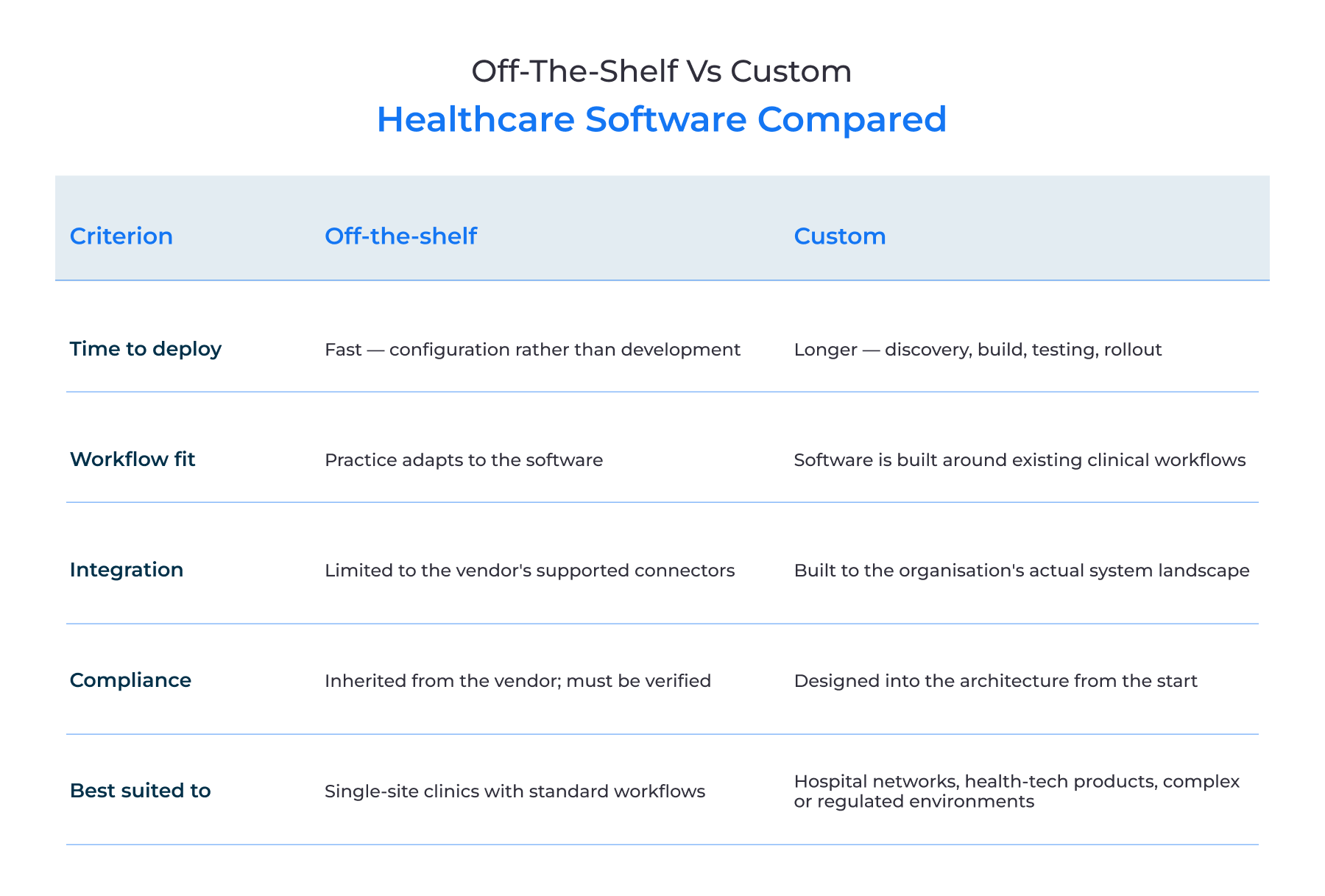
Off-the-shelf is a good choice when the workflow is standardized. Billing, scheduling, and general practice management are areas where generic solutions are likely to serve the organization’s needs better. Custom becomes the reasonable choice when the workflow is the differentiator or when a digital health company is building the product itself rather than buying a tool. The proper decision is usually a mix: standard products for commodity functions, healthcare software development services for the layer that actually distinguishes the organization.
Common Implementation Challenges
Interoperability Between Legacy and New Systems
The legacy system is rarely replaced on the same timeline as the new one. They must work in parallel and agree on the same patient. Legacy systems are often implemented with interfaces that expose their data, long before FHIR was invented. The challenge is to get those using the system to configure interfaces, rather than getting clinicians to engage in unrealistic use cases, and to staff the first few weeks with additional support.
Data Migration Integrity
Migration failures show up months later, when a clinician notices an allergy that did not carry over or a balance that no longer reconciles. Historical records were entered by people following conventions that changed several times, which means a clean mapping on paper meets dirty data in practice. That’s why EHR integration scoping starts with the source data, not the target schema. It can be time-consuming to profile the source data before designing the migration and running the load into a test environment. Also, you need to have clinical and billing staff validate a sample of real records against the original system before cutover.
Staff Adoption and Training
A system that clinicians resist produces workarounds rather than compliance. There are shared logins, notes kept elsewhere, steps skipped under time pressure. Training scheduled as a single session before go-live rarely survives contact with a full patient load. The mitigation is to involve the people who will be using the system in configuration decisions and train against actual workflows.
Ongoing Security and Compliance Maintenance
Compliance is a process that decays over time when roles change, staff turnover, or new connections are made. A vendor upgrade or a change in configuration can render a previously compliant system non-compliant. It can be hard to provide a compliance review cycle with named owners, auditing access rights against actual staff, and inspecting more than just the logs that were retained.
Which Types of Healthcare Software Does Your Organization Need?
The right combination of types of healthcare software depends on your organization’s size, your patient care model, and what you already run. A three-physician practice and a regional hospital network face different problems, and neither is solved by adopting every category on this list. Start from the workflow that costs you the most today. In addition, check what your existing systems can already do before you add another one.
Intellectsoft develops healthcare IT solutions for providers and health-tech companies. The service vendor boasts about 18+ years of experience in software engineering and has delivered solutions for 35+ Global Fortune 1000 organizations. Healthcare software solutions in our portfolio, such as a CRM system for dentistry clinics, an IoT solution for a hospital provider, and a B2C platform for health tracking, confirm our expertise in various business solutions with different customer types.
In terms of quality assurance, the company complies with HIPAA and GDPR regulations and holds ISO 27001 and ISO 9001 certifications. Book a consultation to talk to our architect about which systems your organization actually needs.
FAQ
What software is used in healthcare?
Healthcare software is any software that is used to support the delivery of medical care. This category of software can be broken down into four groups: clinical software, administrative software, patient-facing software, and analytics software. Adoption is near-total at the clinical layer. According to ONC, more than 99 percent of US non-federal acute care hospitals and 91 percent of office-based physicians had adopted a certified EHR.
What software do hospitals use?
At the core of these systems are the hospital management system and the electronic health record. This healthcare software links to various laboratory, imaging, pharmacy, and revenue cycle systems. In addition, ninety percent of hospitals use the same electronic health record system throughout their facilities, increasing from sixty-two percent in 2010. Also, clinics often use practice management software for their patients, linking those patients’ records to their electronic health records.
What are the main types of medical software systems?
There are fifteen types of healthcare software for most of what runs in healthcare providers:
On the hospital’s side, electronic health records (EHR), e-prescribing software, medical imaging systems, laboratory systems, and clinical decision support systems are utilized to manage healthcare data and improve patient care.
On the business side, practice management software, billing software, scheduling software, CRM software, and analytics software are used to manage the practice and increase revenue.
Finally, patients have access to patient portals, telemedicine applications and remote monitoring technologies to increase their involvement in their own healthcare.
Pharmacy and hospital management systems span both. According to Kodiak Solutions, the denial rate on submitted claims ran at 11.65 percent through November 2025, which is why the billing layer gets rebuilt most often.
What is the difference between EHR and EMR software?
An EMR stays inside one practice. The electronic health record is built to travel between the healthcare organizations that treat the same individual. The interoperability standards apply to the EHR, as well as the portability of those records. While vendors often use the terms interchangeably in their marketing, the label on the product shows less about its features than its ability to integrate with other systems.
What is the difference between telemedicine and telehealth software?
Telemedicine means giving health care services from a distance. Telehealth is about more than remote visits between patients and doctors. Telemedicine and telehealth are usually treated as the same thing. They differ in how broad they are and in how much they cost.
Should healthcare organizations buy off-the-shelf software or build a custom solution?
Off-the-shelf works where the workflow is standard: scheduling, general practice management. Custom earns its cost when the workflow is the differentiator, when integration exceeds what any product supports, or when a health-tech company is building the product itself. Most medical organizations run both.
Source link