








Key Takeaways
- Web development costs can vary from several thousand dollars for a simple business website to more than $150,000 for enterprise-level websites with custom features.
- The number of pages is less important than the scope of the project. The more custom features and functions are required, the higher the cost will be.
- In addition, the choice of web development company also affects the cost and quality of project, as well as the cost of subsequent maintenance and support.
- Website development is a long-term process, which requires the customer to have a clear understanding of the desired project and the necessary tools. This will help in selecting the best project implementation package within the framework of the allocated budget.
When creating a website, most business owners have a rough idea of what they want to see on their website. However, the determination of the project’s cost is not always clear to them. It should be understood that the cost of web development varies depending on the company’s requirements, which are spelled out in detail in the contract. Thus, the main reason for the price range is the different levels of project customization.
This guide explains what goes into web development cost and why estimates vary so much. We’ll break down the typical costs of each project stage, compare pricing across different types of websites, explore the factors that have the biggest impact on your plan, and show how to evaluate development proposals with confidence.
Factors Influencing Website Development Costs
The average web development pricing comes down to three groups of factors: hosting-related, size-related, and complexity-related. One could compare website development to building a house, where the investments depend on the desired location, design, and materials.
Web application development cost is largely determined by its purpose. A landing page for a promotional campaign and a large store with custom software development require significantly different amounts of effort and resources, so their development costs differ widely.
Traditionally, the size of a website should match the size of the business. This means that it may be inefficient for a small company to invest in a large, feature-rich website. And vice versa, it may look suspicious if a large enterprise owns a single landing page or a template-based website with a default stock design.
Hosting
As a rule, when a customer asks to build a website from scratch, developers also handle aspects such as name registration, selecting a hosting service provider and an adequate plan, purchasing an SSL certificate, and so on. A reliable hosting provider that offers scalable services is essential for the uninterrupted operation of a website. A good-looking top-tier domain name that is easy to remember may be expensive, but it is for brand recognition and attracting new customers.
Size
The size of a website determines its structure, the number of pages, and the amount of content. In turn, these factors determine the volume of storage required to host the website and the corresponding cost.
Size and complexity also determine whether you have to hire a dedicated team or whether it is viable to build a website by yourself with or without the help of freelancers.
Complexity
The complexity of a website refers to a much more diverse set of factors determining the overall cost. Among them, the choice of technologies is the most impactful factor. In other words, the more features are needed, the more expensive and lengthy the website development will become.
Advanced features and integrations push the cost for web development up, often dramatically. Implementing features takes more work hours from web developers and demands additional plugins, modules, and other paid features.
Complex functionality also demands developers with high skill levels to handle advanced technologies. Their hourly rates are higher, and they are more difficult to find than junior- and middle-level web developers.
Also, do not forget about the additional costs of website maintenance and promotion. Even though these expenses are technically “post-development,” they should be considered when you estimate a budget for creating a website.
So, How Much Does It Cost to Build a Website?
Website development cost can be different. They depend on four factors: project scope, location, industry, and regulatory requirements. For example, location drives hourly rates. The same senior engineer costs several times more in San Francisco than in Warsaw or Kraków, which is why identical projects often receive very different quotes.
Industry also has an equally big impact. An e-commerce store or EdTech platform typically needs payment processing, accessibility, and standard security requirements. Fintech and healthtech projects go much further. Compliance with HIPAA, SOC 2, PSD2, or KYC adds extra web development pricing because of architecture work, encryption, audit trails, penetration testing, and documentation. Those requirements increase both website development cost and delivery, especially when sensitive data is involved.
Typical Costs by Business Type in 2026
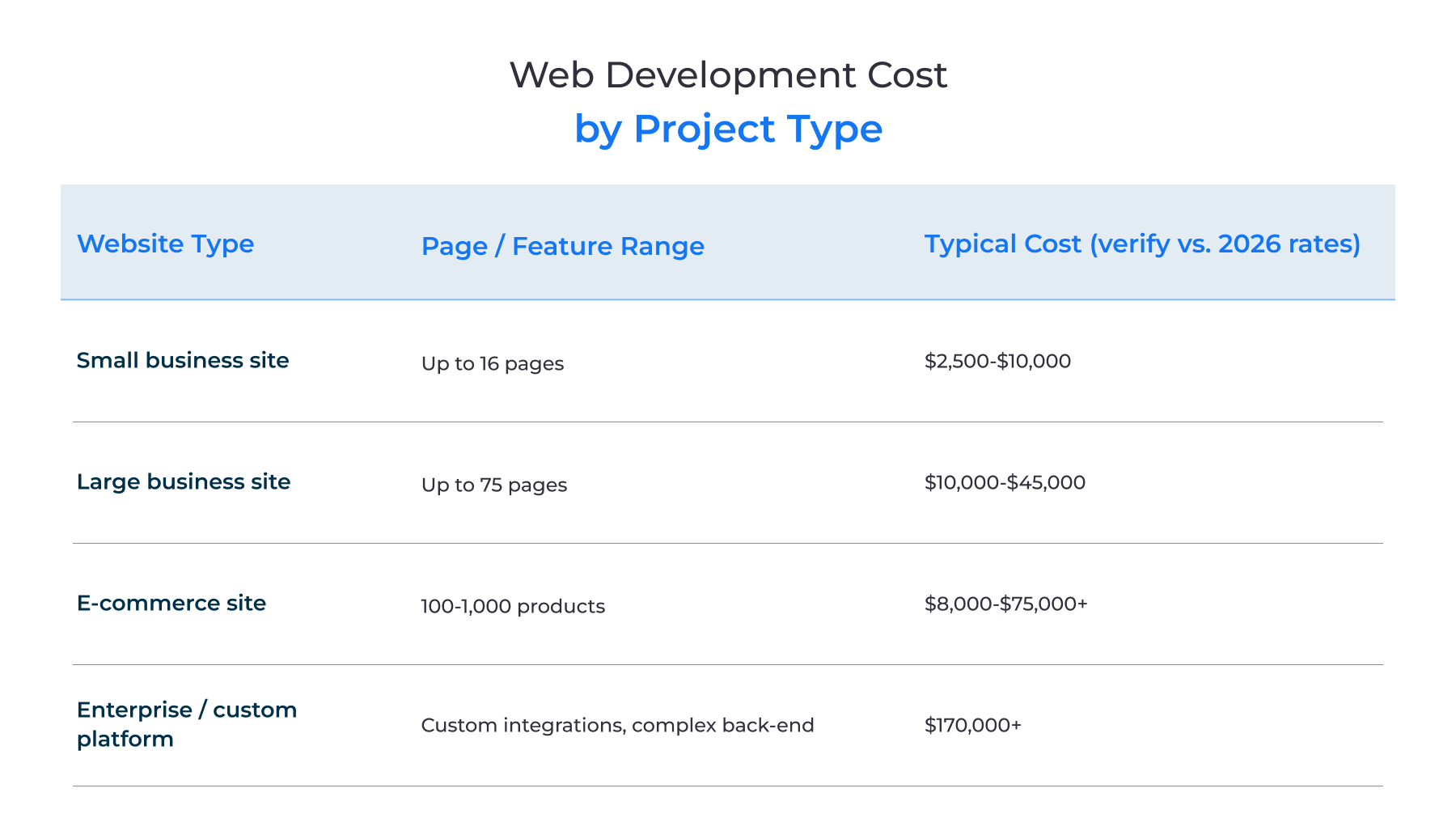
Every phase of website development deserves an adequate plan since each directly affects the quality, performance, and long-term maintainability of the final product. While every project is different, the following web development pricing reflects typical timelines and project costs in 2026.
Typical Specialist Costs per Project in 2026
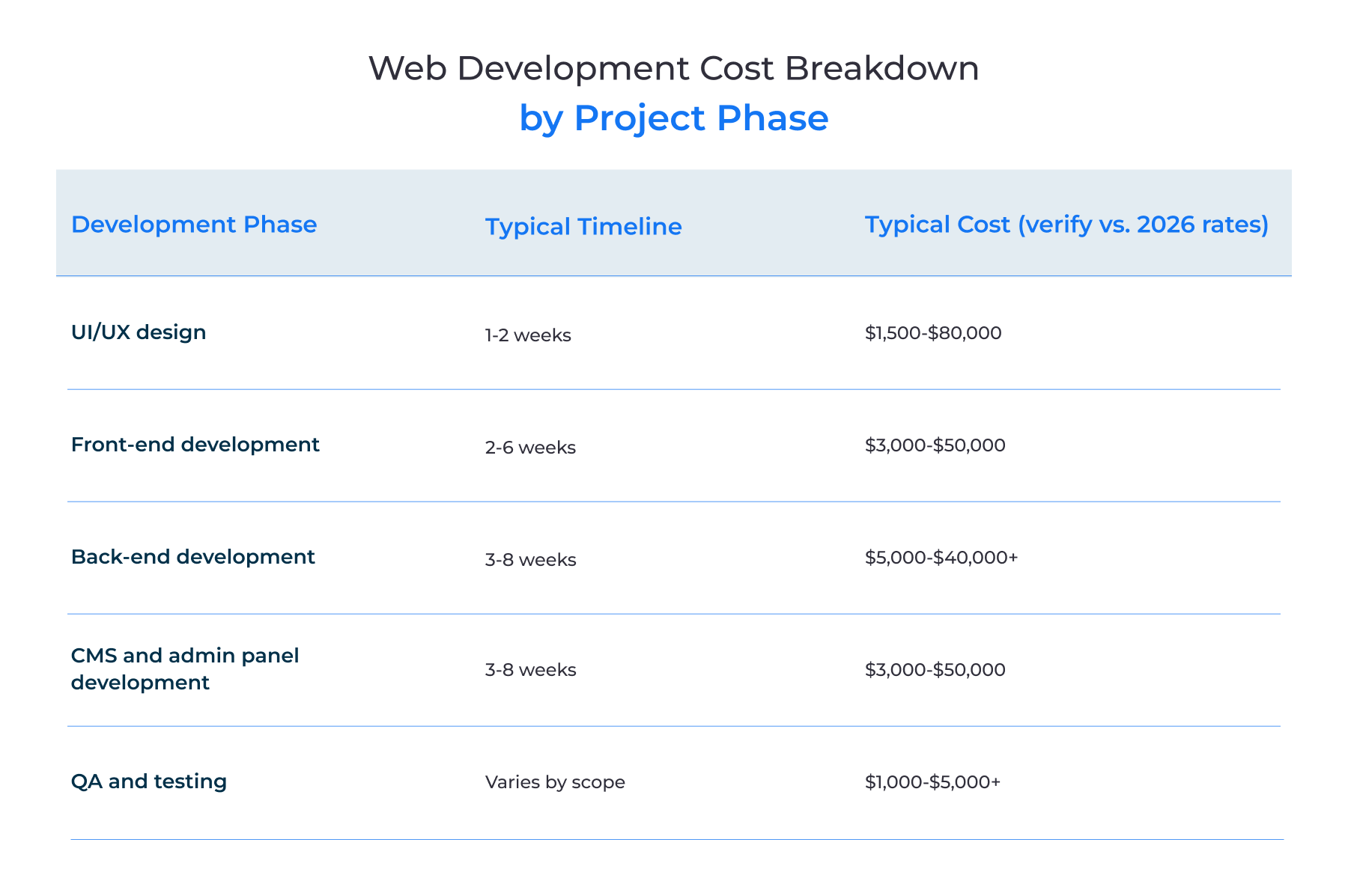
- UI/UX design. This phase typically takes one to two weeks and costs $1,500–80,000, depending on the number of user flows, screen designs, and research activities. It’s also important whether the project requires a simple marketing website or a complex enterprise web development.
- Front-end development. Building responsive, accessible, and interactive user interfaces generally takes two to six weeks and costs $3,500–50,000. It depends on the number of pages, custom components, animations, and integrations.
- Back-end development. Implementing business logic, APIs, databases, authentication, and third-party integrations usually requires three to eight weeks and costs $5,000–40,000. Projects involving complex workflows, payment systems, or custom integrations typically fall toward the higher end of the range.
- CMS and admin panel development. Whether using a platform such as WordPress or building a custom content management system, configuring the admin interface typically takes three to eight weeks. It adds $3,000–50,000 to the project plan, depending on the level of customization.
- QA and testing. The costs are primarily determined by the scope of the task. For large-scale corporate projects, the QA costs may range from several thousands of dollars, while smaller sites generally require from $1000 to $5000. QA-testing typically includes functional, usability, performance, cross-browser compatibility and security testing to catch all possible issues that may arise. In most cases, it is more cost-effective to fix bugs before product launch, than to deal with the consequences of negligence after the site goes live.
Website development is only a minuscule of a larger project. One must also consider project management, copywriting, SEO optimization, hosting, security measures, maintenance and technical support. These factors influence the costs profoundly, hence a solid and reliable plan should be calculated with due consideration of all aspects of production and maintenance.
Finally, customization is arguably the most common factor that influences website development cost. Features such as AI tools, advanced performance options, user-friendly interfaces, permissions system, business logic, API’s, security software and more are highly dependent on customization. They also require additional coding hours to be properly integrated into a website.
Industry Trends Shaping Website Development Costs
The expectations placed on modern websites are shifting. What used to be seen as optional features are now the standard, and a few have become necessary through the passage of technology or law. While not every trend will be relevant for every organization, ignoring trends altogether is a sure fire way to have a faulty budget estimate before even beginning development.
Mobile-first design
Mobile devices now generate more than 50% of global web traffic. Mobile-first design prioritizes the phone screen, with desktop layouts developed subsequently. That’s why mobile-first design requires deliberate consideration of each breakpoint rather than treating mobile as a simplified version of the desktop layout.
Responsive web development
With responsive design, one code base can serve content for every size screen. So, it offers advantages over maintaining separate desktop and mobile sites. This approach is generally more cost-effective to build and maintain. However, teams often underestimate the testing required, as components may behave differently across browsers and devices.
Progressive Web Apps (PWAs)
Progressive Web Apps (PWA) introduce apps’ characteristics such as working offline, sending push notifications, and being launchable from the bottom bar. Additional frontend job and testing are needed to fulfill all the requirements. But a PWA codebase is usually much cheaper to maintain than two native mobile apps.
Voice search optimization
Voice search optimization aims to improve search intent recognition and deliver the best results for voice queries. Schema markup, headers, content structure, and performance are adjusted to make the page easily readable by AI assistants. The optimization does not generate significant website development cost since it mostly affects the content and SEO part of the project.
AI and chatbot integration
Modern chatbots and virtual assistants leverage large language models to fulfill complex tasks. There are retrieving knowledge base articles, booking meetings, or integrating with external systems like CRM. The initial development of such solutions demands extra effort for their creation and training, but they usually pay off by reducing support costs. At the same time, a company should calculate API costs proportional to the number of requests processed by AI chatbots.
AI-assisted design and development
AI tools assist developers in writing code, suggesting repetitive snippets, or even constructing whole blocks of code. According to Figma’s 2025 AI Report, 68% of developers already use AI tools at least several times a week during the coding process. While the technology helps reduce costs by eliminating monotonous tasks, it adds expenses for teams in the form of API credits, tools subscriptions, and human hours spent reviewing suggested code snippets.
Accessibility and WCAG compliance
WCAG compliance has evolved from a recommended standard to an obligatory condition for many businesses. In particular, several EU countries made websites accessible by law since June 2025. In most cases, building an accessible website from scratch is considerably cheaper than reworking an existing design to meet the requirements.
Headless and API-first architecture
Modern content management systems follow the headless paradigm, which means decoupling presentation layer and CMS’s backend. As a result, companies can leverage the same content for web, mobile apps, kiosks, smart displays, and other screens. While such solutions demand extra resources for development, they usually pay off for digital product agencies that build multiple websites.
Overall, website development today is not necessarily more expensive than a decade ago. Increased demand and growing complexity of features tend to push web development cost higher. But the rising costs are more attributable to developers’ salary growth than actual development costs. The actual value depends on the project’s scope, but its baseline should be dictated by the list of necessary features that drive the value for customers.
Cost of Website Development by a Vendor Type
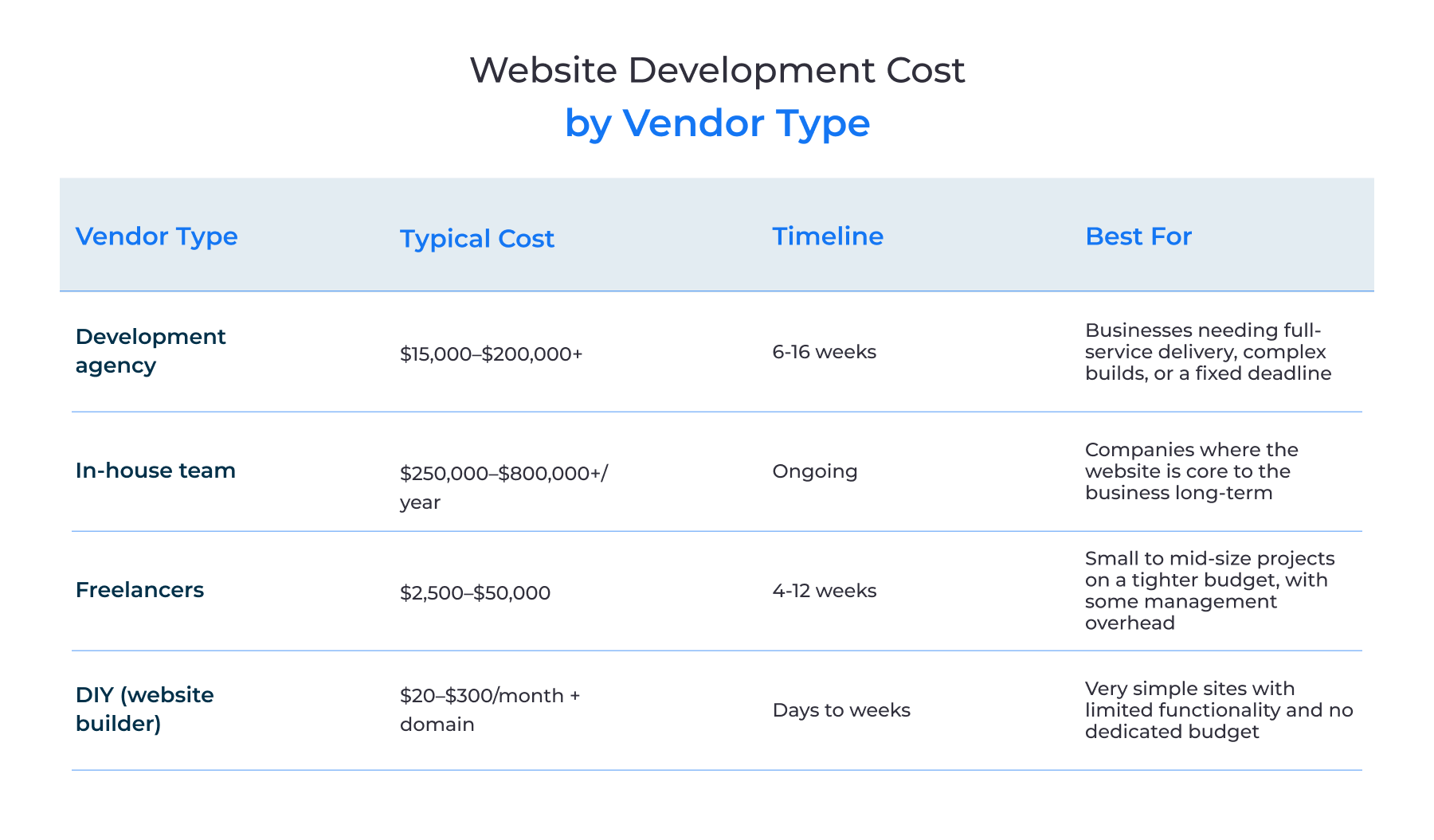
When a company or a person needs a custom website, four paths are on the table. They can hire a dedicated development team, build an in-house team, hire freelancers, or do it yourself. Each one buys a different mix of price, speed, and risk. Here’s how they compare.
Hire a Development Team
This is the most expensive route, but the safest. Agencies already have the skills and the people to deliver projects at any level of complexity, which makes them the practical answer when the result has to land by a fixed date. Most also cover the work around the build: maintenance, SEO, marketing, content updates, and business analysis. Some bundle those into packages at a discount.
Most agencies estimate each project on its own, which is normal in this industry. The buyer contacts several companies, describes the website, and collects estimates. Location moves the number too. Nearshore development companies tend to charge more, while offshore development companies offer better prices but involve additional drawbacks.
Some agencies also decline small projects or push them down the queue. Custom business websites developed by agencies commonly cost from around $20,000 to well over $200,000. Most projects are delivered within 6–16 weeks, although enterprise platforms often take several months.
Hire an In-House Team
Building a team in-house isn’t always the right call. The company gets the same specialists an agency would assign, and they answer to it directly. It also takes on management, working conditions, and hiring. Sourcing, interviewing, and onboarding all take time, and sometimes no candidate matches the criteria. Even a lean in-house team can cost well over $250,000 per year once salaries, benefits, payroll taxes, recruiting, and overhead are included. Teams of three to four specialists can easily exceed $500,000–700,000 annually.
An in-house team makes sense when the website is the business and no one wants to depend on a third party to keep it running. That’s true for an online store or a corporate platform, but it’s excessive for a landing page or a portfolio. The in-house vs. outsourcing decision comes down to that distinction, and to one structural difference. This is the only option with no end date, because the cost is ongoing rather than project-bound.
Hire Freelancers
Even a simple website is rarely a one-person job. In most cases, you’ll need a developer to build it, a designer to shape the user experience, and someone to write or manage the content. For smaller projects, website builders such as WordPress, Wix, Squarespace, Shopify, or GoDaddy often provide enough flexibility without requiring a fully custom build.
According to Upwork, web developer pricing is the widest band of the three: the median rate is $30 per hour, with most contracts between $15 and $50. Web designers sit at a $21 median and a $15 to $30 range. Copywriters run a $30 median and a $19 to $45 range. Professional freelance website projects typically start around $2,500–5,000, while larger custom builds can reach $30,000–50,000 or more, depending on scope. Most projects are completed within roughly four to 12 weeks. Where a project falls depends on the functionality implemented, how much of it is custom code, and how many paid modules get bought.
Do It Yourself
Building the website yourself is possible with enough time. It’s a real commitment, so the honest questions come first: what skills are there, and what hours are free? There’s a lot to learn along the way, which is worth something. The scope stays small and simple, and problems show up that nobody planned for.
Website builders now offer no-code tools that almost anyone can use. Basic functionality is free or close to it, and advanced features need one-time payments or subscriptions. The money saved on specialists goes back into premium features instead. So, this is still the slowest way to get a website live, even with some experience behind it.
A website builder with hosting typically costs between $20 and $300 per month, depending on the platform and plan, plus the cost of a domain name. A standard .com or .net domain typically starts at around $8–12 per year, while alternative extensions vary widely–from about $7 for .shop to $16 or more for .xyz, depending on the registrar and promotional pricing. Most other features come with the plan–basic, and enough for a simple website.
How Much Does It Cost to Maintain a Website?
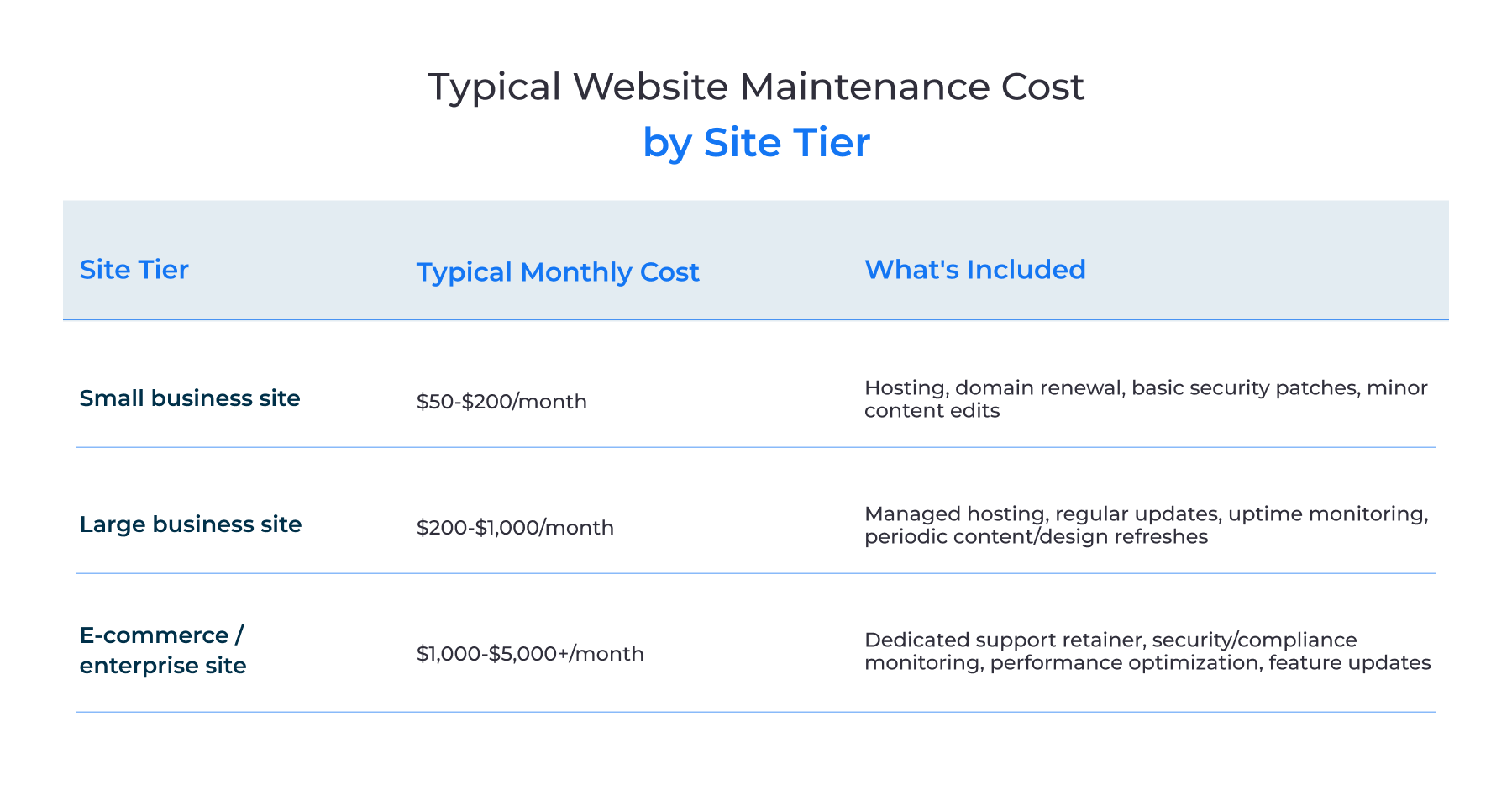
Launching a website is only the beginning. Ongoing maintenance is an additional expense that covers everything needed to keep the site secure, fast, and up to date. Without it, performance declines, security risks grow, and even small issues become expensive to fix.
Hosting and domain
If you have a website you need to pay for hosting and a domain name every year. A standard .com or .net domain typically costs around $10–20 per year, although prices vary by registrar. Premium domain names can cost hundreds or even thousands of dollars depending on demand and availability.
The cost of hosting depends on what kind of server you use and how many people visit your website. Shared hosting plans generally start at $3–15 per month. If you want VPS hosting, it will cost between $20 and $100 per month. WordPress and cloud hosting plans are more expensive they start at around $80 per month.
Hosting companies give you a free SSL certificate, which helps keep your website safe. Organizations that require Organization Validation (OV) or Extended Validation (EV) certificates can expect to pay roughly $50–300+ per year, depending on the certificate type and provider.
Security and software updates
Security and software updates are important for your website. If you do not update your software your website can get hacked. This is why you need to do maintenance and security audits. You also need to back up your website and check if it is working all the time. This costs a money every month but it helps keep your website safe. The cost of security maintenance is usually between $20–100 per month.
If you do not do these things it can cost a lot money. For example if your website gets malware it can cost between $200 and $500 to fix it. If you sell things on your website you may need to pay fees to keep your website safe.
Content updates
You also need to update the content on your website. If you do not your website will look old. You need to add blog posts and update your landing pages. You also need to make sure your website is working well with search engines. The cost of content maintenance depends on how much you need to change and if you need to hire someone to help you.
Businesses that outsource ongoing SEO and content marketing commonly spend around $500–2,500+ per month. Big companies usually have a team of people to help with this.
Ongoing technical support
The company website will also need support sometimes to fix some code or make your website work faster. So, the team can hire someone to do this for them.
Freelance web developers typically charge $50–150 per hour, with senior specialists often charging $150–200+ per hour depending on expertise and location.
Alternatively, agencies may offer retainer agreements, with entry-level retainers starting at approximately $500 per month. Enterprise-level service agreements, which include dedicated support and guaranteed response times, can cost several thousand dollars per month.
One thing is clear: these ongoing costs should be anticipated. Including hosting, security, updates, and support in the initial plan ensures the website remains secure, reliable, and high-performing throughout its lifecycle, minimizing unexpected expenses.
Strategies for Cost Optimization
A limited budget doesn’t have to mean compromising on quality. So, these five strategies help reduce production costs without sacrificing the essentials:
- Make a priority list of features and functionalities. Determine precisely what the website launch requires and distinguish it from desirable improvements. This strategy will help to avoid failing to meet the deadline and cutting costs.
- Use open-source solutions and frameworks. There are website builders, content management systems and design templates that are sourced and have some of the features you need. The project can save money by using these and changing them to fit the needs.
- Employ Agile project management. This means breaking the project into parts. Prioritize things as you go along. Start building the website and get it out faster without spending much time on things that are not essential.
- Consider outsourcing instead of building an in-house team. Consider hiring someone outside of the company to build a website. If you are launching a site for a short-term project, it is usually more cost-effective to outsource web production rather than hire your own professional software developer team.
- Prepare for long-term expenses in advance. Plan for future expenditures. After the launch, the company may still have bills to pay, including hosting, and various security and improvement services. To do this, set aside money to reduce financial risks.
How to Choose a Trustworthy Web Development Partner?
When you are selecting a web development company you should think about the following things:
- Experience and expertise. Even though experience does not mean you will get a quality project it does reduce the risks. A company that has been around for a while has already dealt with the problems that come up when delivering a project. Moreover, they know how to handle changing client requirements and long term cooperation.
- Portfolio and case studies. A company’s portfolio should demonstrate not only the design capabilities of the team but also the scope of the project, its complexity, and the technologies used. Case studies provide a detailed description of the company’s experience. They also help to find out how the partner handles specific challenges. Pay special attention to the clients’ testimonials and the final results delivered by the company.
- Independent Reviews. Many companies publish reviews on their websites. However, you should double-check the information to avoid overestimated claims. Use independent review platforms (such as Clutch, GoodFirms, and Business of Apps) to find out more about the companies in the industry. In addition to the testimonials, these platforms provide relevant information about the scope of services, the number of projects delivered, and the industries of the clients. Independent review platforms are often more transparent than the companies’ own review portals.
- Location. When you choose a partner, consider the rates but also the location. It is best to choose a company that’s in the same time zone and speaks the same language as you. It’s also easier to work with a company that has already shown it can deliver projects to clients in countries.
- Transparency. They should be open about the costs, timeline and what they will deliver. You should also pay attention to what they tell you during the sales process because it can give you an idea of how they will manage the project.
- The cost of developing a website or other software. It depends on how complex the project is, and what technology they use and the company’s hourly rates. Just because something is cheap does not mean it is the choice. Just because something is expensive does not mean it is the most reliable. Calculate the cost based on the company’s experience, technical expertise and the quality of the project they deliver. It is also important to remember that choosing the option can lead to additional costs because of delays, technical problems and poor maintenance.
Conclusion
Web development costs are determined by numerous factors beyond just page numbers or feature lists. The project’s complexity, technical requirements, chosen technology stack, compatibility standards, and the expertise of the team all play a critical role in cost estimation.
In addition, software development costs vary depending on the region where the company operates. Moreover, the more experience your team has, the less likely they are to make avoidable mistakes, saving you time and effort on revisions.
When considering website development or upgrades to your existing online assets, start with conducting a realistic project evaluation. Once the team clearly understands its needs and has a practical vision of your goals and how to achieve them, you will be able to create a plan with realistic expectations for the project’s scope.
Intellectsoft has been providing web development services for startups, small businesses, medium-sized companies, and large corporations with more than 19 years of experience, delivering over 600 digital solutions for emerging businesses and 35 of the world’s largest companies. Thus, if you want to receive an expert’s opinion on your idea and get an approximate budget, contact our professionals to set up a discovery session and define the most optimal strategy for you.
FAQ
Can I build a website by myself?
Technically, yes. There are many no-code or low-code website-building services with intuitive drag-and-drop editors and many options to customize and add functionality to a website. However, if you need a website for business, we recommend hiring a professional web designer at least.
Why should I hire a team of professionals to build my website?
Hiring a team may be costly, but it is essential for ensuring your website’s quality, usability, and security. These are vital qualities that define your business’s ROI: fewer rebuilds and faster time-to-launch.
How much does web development cost on average in 2026?
The cost of web development is different for each project. It depends on how complicated the website’s. A simple business website can cost between $2500 and $10000. If you want a custom website for a big company it can start at $170000. Most business websites are simple and cost between $15000 and $30000.
How much does it cost to build a website for a small business?
The cost of building a website for a business is between $2500 and $10000. This includes things like content. Making sure the website works well on phones and computers. If you want to add things like payment systems or booking options it will cost more.
How much does enterprise web development cost?
Enterprise web production is for companies and it is custom made. These websites have a lot of features, payment systems, and security needs. The starting website development cost for enterprise companies is about $170000. The final cost depends on what the company needs.
What factors affect web development pricing the most?
The main thing that affects the cost of web development is the project scope. This means what the website needs to do and what features it should have. The plan also depends on who’s building the website and what kind of systems they need to include.
How much does it cost to hire a web developer per hour?
It depends on where the developer’s from and how much experience they have. Freelancers usually charge between $15 and $50 per hour. Companies and experienced developers charge more. The cost per hour does not always mean the developer is good or bad.
How much does website maintenance cost after launch?
After a website is built it will cost some money each year to keep it running. This is usually between 15 and 20 percent of what it cost to build the website. This money pays for things like server costs, keeping the website safe and updated.
Does the cost of web development vary by country or developer location?
Yes. The cost of hiring a developer and the final cost of the website can be very different depending on where you’re. Developers in the US and Western Europe usually charge more than developers in places. The cost also depends on what the website needs to do and what the client wants.
How long does it take to build a website, and does the timeline affect cost?
A simple website for a business can take 4 to 8 weeks to build. Bigger projects take longer up to half a year. The complicated the website is, the longer it takes and the more it costs. This is because it takes time to design and test and the people building it charge more per hour. Web development costs can vary a lot. The most important thing is to get a website that works well and does what you need it to do.
Source link